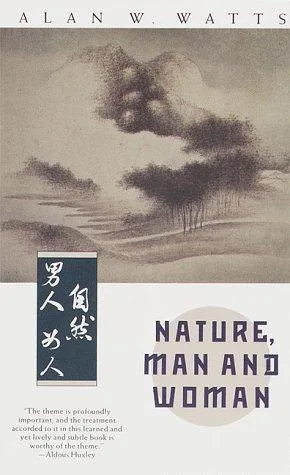
Nature, Man,& Woman
 82
82

Nature, Man,& Woman
Alan Watts’ "Nature, Man & Woman" arrives with the posthumous polish of a 2022 release, but its core remains the mid-20th century philosophical inquiry it always was. Watts, a masterful synthesizer of Eastern thought for Western audiences, here tackles the perennial tension between humanity and nature, and the often-confusing binary of man and woman. His strength lies in dismantling the perceived separation between these elements, positing instead a single, flowing process. The limitation, however, is that the language, while poetic, can sometimes feel like an intellectual exercise rather than a direct experiential guide, particularly when discussing complex concepts like the Tao. A passage that particularly stands out is his argument that the distinction between 'man' and 'woman,' like 'nature' and 'human,' is a linguistic overlay on a fundamentally unified reality. The work offers a refreshing, albeit sometimes abstract, perspective on interconnectedness.
📝 Description
82
Alan Watts' 1958 lectures, later published as Nature, Man & Woman, challenged Western dualism.
Published in 2022 but originating from mid-20th century lectures, Alan Watts' Nature, Man & Woman examines the connections between people, the natural world, and the differences between men and women. Watts aimed to move readers away from seeing things as separate parts, arguing instead for a view of a single, unified cosmic order. He considered how society's ideas and philosophical beliefs influence our understanding of these relationships.
The book speaks to anyone interested in Eastern ways of thinking, like Taoism and Zen Buddhism, but presented for a Western audience. It is for those who question typical divisions in Western thought, such as mind versus body, spirit versus matter, or male versus female. People looking for a more whole view of life, without strict hierarchies, will find much here to think about.
Watts' work entered a period where Eastern thought, particularly Zen Buddhism as introduced by D.T. Suzuki, was gaining traction in the West. This book sits within that intellectual current, acting as a bridge for Westerners curious about mysticism. It aligns with comparative religion studies of the era, offering a perspective that questions fundamental Western dichotomies and suggests a more integrated understanding of existence, rooted in traditions like Taoism.
💡 Why Read This Book?
• Gain a non-dualistic framework for understanding the relationship between humanity and the natural world, moving beyond Western dichotomies, as explored in Watts' lectures from the 1960s. • Develop a more integrated view of gender, recognizing its place within a broader cosmic process, informed by Taoist principles Watts frequently referenced. • Reframe personal identity by questioning the illusion of a separate ego, a concept central to the Zen Buddhist philosophy Watts engaged with throughout his career.
⭐ Reader Reviews
Honest opinions from readers who have explored this book.
❓ Frequently Asked Questions
When was Alan Watts' "Nature, Man & Woman" originally conceived or presented?
While published in 2022, the material for "Nature, Man & Woman" originates from lectures given by Alan Watts in the mid-20th century, reflecting his philosophical engagement with Eastern thought during that period.
What philosophical traditions heavily influence "Nature, Man & Woman"?
The book is significantly influenced by Eastern philosophies, particularly Taoism and Zen Buddhism, which Watts skillfully interpreted and presented for a Western audience.
Does "Nature, Man & Woman" offer practical advice for living?
While not a step-by-step guide, the book offers a shift in perspective that can inform one's approach to life, encouraging a more integrated and less dualistic way of experiencing the world.
How does Watts critique Western thought in this book?
Watts critiques the pervasive tendency in Western philosophy towards dualism – separating mind from body, humanity from nature, and so on – arguing for a more unified, process-oriented view of reality.
Is "Nature, Man & Woman" suitable for beginners to philosophy?
Yes, Watts' accessible style makes complex philosophical and spiritual ideas understandable, making it a good entry point for those new to his work or Eastern philosophies.
🔮 Key Themes & Symbolism
Critique of Dualism
The work systematically deconstructs the Western tendency to divide reality into opposing pairs: mind/body, subject/object, man/woman, human/nature. Watts argues these divisions are artificial constructs that lead to alienation and misunderstanding. He posits that these apparent opposites are, in fact, two sides of the same coin, expressions of a single, underlying reality. This theme is central to understanding his reinterpretation of concepts like the Tao and the nature of the self, moving towards a unified perception of existence.
The Unity of Existence
Central to Watts' philosophy is the idea that all things are fundamentally interconnected and part of a single, dynamic process. He draws parallels from Taoism and Zen Buddhism to illustrate that the universe is not a collection of separate objects but a continuous unfolding. The distinction between the organism and its environment, or between 'self' and 'other,' is presented as an illusion. This unity extends to the relationship between humanity and the natural world, suggesting we are not separate from nature but are, in essence, nature itself.
Gender as Cosmic Play
Watts approaches the subject of man and woman not as fixed biological or social categories, but as manifestations of fundamental cosmic energies. He suggests that the perceived duality of sex is a natural expression of the universal principle of P'o (the feminine, yielding) and Ch'ien (the masculine, active) in Taoist thought. Rather than seeing these as hierarchical or antagonistic, he encourages viewing them as complementary forces in a dynamic, playful interaction that mirrors the creative processes of the universe. This perspective aims to dissolve rigid gender roles and embrace fluidity.
The Illusion of the Separate Self
Drawing heavily on Buddhist notions of Anatta (no-self), Watts challenges the common Western conception of the ego as a distinct, independent entity. He argues that the 'I' we perceive ourselves to be is a construct, a boundary drawn around a collection of experiences and sensations. True understanding, according to Watts, comes from realizing this lack of a solid, separate self, which in turn dissolves the perceived separation between oneself and the rest of the universe. This realization is key to overcoming existential anxiety and alienation.
💬 Memorable Quotes
Direct passages from the work, attributed to the author.
“The universe is a dance. You are not a spectator, but a participant.”
— This concise statement expresses Watts' view of existence as a dynamic, participatory process rather than a fixed stage for individual observation. It encourages a sense of embodiment and inherent belonging within the cosmic flow.
“The distinction between 'man' and 'woman' is like the distinction between the wave and the ocean.”
— This analogy highlights Watts' argument that gender differences, while observable, do not represent fundamental separations. Just as a wave is inseparable from the ocean, male and female are integral aspects of a larger, unified whole.
“Nature is not something to be conquered, but something to be understood as ourselves.”
— This challenges anthropocentric views that see humanity as separate from and dominant over the natural world. It suggests a deep kinship and inherent unity between human beings and the broader ecosystem.
“When you realize you are not a separate self, you become one with all things.”
— This reflects the core Buddhist concept of Anatta (no-self). Watts suggests that the perceived boundary of the ego is illusory, and its dissolution leads to a profound sense of interconnectedness with the entire universe.
“The Tao is the way things go, not a path you must follow.”
— This interpretation of the Tao emphasizes its nature as a spontaneous, inherent order rather than a set of rules or doctrines. It points towards acceptance and alignment with the natural unfolding of reality.
🌙 Esoteric Significance
Tradition
Watts' work is deeply rooted in Taoism and Zen Buddhism, traditions that form the bedrock of East Asian esoteric thought. While not strictly adhering to a single lineage, he draws heavily on the Taoist concept of the Tao as the fundamental, ineffable principle of the universe and the Buddhist doctrine of emptiness (Sunyata) and no-self (Anatta). His approach is less about ritual or dogma and more about a philosophical and experiential understanding of these principles, aiming for a non-dualistic perception of reality that transcends conventional Western metaphysics.
Symbolism
Key symbols in Watts' discourse include the Yin and Yang, representing the complementary and interdependent forces of the universe, often used to illustrate the non-dual nature of existence and the dynamic interplay of opposites. The concept of the 'wave and the ocean' serves as a potent metaphor for understanding the relationship between the individual self and the greater reality, dissolving the illusion of separation. The 'dance' is another recurring motif, symbolizing the spontaneous, process-oriented nature of the cosmos, where creation and dissolution are part of an ongoing, unified movement.
Modern Relevance
Watts' ideas continue to influence contemporary thinkers in fields ranging from psychology and environmentalism to mindfulness and consciousness studies. His critique of dualism and emphasis on interconnectedness resonate with eco-philosophy and deep ecology movements. Furthermore, his accessible explanations of Buddhist concepts like mindfulness and non-duality have informed the popularization of meditation practices and the integration of Eastern wisdom into Western therapeutic modalities. Thinkers exploring integral theory and transpersonal psychology often cite Watts as a foundational influence.
👥 Who Should Read This Book
• Students of comparative religion and philosophy interested in how Eastern concepts like Taoism and Zen Buddhism were introduced and interpreted in the West during the mid-20th century. • Individuals seeking to deconstruct Western dualistic thinking and explore alternative frameworks for understanding the relationship between humanity, nature, and gender. • Seekers interested in mindfulness, non-duality, and the philosophical underpinnings of practices that aim to dissolve the sense of a separate self.
📜 Historical Context
First presented through lectures in the mid-20th century, "Nature, Man & Woman" emerged during a period of intense intellectual ferment in the West regarding Eastern philosophies. Alan Watts, already a prominent voice, was actively synthesizing concepts from Taoism and Zen Buddhism for an English-speaking audience, often in dialogue with figures like D.T. Suzuki. This work appeared as Western psychology began to explore consciousness beyond Freudian models, and as existentialism grappled with meaning in a seemingly absurd world. While figures like Carl Jung were exploring archetypes in a cross-cultural context, Watts offered a more direct, process-oriented interpretation of Eastern thought. The book's reception, as compiled and published, speaks to a sustained interest in bridging the perceived gap between Eastern mysticism and Western rationalism, particularly as the counter-culture movement embraced alternative spiritualities.
📔 Journal Prompts
The concept of the Tao as a 'way things go,' not a prescribed path.
Your personal understanding of the 'wave and the ocean' metaphor for self and universe.
The perceived duality between 'man' and 'woman' in societal constructs.
The notion of nature as an extension of oneself, rather than an external entity.
Experiences that challenge your sense of a fixed, separate 'self'.
🗂️ Glossary
Tao
The fundamental, ineffable principle of the universe in Taoism. It represents the natural order, the source from which all things arise and to which they return, often translated as 'the Way.'
Non-duality
A philosophical or spiritual concept that posits the ultimate reality is not composed of two fundamental, independent substances or principles, but is a unified whole. It challenges the perceived separation between subject and object, mind and matter.
Dualism
In philosophy, the belief that reality consists of two fundamental, independent, and often opposing substances or principles (e.g., mind and matter, good and evil, spirit and flesh).
Ego
In this context, referring to the conventional Western psychological concept of the 'self' as a distinct, isolated, and enduring entity. Watts critiques this as an illusionary construct.
Anatta
A core Buddhist doctrine meaning 'no-self' or 'non-self.' It asserts that there is no permanent, unchanging, independent self or soul underlying existence.
Yin and Yang
Ancient Chinese concepts representing complementary, interconnected, and interdependent forces or principles. Yin (feminine, dark, passive) and Yang (masculine, light, active) are seen as dynamic aspects of a single cosmic reality.
Process Philosophy
A philosophical approach that views reality fundamentally as process, change, and becoming, rather than as static substance or being. Watts' work aligns with this perspective.
🔮 Readers Also Liked
Browse all →








More by Alan Watts
All books →




More Free Occult Philosophy Books
View all →