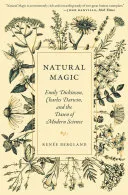
Natural Magic
 72
72

Natural Magic
Renée Bergland's Natural Magic offers a compelling argument for the interconnectedness of poetic observation and scientific exploration in the 19th century, particularly through the lens of Emily Dickinson and Charles Darwin. The book excels in its detailed depiction of the intellectual climate of the 1830s, where 'natural philosophy' was a more unified pursuit. Bergland's examination of how both Dickinson's verse and Darwin's scientific papers reflect a deep engagement with the natural world, despite their different methodologies, is particularly insightful. However, the work occasionally leans too heavily on the premise of shared vision, sometimes presenting the divergence as more absolute than the evidence might strictly support. The exploration of Dickinson's internal world alongside Darwin's external observations, while fascinating, sometimes feels like a juxtaposition rather than a fully integrated narrative. Bergland’s detailed analysis of Darwin’s early specimen notes, juxtaposed with Dickinson's precise botanical imagery, provides a strong anchor. Ultimately, Natural Magic is a valuable contribution for understanding the historical fluidity of knowledge and the diverse ways humans perceive nature.
📝 Description
72
Renée Bergland's 2024 book examines the 19th century's 'natural philosophy' as a unified field.
Natural Magic by Renée Bergland analyzes the 19th century's intellectual climate, particularly the period when scientific inquiry into nature was less specialized. The book focuses on how figures like Emily Dickinson and Charles Darwin engaged with this open domain. It argues that 'natural philosophy,' as it was then known, allowed for a more integrated approach where artistic and scientific pursuits were not seen as separate.
Bergland contrasts the paths of Dickinson and Darwin, showing how their work emerged during a time of significant intellectual change. The 1830s and subsequent decades saw the gradual formalization of disciplines, leading to the separation of poetry from direct scientific observation. This era challenged the holistic worldview that had previously characterized the study of nature. The book details the societal and intellectual forces that drove this divergence, moving from a unified understanding to specialized scientific fields.
This work situates the 19th-century study of nature, termed 'natural philosophy,' within a tradition that predates modern scientific categorization. Before the rise of specialized disciplines, the investigation of the natural world was often intertwined with philosophical, poetic, and even mystical perspectives. This book highlights a historical moment where the perceived 'enchanted view of nature' was still accessible, bridging the perceived gap between empirical observation and subjective experience. It reflects an esoteric interest in the holistic connections between humanity, the cosmos, and the living world, as understood before the strictures of contemporary scientific methodology.
💡 Why Read This Book?
• Gain insight into the 1830s intellectual landscape where 'natural philosophy' bridged poetry and science, learning how figures like Darwin and Dickinson engaged with nature before strict disciplinary divides, as detailed in Bergland's historical context. • Understand the concept of an 'enchanted view of nature' as a precursor to modern scientific inquiry, exploring how poetic sensibility informed early scientific observation, a core theme illuminated through specific examples. • Appreciate the historical separation of scientific and literary pursuits, examining the specific societal and intellectual shifts that led to modern specialization, a key concept analyzed in the book.
⭐ Reader Reviews
Honest opinions from readers who have explored this book.
❓ Frequently Asked Questions
When was Renée Bergland's Natural Magic first published?
Renée Bergland's Natural Magic was first published on April 30, 2024, offering a contemporary perspective on historical intellectual movements.
What is 'natural philosophy' as discussed in Natural Magic?
In Natural Magic, 'natural philosophy' refers to the 19th-century practice of studying the natural world, which encompassed what we now consider both scientific inquiry and philosophical contemplation, often practiced by poets and scholars alike.
How does Natural Magic connect Emily Dickinson and Charles Darwin?
The book connects Emily Dickinson and Charles Darwin by exploring their shared context within the era of 'natural philosophy,' highlighting how both, through poetry and scientific observation respectively, engaged deeply with nature before modern disciplines fully separated.
What historical period does Natural Magic focus on?
Natural Magic primarily focuses on the intellectual climate of the 19th century, with specific attention to the 1830s, when significant shifts began to occur in the study and perception of the natural world.
What was the state of science and poetry during Darwin's time aboard the Beagle?
During Darwin's voyage on the HMS Beagle in the 1830s, the study of nature was still largely considered 'natural philosophy,' a field less specialized than modern science and more open to poetic and philosophical interpretation.
What is the 'enchanted view of nature' mentioned in the book?
The 'enchanted view of nature' is a concept explored in Natural Magic, describing the pre-modern, holistic perception of the natural world where scientific curiosity and a sense of wonder or enchantment were closely intertwined.
🔮 Key Themes & Symbolism
Natural Philosophy's Unity
This theme examines the 19th-century concept of 'natural philosophy' as a unified field, contrasting it with modern disciplinary specialization. The work highlights how figures like Dickinson and Darwin operated within this broader intellectual scope, where poetic and scientific observations were not inherently separate. It illustrates how this unified approach allowed for a more holistic and 'enchanted' engagement with the natural world, preceding the strict categorizations that emerged later.
Divergence of Disciplines
The book traces the intellectual and societal shifts, particularly from the 1830s onward, that led to the separation of poetry and science. It analyzes the forces that pushed these fields apart, transforming 'natural philosophy' into distinct disciplines like biology and literary criticism. This theme explores the consequences of this divergence, questioning what might have been lost when the shared understanding of nature fractured.
Poetic Science
This theme examines the idea that scientific inquiry, especially in its early stages, possessed a poetic quality. It uses Emily Dickinson's verse and Charles Darwin's early writings as case studies, suggesting that both exhibit a deep, observational engagement with nature that transcends mere data collection. The work posits that a certain poetic sensibility can enhance scientific understanding and vice versa.
The Enchanted View
The 'enchanted view of nature' represents a pre-modern, holistic perception where the natural world was imbued with wonder, mystery, and a sense of the sacred. This theme explores how figures like Dickinson and Darwin, despite their different approaches, retained elements of this enchanted perspective. It examines how this view shaped their observations and their understanding of nature's intricate workings.
💬 Memorable Quotes
Direct passages from the work, attributed to the author.
“Poetry and science started to grow apart.”
— This concise statement captures the central tension of the book: the historical fragmentation of knowledge. It signifies the moment when distinct methodologies began to create separate domains for understanding the natural world, moving away from the integrated approach of natural philosophy.
“The science of studying the natural world was known as natural philosophy.”
— This highlights the historical context, framing Darwin's and Dickinson's era as a time when the study of nature was less specialized. It emphasizes the breadth of 'natural philosophy' and its inclusive nature, allowing poets and scientists to share common ground.
“Darwin was a young naturalist aboard the Beagle and Dickinson was a student in Amherst.”
— This juxtaposition grounds the narrative in specific biographical details, placing the two figures within their formative environments during a period of significant intellectual change in the 1830s.
“Modern thinkers challenged the...”
— This unfinished thought from the original blurb suggests the book explores the intellectual challenges and critiques that arose as scientific thought evolved, questioning established views of nature and the universe.
“A pastime for poets, priests, and schoolgirls.”
— This phrase illustrates the accessible and broad nature of 'natural philosophy' in the early 19th century, suggesting it was not yet the exclusive domain of professional scientists but a pursuit open to a wide range of individuals.
🌙 Esoteric Significance
Tradition
While not explicitly a text of a specific esoteric tradition like Hermeticism or Gnosticism, Natural Magic engages with the pre-modern worldview where the boundaries between the material and the spiritual, the scientific and the poetic, were blurred. This aligns with an older, broader esoteric understanding of nature as a living, ensouled entity, rather than a mere collection of inert matter. The work implicitly critiques modern reductionism from a perspective that values intuition and holistic perception, echoing sentiments found in Neoplatonic and Renaissance Hermetic thought.
Symbolism
The book implicitly touches upon the symbolism inherent in natural elements, a common theme in esoteric traditions. For instance, Dickinson's detailed observations of flora and fauna can be seen as akin to alchemical processes of observation and transformation, where each element holds deeper meaning. Darwin's meticulous cataloging, while scientific, also reveals patterns and interconnectedness, hinting at an underlying order or 'logos' within the natural world, a concept central to many mystical philosophies.
Modern Relevance
In contemporary times, where ecological crises and the perceived alienation from nature are prevalent, Natural Magic's exploration of an 'enchanted view' holds significant relevance. It speaks to modern thinkers and practitioners in fields like ecopsychology, depth psychology, and eco-spirituality who seek to reintegrate human consciousness with the natural world. The work's critique of extreme scientific reductionism speaks to contemporary calls for a more holistic and embodied understanding of our planet.
👥 Who Should Read This Book
• Students of 19th-century intellectual history seeking to understand the convergence and divergence of scientific and literary thought, particularly concerning the study of nature. • Literary scholars and poetry enthusiasts interested in Emily Dickinson's engagement with the natural world and how it parallels contemporary scientific thought. • Science historians and philosophers of science examining the evolution of disciplines and the historical relationship between observation, poetry, and scientific methodology.
📜 Historical Context
Renée Bergland's Natural Magic is situated within the intellectual ferment of the 19th century, a period marked by the formalization of scientific disciplines. The 1830s, specifically, saw Charles Darwin beginning his seminal voyage aboard the HMS Beagle, a time when the study of nature was still broadly conceived as 'natural philosophy.' Simultaneously, Emily Dickinson was developing her unique poetic voice in Amherst, Massachusetts, engaging with the natural world through a distinctly literary lens. This era witnessed a significant shift: the growing separation of poetic observation from empirical scientific investigation. While figures like Alexander von Humboldt had previously championed a holistic approach to natural science, Bergland's work examines how this integrated view began to fragment. The rise of positivism and the increasing professionalization of science contributed to this divergence, challenging the older, more philosophical and poetic modes of understanding the world. This context is crucial for understanding how Dickinson's introspective naturalism and Darwin's systematic observations, though distinct, originated from a shared intellectual soil.
📔 Journal Prompts
The concept of 'natural philosophy' as a unified pursuit.
Emily Dickinson's poetic observations versus Darwin's scientific notes.
The 1830s intellectual climate and its impact on nature study.
The notion of an 'enchanted view of nature'.
The historical divergence between poetry and science.
🗂️ Glossary
Natural Philosophy
In the 19th century, this term encompassed the scientific study of the natural world, integrating empirical observation with philosophical inquiry, and was accessible to a broad range of thinkers, including poets.
Naturalism (in poetry)
A literary approach focusing on the detailed and often objective depiction of nature, emphasizing the observable world and its processes, as seen in the works of poets like Emily Dickinson.
Positivism
A philosophical theory stating that certain knowledge is based on natural phenomena and their properties and relations as verified by the senses, which gained prominence in the 19th century and influenced scientific methodology.
Disciplinary Specialization
The process by which academic fields, such as science and literature, become increasingly divided into distinct areas of study with their own methodologies and theories, a trend that accelerated in the 19th century.
Enchanted View of Nature
A perception of the natural world imbued with wonder, mystery, and a sense of holistic interconnectedness, often associated with pre-modern or non-reductionist ways of understanding the environment.
Empirical Observation
Information acquired through direct sensory experience and experimentation, forming the basis of scientific inquiry and contrasted with purely philosophical or poetic contemplation.
HMS Beagle
The ship on which Charles Darwin sailed from 1831 to 1836, conducting geological surveys and collecting biological specimens that formed the foundation for his theory of evolution.