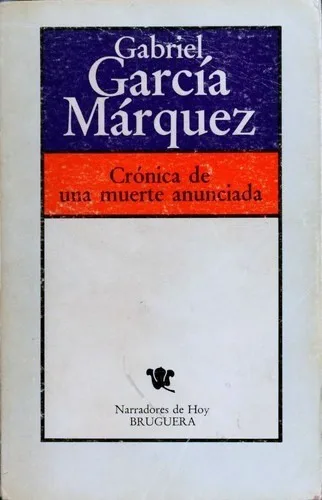
Crónica de una muerte anunciada
 76
76

Crónica de una muerte anunciada


Lorelei Sage (Contemplative Literature Editor) — García Márquez masterfully crafts a narrative that functions as a profound meditation on fate and collective responsibility. Beyond its surface as a compelling crime story, 'Chronicle of a Death Foretold' reveals the intricate, often unseen, rituals that govern human interaction and the inexorable pull of destiny. The novel's power lies in its examination of how a community’s shared consciousness can become a vehicle for a fated event. It is a testament to the author's genius in imbuing the mundane with an aura of the sacred and the inevitable. This work will resonate deeply with readers attuned to the subtle energies of life and the profound philosophical underpinnings of human existence, offering a potent literary exploration of preordained paths.
📝 Description
76
Gabriel García Márquez published "Chronicle of a Death Foretold" in 1981, a novella that examines a community's role in a murder.
The novella reconstructs the events leading to Santiago Nasar's death, as investigated years later by an unnamed narrator. It portrays a town where the impending murder is an open secret, yet no one truly intervenes to stop it. The narrative suggests a shared responsibility, a collective consciousness that allows fate to unfold. Through its detailed account, the book questions the nature of free will and determinism, exploring how societal pressures and ingrained beliefs can seal an individual's destiny. The townsfolk, bound by honor and tradition, seem powerless against the predetermined outcome, making the murder feel less like a singular act and more like an inevitable event.
This story is not simply a crime report but a reflection on how communities participate in tragedy. It highlights the subtle mechanisms of social complicity and the way shared assumptions can lead to fatal inaction. The atmosphere of the novel is thick with a sense of the inevitable, as if the very fabric of reality conspires to fulfill a prophecy. It invites contemplation on the forces that govern human lives, the unspoken rules that shape collective behavior, and the deeper meanings behind seemingly random events.
While not explicitly religious, the novella taps into archetypal themes often found in esoteric thought, such as preordination and the inescapable nature of certain destinies. The community's shared awareness of the impending death, coupled with their inability to prevent it, echoes concepts of a collective unconscious or a shared spiritual fate that transcends individual agency. The ritualistic unfolding of the tragedy and the symbolic weight of actions within the town can be seen as reflecting a worldview where events are not merely random occurrences but part of a larger, often unseen, cosmic order.
💡 Why Read This Book?
This novel offers a unique lens into the mystical concept of preordained fate, exploring how collective belief and unspoken societal rituals can pave the way for inevitable events. It is essential reading for seekers of hidden knowledge, scholars of narrative symbolism, and practitioners interested in the intersection of human will and cosmic design. Discover how a community’s spirit can orchestrate a destiny, and contemplate the echoes of the fated.
⭐ Reader Reviews
Honest opinions from readers who have explored this book.
❓ Frequently Asked Questions
Is this book about predicting the future?
While the book deals with a foretold death, its focus is on the inevitability and the community's role in fulfilling that destiny, rather than on methods of prophecy or divination.
What is the primary esoteric theme explored?
The primary esoteric theme is the concept of fate and predetermination, examining how collective consciousness and societal rituals can manifest a seemingly unavoidable future.
Does the book offer practical magical advice?
No, this is a literary exploration of metaphysical themes. It does not provide practical instructions for magical practices but rather invites contemplation on universal forces.
Who would benefit most from reading this?
Those interested in fatalism, the power of collective belief, symbolic storytelling, and the philosophical implications of destiny would find this book particularly enriching.
Is this a translation of a different work?
The original title is 'Crónica de una muerte anunciada', a seminal work by Gabriel García Márquez written in Spanish. This edition is an English translation.
🔮 Key Themes & Symbolism
The Inevitability of Fate
The novel masterfully constructs a palpable sense of preordained destiny, where the events leading to Santiago Nasar's demise feel less like a series of choices and more like the unfolding of an ancient decree. It looks at the idea that some lives are cosmically chartered, and the narrative becomes a meticulously detailed account of how that charter is fulfilled. This theme appeals to ancient notions of karma and divine will, inviting readers to ponder the extent to which our lives are truly our own or orchestrated by forces beyond our comprehension. The town itself acts as a chorus, its collective inaction and whispered knowledge contributing to the inevitable outcome, underscoring the power of shared consciousness in shaping reality.
Collective Consciousness and Complicity
Beyond the individual tragedy, the book serves as a profound study of collective consciousness and the subtle, often unconscious, complicity of an entire community. The murder is 'announced,' yet no one intervenes effectively. This points to a deeper societal ritual where the known but unprevented act becomes a part of the communal psyche. It explores how shared beliefs, unspoken rules, and a peculiar form of fatalistic acceptance can bind individuals together, transforming them into passive participants in a predetermined event. This exploration touches upon the Jungian concept of the collective unconscious and how shared archetypes can manifest in tangible, often tragic, ways within a society.
The Ritual of Death and Memory
The act of killing Santiago Nasar is depicted not as a spontaneous act of violence, but as a ritualistic execution, imbued with a sense of solemnity and inevitability. The narrative structure, mirroring a retrospective investigation, transforms the recounting of events into its own form of ritual, seeking meaning and order in chaos. The 'chronicle' itself becomes a sacred text, preserving the memory of the fated event and its participants. This theme invites contemplation on how societies process death, how memories are constructed and maintained, and how the ritualistic retelling of tragic events can serve to both understand and perpetuate them, creating a lasting echo in the collective soul.
💬 Memorable Quotes
Direct passages from the work, attributed to the author.
“On the day they were going to kill him, Santiago Nasar got up at five-thirty in the morning to wait for the boat the bishop was coming on.”
— This opening line immediately establishes the core paradox of the narrative: a death known in advance, yet life continues its ordinary course, highlighting the strange dance between destiny and daily existence.
“It was impossible to think of him as dead.”
— This reflects the profound disconnect between the foretold reality of death and the human struggle to reconcile it with the vibrant presence of the living, suggesting a denial of the inevitable.
“They had killed him with the same ease as if they had been killing a chicken.”
— This stark comparison underscores the dehumanizing aspect of the fated act, portraying the murder as a perfunctory, almost ritualistic, task rather than a passionate crime.
“The only thing I didn't know was that he was already dead.”
— This reveals the narrator's own journey of discovery, mirroring the reader's, and emphasizes how the truth of death can be obscured by the ongoing flow of life until revealed.
“He had the feeling that he was going to die, and he did die.”
— This simple, direct statement captures the essence of the book: the profound connection between a deep-seated premonition and its ultimate, undeniable fulfillment.
🌙 Esoteric Significance
Tradition
The novel deeply appeals to the philosophical underpinnings of Stoicism and certain fatalistic interpretations found in ancient Greek tragedy, where destiny is an inescapable force. It also echoes Gnostic ideas of a predetermined fate and the challenges of recognizing and transcending it. The collective complicity can be viewed through a Jungian lens, exploring the shadow aspects of the collective unconscious manifesting in societal actions. The very act of the 'announcement' and the subsequent unfolding can be seen as a ritualistic performance of destiny, aligning with archetypal narratives of sacrifice and inevitable doom.
Symbolism
The bishop's visit, a recurring motif, symbolizes a higher, perhaps divine, authority or witness whose presence is noted but ultimately powerless to avert the fated event. Santiago Nasar's name itself carries traces of biblical figures and martyrdom. The repeated references to the heat and the early morning light can be interpreted as symbolic of clarity and revelation, yet also a harsh, unyielding illumination of an unavoidable truth. The knives used in the murder are potent phallic and sacrificial symbols, representing the instrument of fate and the ritualistic nature of the act.
Modern Relevance
In an era increasingly grappling with societal polarization, the spread of misinformation, and the feeling of powerlessness in the face of global events, the novel's exploration of collective inaction and the power of shared narratives remains profoundly relevant. It prompts us to question our own roles in unfolding events, the subtle ways we become complicit, and the enduring human fascination with destiny and the unknown forces that shape our lives. The book serves as a timeless reminder of the intricate web connecting individual lives to broader communal and cosmic patterns.
👥 Who Should Read This Book
Beginners to magical realism will find "Chronicle of a Death Foretold" an accessible yet profound introduction, offering a gentle immersion into the genre's combination of the ordinary and the extraordinary. Scholars of literature and philosophy will appreciate its intricate narrative structure, exploration of fatalism, and the complex interplay of societal forces. Seekers interested in the esoteric will be drawn to its potent themes of destiny, collective consciousness, and the symbolic weight of human actions. Practitioners of contemplative arts may find inspiration in its examination of preordained paths and the rituals that shape our perception of reality, encouraging introspection on the unseen currents of life.
📜 Historical Context
Published in 1981, "Chronicle of a Death Foretold" emerged from Gabriel García Márquez’s rich Colombian heritage and the broader context of Latin American magical realism. This literary movement, which gained prominence in the mid-20th century, sought to blend the fantastical and the mundane, presenting supernatural or mythical elements as ordinary occurrences. The novel reflects a period of significant social and political upheaval in Latin America, where themes of violence, fate, and the cyclical nature of history were deeply embedded in the cultural consciousness. Márquez’s work, deeply rooted in the oral traditions and folklore of his homeland, uses this context to explore universal human experiences through a distinctly unique and often mystical lens, challenging conventional notions of reality and narrative.
📔 Journal Prompts
Reflect on a time you felt an event was inevitable. How did you or others react?
What societal 'rituals' do you observe that seem to guide collective behavior, even subconsciously?
Consider the concept of 'announced' deaths or tragedies in the news. How does knowing about them change your perception?
Explore the symbolism of light and heat in your own life. What do they illuminate or reveal?
If you could chronicle your own life’s fated moments, what would they be and why?
🗂️ Glossary
Magical Realism
A literary genre where fantastical or mythical elements are woven into an otherwise realistic narrative, presented as ordinary occurrences without explanation.
Fatalism
The belief that all events are predetermined and inevitable, thus rendering human free will powerless to change them.
Collective Consciousness
The shared set of beliefs, ideas, attitudes, and knowledge that are common to a social group or society, influencing individual behavior.
Archetype
A universally understood symbol, character, or pattern of behavior that recurs in mythology and literature, representing fundamental human experiences.
Complicity
The state of being involved in a guilty or illegal act; in this context, the passive or active participation in a fated event.
This book appears in 2 collections
🔮 Readers Also Liked
Browse all →







More by Gabriel García Márquez
All books →




From the “Ritual Magic” Collection
View all →







More Free Magic & Ritual Books
View all →