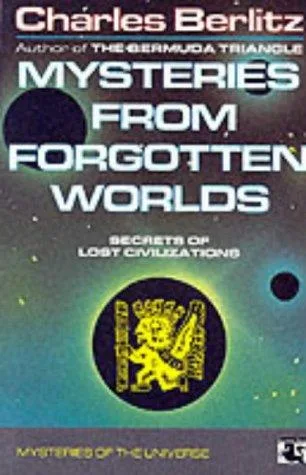
Mysteries from Forgotten Worlds
 75
75

Mysteries from Forgotten Worlds
Charles Berlitz's *Mysteries from Forgotten Worlds* is less a rigorous academic inquiry and more a collection of intriguing, often sensationalized, possibilities. The strength lies in its breadth of subjects, touching upon ancient sites, myths, and unexplained events with a consistent, if uncritical, enthusiasm. Berlitz's chapter on the supposed "crystal skulls" and their purported mystical properties, while lacking solid provenance, is indicative of the book's approach: presenting compelling narratives that challenge conventional understanding. However, the primary limitation is the absence of critical analysis; evidence is often accepted at face value, and alternative explanations are rarely considered. For instance, the book discusses ancient flood myths without fully engaging with geological or anthropological counter-arguments. The work serves as a fascinating, if flawed, primer for those new to alternative histories, but it requires significant reader discernment.
📝 Description
75
Charles Berlitz's 1960 book surveyed anomalous phenomena and ancient mysteries.
Mysteries from Forgotten Worlds, published in 1960, examines a range of unexplained events and historical enigmas. Charles Berlitz, known for his work on the Bermuda Triangle, gathered accounts and theories about lost civilizations, potential extraterrestrial involvement in early human history, and puzzling archaeological finds. He sought to link these varied subjects into a unified, speculative account.
The book is for readers interested in the overlap between archaeology, mythology, and speculative history. It appeals to those who question mainstream academic views and consider unconventional explanations for historical events and ancient artifacts. Readers drawn to ancient astronaut theories, pre-diluvian societies, and unexplained phenomena will find familiar concepts discussed within its pages.
Published in 1960, Mysteries from Forgotten Worlds appeared during a time of growing public fascination with ufology and ancient mysteries. This post-war period saw a rise in alternative explanations for human origins, partly fueled by counter-cultural interests. Berlitz's work synthesized then-current fringe theories and anecdotal evidence, engaging with themes that challenged established archaeological and historical narratives and tapped into a cultural zeitgeist.
💡 Why Read This Book?
• Gain exposure to early theories of ancient astronautry and lost civilizations, exemplified by Berlitz's discussions of sites like Puma Punku, offering a different perspective on prehistoric engineering. • Understand the cultural milieu of the early 1960s, when works like this began questioning established historical narratives, as seen in its engagement with the emerging ufology movement. • Explore specific examples of unexplained artifacts and phenomena, such as the Nazca Lines, presented as potential evidence for sophisticated ancient cultures or external influences.
⭐ Reader Reviews
Honest opinions from readers who have explored this book.
❓ Frequently Asked Questions
When was Charles Berlitz's *Mysteries from Forgotten Worlds* first published?
Mysteries from Forgotten Worlds by Charles Berlitz was first published in 1960, positioning it as an early entry in the popular wave of speculative non-fiction concerning ancient mysteries and extraterrestrial theories.
What kind of topics does *Mysteries from Forgotten Worlds* cover?
The book covers a wide range of topics including lost civilizations, ancient astronaut theories, unexplained archaeological sites like Easter Island, and purported evidence of advanced ancient technologies.
Is *Mysteries from Forgotten Worlds* considered a scientific book?
No, the book is not considered a scientific work. It presents speculative theories and anecdotal evidence rather than findings supported by mainstream archaeological or historical methodologies.
What is Charles Berlitz known for besides this book?
Charles Berlitz is perhaps most famous for his later work, *The Bermuda Triangle* (1974), which popularized theories about mysterious disappearances in that region of the Atlantic Ocean.
Where does *Mysteries from Forgotten Worlds* fit in the history of esoteric literature?
Published in 1960, it was part of a growing trend in esoteric and fringe literature that sought to challenge conventional historical accounts and explore possibilities of ancient advanced civilizations and extraterrestrial contact.
Does the book provide evidence for its claims?
The book presents various accounts, interpretations of ancient texts, and archaeological anomalies as evidence, but these are often debated and not accepted by conventional academic fields.
🔮 Key Themes & Symbolism
Lost Civilizations
The book posits the existence of highly advanced civilizations that predated known recorded history. Berlitz draws on myths of Atlantis and Lemuria, as well as interpretations of archaeological sites like the pyramids and the structures at Sacsayhuamán, to suggest that sophisticated societies with advanced knowledge and technology once flourished and then vanished, leaving behind enigmatic ruins and legends. This theme challenges the linear progression of human development as understood by mainstream archaeology.
Extraterrestrial Influence
A central tenet explored is the potential involvement of non-terrestrial intelligences in the development of early human societies and cultures. Berlitz examines ancient texts and artwork, such as certain Vedic scriptures or cave paintings, interpreting them as descriptions or depictions of advanced craft and alien beings. This perspective suggests that key advancements in human civilization may not have originated solely from terrestrial sources but were influenced or guided by visitors from other worlds.
Unexplained Archaeological Anomalies
The work meticulously details numerous archaeological sites and artifacts that appear to defy conventional explanations for their creation and purpose. Examples include the colossal statues of Easter Island, the intricate stonework of Puma Punku, and the mysterious Nazca Lines. Berlitz presents these as evidence for lost technologies or forgotten peoples possessing capabilities far beyond what is typically attributed to ancient cultures, prompting questions about who built them and why.
Ancient Wisdom and Lost Knowledge
Mysteries from Forgotten Worlds suggests that ancient peoples possessed a profound understanding of cosmology, spirituality, and technology that has been largely lost to modern humanity. This lost knowledge is often linked to esoteric traditions, psychic abilities, or a deeper connection to universal forces. The book implies that by studying these ancient enigmas, we might recover fragments of this forgotten wisdom, offering new perspectives on consciousness and reality.
💬 Memorable Quotes
Direct passages from the work, attributed to the author.
“Certain monumental structures exhibit construction techniques and precision that seem impossible for the presumed technological capabilities of their era.”
— This interpretation refers to Berlitz's focus on sites like Sacsayhuamán or Puma Punku, where the massive, precisely cut stones challenge conventional explanations for how ancient peoples achieved such feats without advanced tools or methods.
“Interpretations of ancient texts often reveal descriptions that could be understood as accounts of aerial vehicles or visitors from the stars.”
— This concept reflects Berlitz's tendency to read ancient scriptures, such as the Mahabharata or the Bible, through the lens of modern technology, suggesting that descriptions of divine chariots or beings from the sky might actually refer to extraterrestrial craft and visitors.
“Unexplained phenomena, from disappearances to anomalous artifacts, may be interconnected threads in a larger cosmic mystery.”
— This interpretation captures Berlitz's overarching thesis that seemingly disparate unexplained events and objects are not isolated incidents but are part of a grander, hidden pattern of reality that defies conventional scientific and historical explanation.
💡 Key Ideas
Editorial paraphrase of the work's core concepts — not direct quotes.
Ancient myths across diverse cultures frequently describe cataclysmic events and the survival of select groups.
This paraphrased concept highlights Berlitz's use of global mythology to suggest a common, underlying truth about a forgotten past, likely a great flood or a societal collapse, from which remnants of ancient knowledge or peoples endured.
The recurrence of themes like sunken continents and advanced prehistoric societies appears in legends worldwide.
This paraphrased quote points to Berlitz's method of cross-referencing myths from different geographical regions, such as Atlantis and Lemuria, to build a case for a shared, ancient global history involving advanced civilizations that met catastrophic ends.
🌙 Esoteric Significance
Tradition
While not strictly aligned with a single esoteric lineage, Berlitz's work draws heavily from the Theosophical and Atlantean traditions, popularized by Helena Blavatsky and later Edgar Cayce. It echoes Gnostic ideas of lost knowledge and fallen civilizations. The book fits within the broader genre of fringe archaeology and speculative history that seeks to uncover hidden truths about humanity's past, often outside the purview of mainstream academia and established esoteric schools.
Symbolism
The book frequently references ancient megalithic structures like the pyramids and Stonehenge as potent symbols of lost knowledge and forgotten power. These sites, according to Berlitz's interpretations, represent not just architectural feats but also repositories of advanced understanding of astronomy, geometry, and possibly energy manipulation. The 'crystal skulls' also emerge as significant symbols, representing a supposed ancient wisdom or consciousness that modern humanity has yet to reintegrate or comprehend.
Modern Relevance
Contemporary thinkers in the ancient astronaut theory community, such as those featured on programs like 'Ancient Aliens,' continue to cite and popularize the types of theories presented by Berlitz. His work remains a foundational text for many who explore alternative histories and the possibility of extraterrestrial involvement in human origins. It also influences independent researchers and enthusiasts interested in reconciling ancient myths with modern scientific and technological speculation.
👥 Who Should Read This Book
• Enthusiasts of ancient astronaut theories and speculative archaeology seeking early explorations of these concepts. • Readers interested in the history of fringe literature and how ideas about lost civilizations gained traction in the mid-20th century. • Individuals curious about alternative interpretations of ancient myths and monuments who enjoy a broad, though not critically rigorous, survey of unexplained phenomena.
📜 Historical Context
The 1960 publication of *Mysteries from Forgotten Worlds* occurred at a key moment in post-war Western culture. Public fascination with the unknown was amplified by the burgeoning UFO phenomenon and a growing skepticism towards established institutions. This era saw the rise of influential figures like George Adamski, who claimed contact with extraterrestrials, and the popularization of theories about ancient civilizations. Berlitz's work entered a landscape where authors like Ivan T. Sanderson were also exploring unusual phenomena. While not a direct contemporary in terms of publishing similar works on ancient mysteries, the intellectual climate was ripe for such speculative inquiries, especially following the widespread impact of Immanuel Velikovsky's controversial *Worlds in Collision* (1950) which had already challenged established scientific and historical timelines.
📔 Journal Prompts
The enigmatic precision of Puma Punku stonework and its implications for ancient technology.
Ancient flood myths as narratives of societal collapse and the survival of knowledge.
Interpreting ancient artwork as potential evidence for extraterrestrial contact.
The recurring legends of sunken continents like Atlantis and their symbolic meaning.
Reflecting on the Nazca Lines: their creation, purpose, and what they suggest about ancient capabilities.
🗂️ Glossary
Atlantis
A legendary island civilization, often described as highly advanced, that supposedly sank beneath the ocean. Berlitz frequently references Atlantean myths as evidence for lost, sophisticated ancient cultures.
Lemuria
Another mythical lost continent, often depicted as an ancient cradle of humanity or a spiritual civilization that predates Atlantis. It is frequently cited alongside Atlantis in theories of forgotten global history.
Megalithic Structures
Large stone constructions, such as Stonehenge, the pyramids of Egypt, or sites like Puma Punku. Berlitz uses their scale and precision to question the technological capabilities of ancient peoples.
Ancient Astronaut Theory
The hypothesis that extraterrestrial beings visited Earth in antiquity and influenced human culture, technology, and religion. Berlitz explores this theory by reinterpreting ancient texts and artifacts.
Crystal Skulls
Carved human skulls, often made of clear quartz, some of which are claimed to have mystical properties or to be of ancient, unknown origin. Berlitz discusses these as potential relics of lost civilizations.
Nazca Lines
Geoglyphs etched into the desert plains of Peru, depicting various animals, plants, and geometric shapes. Their massive scale and visibility primarily from the air are cited as evidence for advanced ancient understanding or purposes.
Puma Punku
An archaeological site in Bolivia featuring intricately cut and precisely fitted stone blocks, some weighing many tons. Its construction is often presented as a mystery beyond the capabilities of known ancient tools.
🔮 Readers Also Liked
Browse all →









More by Charles Berlitz
All books →





More Free Occult Philosophy Books
View all →