Monsieur Pain
 76
76

Monsieur Pain
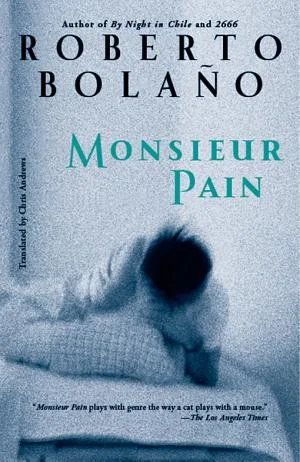
Roberto Bolaño’s *Monsieur Pain* operates on a frequency distinct from typical noir. The premise—a timid mesmerist, Pierre Pain, tasked with treating the hiccuping poet César Vallejo, only to be bribed by shadowy figures to desist—is inherently intriguing. Bolaño excels at creating an atmosphere that is simultaneously mundane and unnerving. The descriptions of Pain’s solitary existence and his infatuation with Madame Reynaud possess a stark, almost melancholic beauty. However, the novel’s brevity, while often a strength in Bolaño’s work, here leaves certain narrative threads feeling somewhat underdeveloped. The central conflict, the pressure from the Spanish men, could have benefited from more direct exploration. Despite this, the prose itself, sharp and observant, makes even the quiet moments compelling. The novel offers a potent, if condensed, glimpse into Bolaño’s masterful control of tone and character.
📝 Description
76
Roberto Bolaño's 2012 novella *Monsieur Pain* concerns a mesmerist entangled with a dying poet.
Published in 2012, *Monsieur Pain* follows Pierre Pain, a mesmerist who becomes involved with the ailing Peruvian poet César Vallejo in 1930s Paris. Vallejo suffers from a persistent, undiagnosed illness, and Pain finds himself drawn into a disturbing situation involving mysterious Spanish men who exert pressure on Vallejo and his wife. The narrative unfolds in a disquieting atmosphere, blending elements of mystery and the uncanny with a surprising undercurrent of tenderness.
Bolaño’s distinctive voice is present throughout, focusing on marginal figures and shadowy circumstances. The story does not adhere to conventional genre structures, instead creating a mood that is both intellectually stimulating and emotionally complex. It captures a sense of unease and hidden agendas, characteristic of Bolaño's broader literary concerns.
While not overtly occult, *Monsieur Pain* touches on esoteric themes through its depiction of mesmerism. This is presented not as mere entertainment, but as a form of subtle control or influence, a 'system of influence and coercion.' Vallejo's affliction, with its potential psychosomatic or symbolically induced nature, hints at deeper psychological or spiritual distress. The mysterious Spanish figures and their pressure on Vallejo and his wife also suggest forces operating beneath the surface of ordinary reality, a common trope in esoteric traditions that explore unseen powers and their impact on human lives.
💡 Why Read This Book?
• Understand the symbolic weight of illness and influence through the undiagnosed affliction of César Vallejo, a recurring motif in Bolaño's exploration of societal malaise. • Experience Bolaño's unique approach to the noir genre, focusing on atmosphere and character psychology over plot mechanics, as seen in Pierre Pain's reluctant involvement. • Engage with the subtle political subtext woven into the narrative, particularly the mysterious Spanish men and their motivations, reflecting Bolaño's broader concerns with power dynamics.
⭐ Reader Reviews
Honest opinions from readers who have explored this book.
❓ Frequently Asked Questions
What is the primary role of Pierre Pain in Monsieur Pain?
Pierre Pain is a timid bachelor and a mesmerist who is drawn into a mysterious situation involving the ailing poet César Vallejo. His primary role evolves from a potential healer to an unwilling participant in a clandestine power play.
Who is César Vallejo and why is he significant in the book?
César Vallejo is a renowned Peruvian poet, depicted here suffering from an undiagnosed illness and persistent hiccups. His presence anchors the narrative, serving as the focal point for the intrigue and the pressure exerted by external forces.
What is the central conflict or mystery in Monsieur Pain?
The central mystery involves two Spanish men who bribe Pierre Pain not to treat César Vallejo. This act suggests hidden agendas and a larger conspiracy or conflict at play, the full extent of which is not immediately clear.
What is the overall tone of Monsieur Pain?
The tone is described as odd, dark, and comic, with an undercurrent of strangeness. It blends elements of noir with Bolaño's characteristic literary style, creating a disquieting yet tender atmosphere.
When was Monsieur Pain first published?
Monsieur Pain was first published on February 23, 2012.
Does Monsieur Pain connect to other works by Roberto Bolaño?
While a standalone novel, it shares Bolaño's thematic concerns with literature, exile, and the search for meaning in ambiguous circumstances, aligning with the spirit of his more expansive works like 'The Savage Detectives'.
🔮 Key Themes & Symbolism
The Shadowed Literary World
The novel probes the fringes of the literary and artistic scene, focusing on figures like the poet César Vallejo and the seemingly ordinary yet involved mesmerist Pierre Pain. It highlights how individuals, often operating outside the spotlight, can become entangled in larger, more sinister machinations, suggesting that artistic pursuits can exist alongside or be threatened by hidden power structures. This theme reflects Bolaño's persistent interest in the lives of writers and artists, often depicted in precarious or compromised situations.
Mesmerism and Influence
Mesmerism, as practiced by Pierre Pain, functions as a central, albeit peculiar, motif. It represents a form of influence, potentially healing or controlling, that operates on a subtle, psychological level. The pressure exerted by the Spanish men to prevent Pain's treatment of Vallejo transforms this practice into a battleground for unseen forces. The work questions the nature of control and suggestion, implying that even seemingly benign practices can be co-opted for darker purposes within a network of hidden agendas.
Undiagnosed Ailments and Symbolic Illness
The undiagnosed illness and persistent hiccups of César Vallejo serve as a potent symbol. They represent a profound unease that cannot be easily named or treated, mirroring the narrator's own disquiet and the ambiguous nature of the threats he faces. This focus on physical symptoms without clear causes suggests a deeper, perhaps existential or socio-political malaise that permeates the characters' lives and the world they inhabit.
The Underworld of Coercion
Bolaño constructs a palpable sense of an 'underworld' that is not necessarily criminal in the traditional sense, but operates through veiled threats, bribes, and unspoken rules. The encounter between Pierre Pain and the Spanish men exemplifies this, where coercion is enacted through financial incentives and implied danger. This theme speaks to the pervasive influence of power and the ways in which individuals can be manipulated within systems they barely comprehend.
💬 Memorable Quotes
Direct passages from the work, attributed to the author.
“The Peruvian poet César Vallejo is in the hospital, afflicted with an undiagnosed illness and unable to stop hiccuping.”
— This establishes the peculiar predicament of a significant literary figure, framing his physical suffering as a mystery that draws other characters into its orbit, symbolizing a broader sense of unease.
“Pain, a timid bachelor, is in love with the widow Reynaud and agrees to help.”
— This reveals Pierre Pain's personal motivations and vulnerabilities, linking his professional task to his emotional life and suggesting that his actions are driven by a mix of duty and personal desire.
“But two mysterious Spanish men follow him and bribe him not to treat Vallejo.”
— This marks the turning point where the narrative shifts from a personal drama to a more suspenseful and potentially dangerous situation, introducing external antagonists and the core conflict of the novel.
“Ravaged by gui”
— This fragmented phrase suggests a profound suffering or affliction affecting Pain, hinting at internal struggles or consequences stemming from his involvement in the unfolding events, leaving the reader to infer the nature of this torment.
💡 Key Ideas
Editorial paraphrase of the work's core concepts — not direct quotes.
His wife calls on an acquaintance of her friend Madame Reynaud: the mesmerist Pierre Pain.
This line introduces the central character and the unusual nature of his profession, immediately setting a tone of intrigue and hinting at the interconnectedness of seemingly disparate individuals in a hidden social web.
🌙 Esoteric Significance
Tradition
While not explicitly tied to a single esoteric lineage, *Monsieur Pain* engages with themes that resonate with Gnostic and Hermetic traditions. The focus on hidden knowledge, the influence of unseen forces (mesmerism, the mysterious Spanish men), and the idea of individuals being caught in opaque systems of control echo Gnostic dualism and the Hermetic concept of correspondence. The novel suggests a reality where surface appearances mask deeper, often unsettling, truths and where individuals may be manipulated by powers beyond their immediate understanding.
Symbolism
The persistent, undiagnosed illness and hiccups of César Vallejo can be interpreted as a symbol of a societal or spiritual malaise that cannot be easily diagnosed or cured, a form of 'gnosis' that remains elusive. Pierre Pain’s mesmerism itself symbolizes the power of suggestion and psychological influence, a force that can be used for healing or manipulation, akin to the esoteric concept of working with subtle energies. The two Spanish men represent external agents of control, embodying forces that seek to suppress or redirect vital energies and knowledge.
Modern Relevance
Contemporary thinkers and practitioners interested in the psychological underpinnings of power and influence, particularly as they intersect with artistic and intellectual spheres, find relevance in *Monsieur Pain*. The novel’s exploration of how individuals can be entangled in shadowy networks and coerced through subtle means speaks to modern concerns about disinformation, psychological operations, and the manipulation of public perception in a digitally saturated world.
👥 Who Should Read This Book
• Readers interested in the intersection of literary fiction and subtle psychological thrillers, particularly those drawn to Bolaño's distinctive prose and thematic concerns. • Students of esoteric thought who appreciate explorations of influence, unseen forces, and the symbolic representation of societal unease, as seen in the mesmerism motif and Vallejo's affliction. • Comparative literature scholars examining post-dictatorship Latin American narratives and authors who engage with themes of memory, trauma, and the ambiguous nature of power dynamics.
📜 Historical Context
Published in 2012, *Monsieur Pain* emerged late in Roberto Bolaño's posthumously celebrated career, following the monumental impact of *2666* (2004). The novel situates itself within the tradition of Latin American literature grappling with the aftermath of political repression and the elusive nature of truth. Its publication occurred during a period when Bolaño's work was being intensely studied and debated, solidifying his status as a major voice of his generation. The narrative’s engagement with mysterious Spanish figures and its exploration of veiled threats echo concerns present in works by contemporaries like Javier Marías, who also frequently examined themes of memory, secrets, and the lingering effects of historical events. The novel’s quiet intensity and focus on marginal characters align with Bolaño's distinctive style, which diverged from more overtly political or magical realist trends, offering instead a starkly drawn, psychologically charged realism.
📔 Journal Prompts
Pierre Pain's infatuation with Madame Reynaud and his professional task: how do personal desires complicate external pressures?
The undiagnosed illness and hiccups of César Vallejo: what might this affliction symbolize beyond the physical?
The mysterious Spanish men's bribe: analyze the nature of coercion when it operates through financial incentive rather than overt threat.
Mesmerism as depicted in the novel: explore its function as a tool for healing, control, or a reflection of deeper psychological states.
The concept of an 'underworld' in Monsieur Pain: how does Bolaño construct this space without relying on traditional criminal tropes?
🗂️ Glossary
Mesmerist
An practitioner of mesmerism, a pseudoscientific therapeutic technique developed in the late 18th century, involving the use of passes or the laying on of hands to induce a trance-like state. In *Monsieur Pain*, it represents a subtle form of influence and psychological manipulation.
César Vallejo
A highly influential Peruvian poet (1892–1938) known for his avant-garde style and profound exploration of human suffering and social injustice. His inclusion in the novel grounds the narrative in a specific literary context.
Undiagnosed Illness
A sickness whose cause cannot be identified by medical professionals. In the novel, Vallejo's condition serves as a central mystery and a symbol of deeper, unarticulated problems.
Hiccuping
Involuntary spasms of the diaphragm and vocal cords. Vallejo's persistent hiccups are a peculiar symptom that underscores his distress and the enigma of his ailment.
Madame Reynaud
A character in the novel, connected to Pierre Pain and the circle of individuals involved with César Vallejo. Her presence adds to the network of relationships and potential motivations.
Spanish Men
Two mysterious characters who approach Pierre Pain with a bribe, introducing the element of external coercion and hidden agendas into the narrative.
Noir
A genre of crime fiction characterized by cynical protagonists, bleak settings, and often convoluted plots involving corruption and moral ambiguity. *Monsieur Pain* adapts noir elements to Bolaño's unique literary style.
This book appears in 1 collection
🔮 Readers Also Liked
Browse all →









From the “Occultism” Collection
View all →







More Free Occult Philosophy Books
View all →