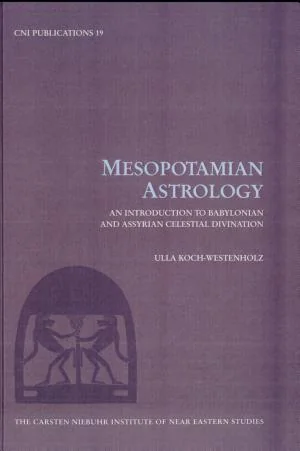
Mesopotamian Astrology
 75
75

Mesopotamian Astrology
Koch's "Mesopotamian Astrology" is a rigorous academic survey, eschewing sensationalism for a methodical exploration of its subject. Its strength lies in its systematic presentation of the outward phenomena and inner structure of Mesopotamian celestial interpretation, grounding the reader in the specific context of the ancient Near East. The detailed discussion of *enuma Anu Enlil* tablets, for instance, offers a concrete anchor in the vast corpus of Mesopotamian divination. However, the book's academic tone, while laudable for its precision, might prove dense for readers unfamiliar with Assyriological terminology or complex scholarly apparatus. The limited focus on practical application, prioritizing historical analysis over contemporary relevance, is a deliberate choice but may leave some seeking more direct engagement with the esoteric implications. Overall, it is an indispensable resource for serious students of the subject, providing essential factual scaffolding.
📝 Description
75
Ulla Susanne Koch's 1995 book details the celestial interpretive system developed by Babylonian and Assyrian scribes.
Ulla Susanne Koch's "Mesopotamian Astrology" examines the ancient practice of interpreting the heavens as practiced by Babylonian and Assyrian cultures. The book details the astronomical observations and predictive methods developed by scribes, explaining how cuneiform texts recorded celestial events as divine omens. Koch's work maps the evolution of these astrological traditions, revealing how heavenly phenomena were understood as messages from the gods.
The text is particularly valuable for students and scholars interested in ancient Near Eastern civilizations, comparative religion, and the history of science. It traces the origins of astrological thought, showing how early Mesopotamian systems influenced later traditions, including Hellenistic and Western astrology. Readers curious about the earliest known systematic attempts to link astronomical occurrences with earthly events will find this study informative.
This book places Mesopotamian astrology within the lineage of early divination systems that sought to understand divine will through celestial observation. It predates and informs later traditions, demonstrating how the systematic recording of stars, planets, and atmospheric events served as a primary method for interpreting the cosmos. The work highlights how these early astronomical practices were not merely scientific inquiry but deeply embedded in religious and political structures, aiming to gain insight into the intentions of deities and predict future events.
⭐ Reader Reviews
Honest opinions from readers who have explored this book.
❓ Frequently Asked Questions
What is the primary difference between Mesopotamian astrology and modern Western astrology?
Mesopotamian astrology, primarily documented in texts like *enuma Anu Enlil* from around the 2nd millennium BCE, focused heavily on omen interpretation and state-level divination. Modern Western astrology often emphasizes individual psychological profiling and personal horoscopes.
When was Ulla Susanne Koch's 'Mesopotamian Astrology' first published?
The book was first published in 1995, providing a scholarly overview of ancient Near Eastern celestial interpretation.
What are the 'outward phenomena' and 'inner structure' of Mesopotamian astrology mentioned in the book's description?
Outward phenomena refer to the observable celestial events and their recording, while inner structure pertains to the interpretive frameworks, omen categories, and predictive methods developed by Mesopotamian scribes.
Does the book discuss specific Mesopotamian deities in relation to astrology?
While focusing on the interpretive system, the work implicitly acknowledges the divine attribution of celestial phenomena in Mesopotamian religion, where stars and planets were seen as manifestations of the gods.
Is 'Mesopotamian Astrology' suitable for complete beginners to ancient esotericism?
It serves as a general introduction but assumes some familiarity with academic study of ancient cultures due to its scholarly approach and detailed textual analysis.
What role did eclipses play in Mesopotamian astrological interpretation?
Eclipses were considered highly significant and often portended major events for the king and the state, requiring careful interpretation within the framework of omen collections like *enuma Anu Enlil*.
🔮 Key Themes & Symbolism
Astral Omen Tradition
The book meticulously details the vast corpus of Mesopotamian omen literature, particularly the *enuma Anu Enlil*, which systematically recorded celestial phenomena and their perceived earthly consequences. This tradition viewed the heavens not as a passive backdrop but as an active divine communication channel. Koch explains how specific planetary movements, lunar phenomena, and star configurations were cataloged and interpreted to provide guidance for rulers and the state, establishing a sophisticated system of astral divination predating later astrological developments.
The Role of the Scribe-Astrologer
Koch highlights the critical function of scribes in Mesopotamian society, who were responsible for astronomical observation, textual compilation, and interpretation. These individuals were not merely recorders but intellectual mediators between the divine and the human realm. Their work involved mastering complex cuneiform scripts, astronomical cycles, and the vast body of established omen lore. The book illustrates how these learned individuals advised kings, potentially influencing political decisions through their celestial readings.
Planetary Significance and Divination
Central to Mesopotamian astral interpretation was the perceived significance of individual planets and their movements. The work explores how planets like Jupiter (associated with Marduk) and Venus (associated with Ishtar) were observed for their positions, retrogradations, and conjunctions. These celestial events were meticulously noted and correlated with specific omens concerning warfare, agriculture, and the well-being of the kingdom, forming a core component of the divinatory practices analyzed.
From Observation to Prediction
The book traces the evolution of Mesopotamian celestial knowledge from basic astronomical observation to complex predictive systems. Koch explains how the meticulous recording of phenomena over centuries allowed for the identification of patterns and cycles. These observations were then integrated into a divinatory framework, where celestial events were seen as portents of future occurrences, demonstrating an early form of systematic, albeit divinely-oriented, prediction based on empirical data.
💬 Memorable Quotes
Direct passages from the work, attributed to the author.
“The celestial phenomena were considered divine signs and portents.”
— This statement captures the core belief system of Mesopotamian astrology, where the movements and appearances of celestial bodies were not random but deliberate messages from the gods, requiring careful decipherment.
“The *enuma Anu Enlil* comprises a vast collection of celestial omens.”
— This highlights the monumental scale and systematic nature of Mesopotamian divination, emphasizing the importance of this specific collection of cuneiform tablets as a primary source for understanding their astrological practices.
“Astrology was deeply integrated into the administration of the state.”
— This interpretation underscores that Mesopotamian celestial interpretation was not a fringe activity but a vital tool used by rulers and advisors for decision-making, forecasting, and maintaining cosmic order.
“The work explores both the outward phenomena and the inner structure of Mesopotamian astrology.”
— This reflects the book's dual approach: examining the observable astronomical events (phenomena) alongside the underlying interpretive logic, cultural beliefs, and scribal methodologies (inner structure).
“Early Babylonian astronomy was largely divinatory.”
— This points to the primary function of early Mesopotamian celestial study, suggesting that the motivation behind observation and recording was less about scientific curiosity and more about seeking divine will and future knowledge.
🌙 Esoteric Significance
Tradition
This work fits within the broader esoteric lineage of foundational divinatory systems that inform Western esotericism, particularly Hermeticism and early Kabbalistic thought which drew heavily on ancient Near Eastern symbolism and numerology. While not strictly Gnostic or Theosophical, it provides essential historical and conceptual roots for understanding how celestial mechanics became imbued with spiritual and predictive meaning across millennia.
Symbolism
Key symbols include the planets, each often associated with a major deity (e.g., Jupiter with Marduk, Venus with Ishtar), representing divine forces impacting the earthly realm. Lunar eclipses were particularly potent symbols, often interpreted as a ritual replacement of the king by a substitute during the eclipse period to avert disaster, demonstrating a profound symbolic link between celestial events and royal power.
Modern Relevance
Contemporary practitioners of Western astrology, comparative religion scholars, and historians of science continue to draw upon the foundational understanding of Mesopotamian celestial interpretation provided by works like Koch's. It informs discussions on the evolution of divination, the relationship between observation and belief, and the deep historical roots of humanity's quest to understand cosmic influence.
👥 Who Should Read This Book
['• Students of ancient Near Eastern history and religion: Gain a comprehensive overview of how celestial phenomena were observed, recorded, and interpreted in Babylonian and Assyrian societies.', '• Aspiring astrologers seeking historical depth: Understand the earliest known systematic forms of astral divination, differentiating them from later Hellenistic and modern astrological systems.', '• Comparative mythology and esotericism researchers: Explore the origins of symbolic celestial interpretation and its integration into statecraft and religious belief systems in antiquity.']
📜 Historical Context
Published in 1995, Ulla Susanne Koch's "Mesopotamian Astrology" emerged during a period of robust academic engagement with the ancient Near East. It provided a crucial counterpoint to the often Hellenocentric view of early astrology, focusing instead on the foundational Babylonian and Assyrian traditions. This era saw significant advancements in the decipherment and interpretation of cuneiform texts, with scholars like Simo Parpola and Rykle Borger making substantial contributions to understanding Mesopotamian religion and science. Koch's work positioned itself within this scholarly milieu, offering a systematic overview of a practice deeply interwoven with Mesopotamian statecraft and cosmology. Unlike the philosophical underpinnings of later Greek astrology, Mesopotamian celestial interpretation was primarily a divinatory practice focused on omens for the king and the realm, a distinction the book meticulously clarifies.
📔 Journal Prompts
The *enuma Anu Enlil* as a corpus of divine communication.
Celestial omens and their impact on Mesopotamian statecraft.
The scribe-astrologer's role in interpreting divine will.
Planetary symbolism in the context of Babylonian religion.
The transition from celestial observation to divinatory prediction.
🗂️ Glossary
Enuma Anu Enlil
A monumental series of Babylonian cuneiform tablets containing celestial omens, dating primarily from the second millennium BCE. It represents one of the most comprehensive collections of Mesopotamian astral divination.
Cuneiform
The ancient writing system used in Mesopotamia, characterized by wedge-shaped marks impressed on clay tablets. It was employed for administrative, literary, religious, and scientific texts, including astrological records.
Omen
An event believed to foreshadow or foretell a future occurrence. In Mesopotamian astrology, celestial phenomena were interpreted as omens, carrying messages from the gods about the fate of the king and the land.
Divination
The practice of seeking knowledge of the future or the unknown by supernatural means. Mesopotamian astrology is a form of divination, using celestial observations to interpret divine intentions.
Planet
In Mesopotamian context, refers to the wandering stars (Mercury, Venus, Mars, Jupiter, Saturn) which were observed closely and associated with specific deities and omens.
Eclipse
A celestial event where one body obscures another. Lunar and solar eclipses were particularly significant omens in Mesopotamia, often interpreted as dire portents requiring ritual mitigation.
Scribe
An individual trained in writing and record-keeping. In Mesopotamia, scribes were intellectuals who compiled, interpreted, and preserved texts, including those related to astrology and divination.
This book appears in 1 collection
🔮 Readers Also Liked
Browse all →









From the “Divination” Collection
View all →








More Free Occult Philosophy Books
View all →