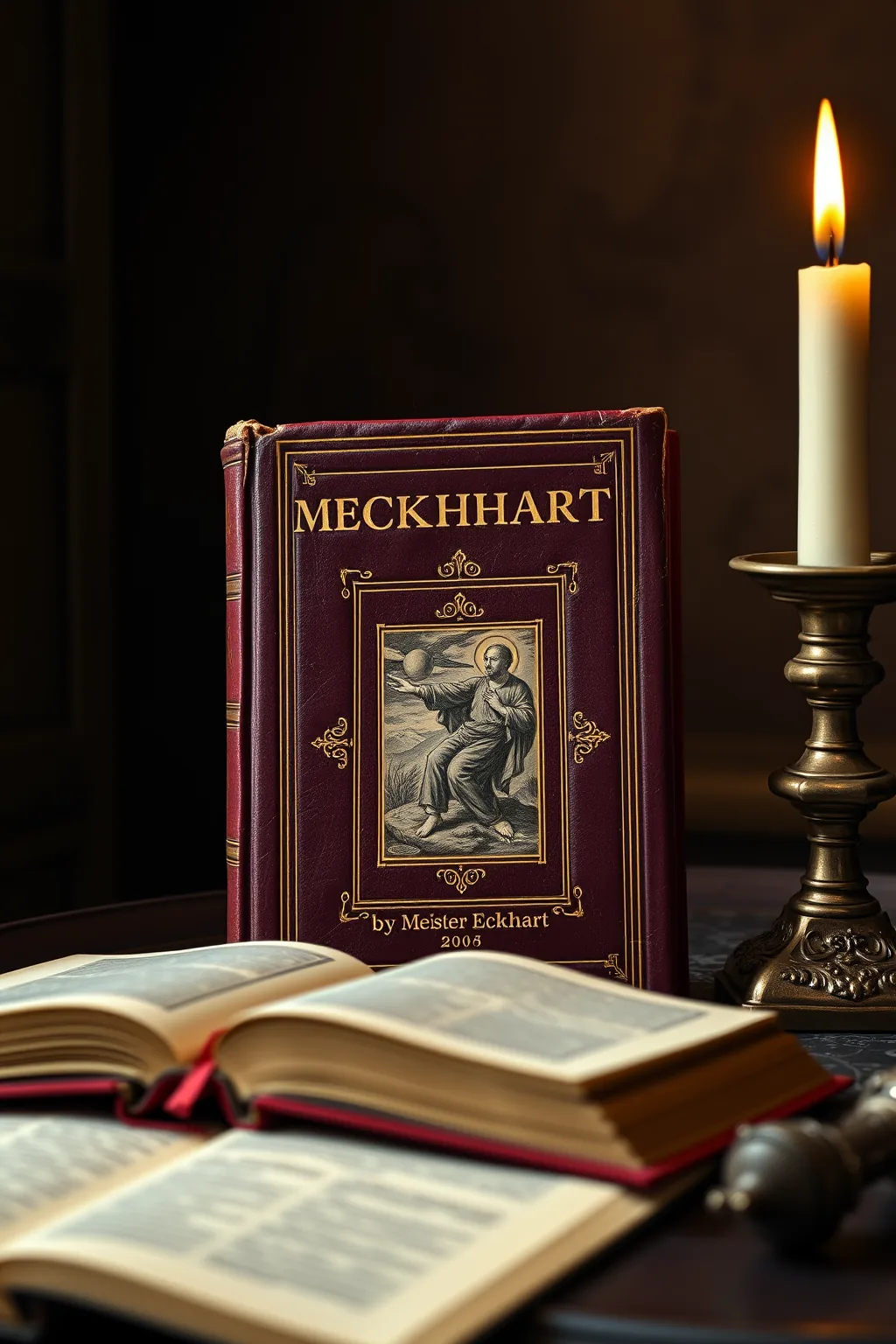
Meister Eckhart
 71
71

Meister Eckhart



Isolde Whitaker, Sacred Texts Editor: Meister Eckhart's collected works represent a monumental achievement in esoteric Christian thought. This volume masterfully presents his profound insights, particularly his revolutionary doctrines on the 'birth of God' in the soul and the absolute necessity of detachment. Eckhart's sermons, rendered in accessible English, cut through theological dogma to reveal the direct, unmediated experience of the Divine. Scholars and mystically inclined readers will find unparalleled depth in his exploration of obedience, emptiness, and the Godhead. This is essential reading for anyone seeking a radical understanding of spiritual liberation and the ultimate nature of reality.
📝 Description
71
Meister Eckhart, a 13th-century German theologian, wrote sermons and treatises that explored the divine.
This collection presents the writings of Meister Eckhart, a significant figure in late medieval mysticism. His works, originally composed in Latin and Middle High German, offer direct access to his spiritual teachings. The text includes his doctrines and translated sermons, aiming to convey his ideas on the soul's relationship with God.
Eckhart’s writings focus on concepts like the divine spark within individuals and the unity of God and humanity. He addresses spiritual transformation and the pursuit of detachment from worldly concerns. The collection invites readers to engage with challenging ideas about the nature of existence and the inner life.
Meister Eckhart's thought stands within the tradition of Christian mysticism, particularly the Rhineland mystics. His emphasis on direct experience of the divine and the inner life connects him to contemplative practices found in various spiritual traditions. While rooted in Christianity, his ideas on the dissolution of the self and union with the absolute resonate with broader esoteric themes of spiritual realization.
💡 Why Read This Book?
Uncover the radical core of Christian mysticism. Eckhart offers direct access to the Godhead, challenging conventional spiritual paths. Ideal for seekers of profound self-knowledge, theologians seeking historical esoteric perspectives, and practitioners aiming for deeper union with the Divine. Explore the liberating power of detachment and the divine spark within.
⭐ Reader Reviews
Honest opinions from readers who have explored this book.
❓ Frequently Asked Questions
What is Meister Eckhart's central message?
Eckhart's central message revolves around the 'birth of God' within the soul and the necessity of divine detachment to achieve this union. He emphasizes the direct experience of God beyond conceptual understanding.
Who was Meister Eckhart?
Meister Eckhart (c. 1260 – c. 1328) was a German theologian, mystic, and philosopher of the High Middle Ages. He is renowned for his profound spiritual teachings and his influential role in Christian mysticism.
What does Eckhart mean by 'detachment'?
Detachment, for Eckhart, signifies a profound inner freedom from all created things, desires, and even the self. It is a state of pure receptivity to the Divine, allowing God to work unimpeded.
How does Eckhart's work relate to other mystical traditions?
Eckhart's emphasis on inner experience, emptiness, and direct union with the Divine resonates with many Eastern mystical traditions, though firmly rooted in a Christian framework. His teachings offer a bridge between seemingly disparate spiritual paths.
Are Eckhart's sermons easy to understand?
While Eckhart's concepts are profound, the English translations in this collection aim for clarity. However, his teachings are rich and require contemplation. Beginners may find it beneficial to read alongside scholarly guides.
🔮 Key Themes & Symbolism
The Birth of God in the Soul
Eckhart posits that God is eternally being 'born' within the human soul. This is not a metaphorical event but a direct, experiential reality accessible through profound inner stillness and detachment. He teaches that by emptying ourselves of ego and worldly attachments, we create the perfect vessel for the Divine presence to manifest, clear the soul with God's own essence. This theme challenges traditional notions of divine transcendence, bringing God immanently into the core of our being.
Divine Detachment and Emptiness
At the heart of Eckhart's mysticism lies the concept of 'detachment' – a radical letting go of all things, including one's own will and desires, to become one with the Divine will. He speaks of the 'desert of the soul' and the necessity of embracing emptiness as the fertile ground for spiritual awakening. This state of pure receptivity, free from the clutter of the ego, allows for the unhindered flow of divine grace and truth, leading to true spiritual freedom.
Obedience as Ultimate Virtue
Eckhart elevates obedience to a virtue surpassing all others, not as servile compliance, but as a profound alignment with the Divine order. True obedience, in his view, stems from an inner knowing and surrender to the will of God, which is the ultimate reality. This perfect obedience is not about external rules but an internal resonance with the cosmic flow, a state where one's own will dissolves into the divine, leading to a powerful integration of self and spirit.
💬 Memorable Quotes
Direct passages from the work, attributed to the author.
“True and perfect obedience is a virtue above all virtues.”
— This highlights Eckhart's radical view that complete surrender to the Divine will is the highest spiritual attainment, transcending all other ethical or religious practices.
“The eye with which I see God is the same eye with which God sees me.”
— This profound statement points to the non-dualistic nature of reality, suggesting an ultimate unity between the human soul and the Divine, where perception is shared.
“We are all equally far from God and equally near to God.”
— Eckhart emphasizes that spiritual distance is an illusion created by the ego. In our essential being, we are always in the presence of the Divine, regardless of our perceived spiritual progress.
“If a person could only be empty, God would fill him.”
— This expresses the core teaching on detachment and receptivity. Emptiness is not a void but a sacred space that awaits the divine fullness.
“I pray God to rid me of God.”
— A provocative statement illustrating the desire to transcend even the concept and image of God, reaching for the unnamable, absolute Godhead beyond all form.
🌙 Esoteric Significance
Tradition
Eckhart's work is a seminal text within Christian Esotericism, specifically the contemplative and mystical branches of the faith. He represents a powerful articulation of the 'via negativa' (apophatic theology) and the pursuit of direct, unitive experience with the Divine. His teachings echo Gnostic themes of inner knowledge and the spark of the divine within, while his emphasis on detachment and emptiness finds parallels in Eastern contemplative practices.
Symbolism
Key symbols in Eckhart's teachings include the 'birth of God' (representing divine manifestation within the soul), the 'desert' or 'emptiness' (symbolizing the unadorned state of the soul ready for God), the 'light' (representing divine illumination and truth), and the 'eye' (symbolizing the faculty of spiritual perception). These symbols are not mere allegories but pointers to profound inner states and the nature of ultimate reality.
Modern Relevance
In an age often marked by materialism and spiritual seeking, Eckhart's emphasis on inner transformation, detachment from external validation, and the recognition of the divine spark within offers a potent antidote. His challenging yet liberating message continues to resonate with those seeking authentic spiritual depth, psychological integration, and a profound understanding of consciousness beyond superficial doctrines. His work provides a timeless blueprint for awakening to one's true, divine nature.
👥 Who Should Read This Book
This collection is essential for spiritual seekers yearning for a deeper, more direct connection with the Divine, moving beyond dogma. Scholars of medieval philosophy, theology, and mysticism will find Eckhart's original insights useful for understanding the intellectual and spiritual currents of his era. Practitioners of contemplative prayer and meditation will discover profound guidance on achieving inner stillness and union. Beginners may find the concepts challenging but immensely rewarding with dedicated study, offering a radical new perspective on spirituality.
📜 Historical Context
Meister Eckhart lived and wrote during a period of immense intellectual and spiritual ferment in 13th and 14th century Europe. The High Middle Ages saw the flourishing of Scholasticism, but also a growing counter-movement emphasizing direct mystical experience over purely rational theology. Eckhart, a Dominican friar, was deeply influenced by Aristotelian philosophy and Neoplatonism, yet his teachings transcended academic dogma, offering a radical, immanent theology. His bold pronouncements, often pushing the boundaries of orthodox expression, led to controversy and posthumous scrutiny by the Church. His work represents a peak of medieval German mysticism, influencing subsequent generations of spiritual thinkers and mystics across various traditions.
📔 Journal Prompts
Reflect on a time you experienced profound 'emptiness' or stillness. What did this state reveal to you?
How does the concept of 'divine detachment' challenge your current attachments and desires?
In what ways can you practice 'perfect obedience' in your daily life, aligning with a higher purpose?
Consider the quote, 'The eye with which I see God is the same eye with which God sees me.' What implications does this have for your self-perception and your perception of others?
What does it mean for you to experience the 'birth of God' within your own soul?
🗂️ Glossary
Godhead
In Eckhart's context, the Godhead (Gottheit) refers to the absolute, unmanifest, and unknowable essence of God, beyond all attributes and distinctions, often contrasted with the personal God (Gott).
Detachment
A state of profound inner freedom from all worldly desires, attachments, and even the ego's will, allowing for complete receptivity to the Divine will and presence.
Birth of God
The concept that God is eternally and continuously being born within the human soul, a process of divine manifestation accessible through spiritual practice and inner stillness.
Via Negativa
Also known as apophatic theology, this spiritual approach emphasizes understanding God by what God is *not*, focusing on negation and silence to approach the ineffable divine essence.
Ego
The self or individual consciousness, often seen by Eckhart as the primary obstacle to spiritual union, which must be relinquished or transcended.
This book appears in 3 collections
🔮 Readers Also Liked
Browse all →







From the “Tarot” Collection
View all →









More Free Divination & Tarot Books
View all →