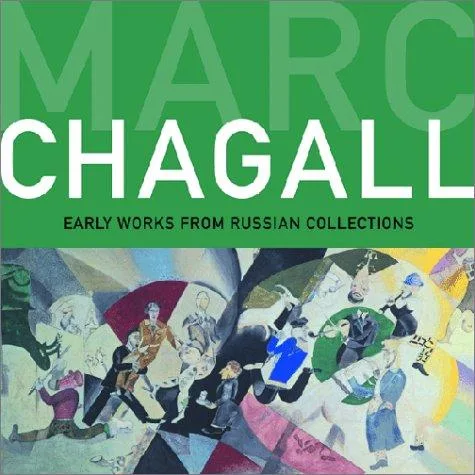
Marc Chagall
 75
75

Marc Chagall
The enduring power of Marc Chagall's art is undeniable, and this text offers a solid, if somewhat academic, examination of his trajectory. Petrova and Shatskikh provide a comprehensive overview, particularly commendable in their detailed analysis of Chagall's early engagement with the Russian avant-garde in St. Petersburg. A notable strength lies in the thorough cataloging of recurring motifs—the violinist, the floating lovers, the rooster—and their evolution across decades. However, the book's early publication date (1948) means it predates much of Chagall's later significant work, particularly his stained glass commissions in France, which are only touched upon in later editions. The prose, while informative, occasionally lacks the vibrant immediacy of the artist himself. The analysis of his Vitebsk period is particularly insightful, grounding the fantastical elements in concrete personal memory. Ultimately, this book serves as a valuable historical document and an essential primer for understanding Chagall's foundational artistic vocabulary.
📝 Description
75
Published in 1948, Marc Chagall's volume examines the artist's unique visual language.
This 1948 book, with contributions from Evgenija Petrova and Aleksandra Shatskikh, looks at Marc Chagall's art. It traces his development from his early Russian avant-garde work to his later involvement with art in Paris and internationally. The book is aimed at art historians, critics, and anyone wanting a deeper understanding of Chagall's work.
It is particularly relevant for those interested in how art connects with spirituality and cultural identity, and the symbolic aspects of 20th-century modernism. Readers familiar with Cubism or Surrealism will notice connections to Chagall's distinct style. The text highlights his specific use of color, form, and subject matter. Key subjects include Jewish folklore, his Vitebsk childhood mythology, and his interpretations of biblical stories, all filtered through a modernist viewpoint.
While not strictly esoteric in the occult sense, this book engages with the symbolic and spiritual dimensions that often intersect with esoteric traditions. Chagall's work frequently draws on Jewish mysticism, folklore, and personal mythology, imbuing his art with a dreamlike, lyrical quality. His reinterpretation of biblical narratives and personal iconography, viewed through a modernist lens, touches on themes of transcendence and the sacred that resonate with broader esoteric interests in the connection between the inner life and outward artistic expression.
💡 Why Read This Book?
• Gain insight into Chagall's early influences by examining his formative years in Vitebsk, understanding how his childhood environment shaped his symbolic language. • Comprehend the symbolic weight of recurring figures like the 'flying bride' and the 'robed prophet,' which are central to Chagall's personal mythology and spiritual explorations. • Appreciate Chagall's unique position within 20th-century art by understanding his divergence from movements like Cubism and Surrealism, as detailed in the text's analysis of his stylistic development.
⭐ Reader Reviews
Honest opinions from readers who have explored this book.
❓ Frequently Asked Questions
When was Marc Chagall's book originally published?
The original edition of Marc Chagall's work, featuring contributions from Evgenija Petrova and Aleksandra Shatskikh, was first published in 1948.
What are some key recurring symbols in Marc Chagall's art discussed in this book?
The book frequently highlights symbols such as the violinist, lovers in flight, the rooster, and biblical figures, all integral to Chagall's personal iconography and spiritual narratives.
How does this book contextualize Chagall's art historically?
It places Chagall's work within the context of early 20th-century modernism, tracing his development from Russian avant-garde roots through his engagement with international art scenes after World War II.
Does the book cover Marc Chagall's stained glass work?
While the original 1948 publication primarily focuses on his earlier career, later analyses and editions often include discussions of his significant stained glass commissions, such as those for the Metz Cathedral.
What is the significance of Vitebsk in Marc Chagall's art?
Vitebsk, Chagall's birthplace, is presented as a wellspring of his artistic inspiration, providing many of the folkloric and personal motifs that populate his canvases throughout his career.
Who are the main authors contributing to this study of Marc Chagall?
The primary contributors to this volume are Evgenija Petrova and Aleksandra Shatskikh, alongside extensive material from Marc Chagall himself.
🔮 Key Themes & Symbolism
Jewish Folklore and Identity
This volume meticulously explores how Marc Chagall integrated the wide range of Jewish folklore and his personal identity into his visual lexicon. From the ubiquitous violinist symbolizing the soul's melody to the specific Yiddish cultural references embedded in his canvases, the book details how these elements moved beyond mere representation. They became conduits for spiritual expression, exploring themes of exile, memory, and the sacred within the everyday, particularly drawing from his Vitebsk heritage.
Biblical Narratives Reimagined
The work analyzes Chagall's profound and often unconventional reinterpretations of biblical stories. Rather than adhering to strict iconographic traditions, Chagall infuses these narratives with his characteristic lyrical style and personal symbolism. The text examines how figures like Moses or the prophets are rendered with an emotional intensity and dreamlike quality, suggesting a deeply personal spiritual dialogue with ancient texts, often emphasizing themes of transcendence and divine presence.
The Language of Flight and Love
Central to Chagall's oeuvre, as detailed here, is the motif of lovers suspended in air, a powerful symbol of transcendent love and spiritual union. The book explores how this recurring image transcends the physical, representing an ecstatic connection that defies earthly limitations. This theme is intrinsically linked to Chagall's optimistic outlook and his belief in the spiritual dimension of human relationships, often set against fantastical, dreamlike backdrops.
Vitebsk as a Mythic Landscape
The book underscores the profound influence of Vitebsk, Chagall's childhood town, on his artistic output. It is presented not merely as a place but as a mythic landscape teeming with memory, tradition, and spiritual resonance. Elements from Vitebsk—its architecture, its inhabitants, its cultural life—are transformed into archetypal symbols, forming the bedrock of Chagall's unique visual language and his exploration of rootedness and displacement.
💬 Memorable Quotes
Direct passages from the work, attributed to the author.
“My paintings are not dreams, they are my life.”
— This statement, attributed to Chagall, emphasizes the deeply personal and lived reality that fuels his art. It suggests that the seemingly fantastical elements are rooted in his actual experiences, memories, and emotional landscape, rather than being purely products of imagination.
“The artist is a prophet.”
— This concept highlights Chagall's view of the artist's role as one who perceives and reveals deeper truths, much like a prophet. It underscores the spiritual dimension of art-making and the artist's responsibility to interpret the world and its hidden meanings.
“Color is the character of the painting.”
— This interpretation emphasizes Chagall's sophisticated use of color not just for aesthetic appeal, but as a primary vehicle for conveying emotion, narrative, and symbolic meaning within his works.
“When I paint, I am transported.”
— This reflects the deeply immersive and almost mystical state Chagall experienced while creating. It speaks to the transcendent power of the artistic process itself, where the artist transcends the mundane and enters a field of pure creative energy.
💡 Key Ideas
Editorial paraphrase of the work's core concepts — not direct quotes.
The violin sings the soul.
This paraphrased concept captures the symbolic resonance of the violin in Chagall's work, often seen as an instrument that expresses the deepest emotions and spiritual yearnings of the human spirit.
🌙 Esoteric Significance
Tradition
Chagall's work, as explored in this volume, aligns with a broad stream of Western esotericism that emphasizes personal mythology, spiritual symbolism, and the integration of folkloric traditions. While not strictly adhering to a single lineage like Hermeticism or Kabbalah, his art draws from a deep well of spiritual and mystical thought present in Jewish mysticism (Chasidism) and broader European symbolic traditions. The emphasis on inner vision and the translation of the unseen into tangible forms places his work in dialogue with Gnostic principles of revealing hidden realities.
Symbolism
Key symbols examined include the ubiquitous floating lovers, representing spiritual union and transcendent love, often depicted against celestial or dreamlike backdrops. The violinist, frequently seen perched atop buildings or in mid-air, symbolizes the music of the spheres, the voice of the soul, and the enduring spirit of Jewish tradition. The rooster, another recurring motif, often signifies resurrection, vitality, and a connection to the primal forces of life, echoing ancient fertility symbols.
Modern Relevance
Contemporary art practices that explore identity, spirituality, and the fusion of diverse cultural symbols find resonance in Chagall's approach. Thinkers and artists interested in post-colonial narratives, the psychogeography of place (particularly concerning Vitebsk), and the use of personal iconography to explore universal human experiences often reference Chagall. His stained glass, in particular, continues to inspire architects and artists seeking to imbue sacred and public spaces with light, color, and symbolic meaning.
👥 Who Should Read This Book
• Students of comparative mythology and folklore seeking to understand how ancient narratives are reinterpreted in modern art. • Art historians and critics specializing in 20th-century European modernism, particularly those examining artists who defied categorization. • Individuals interested in the spiritual dimensions of art, exploring how personal symbolism and cultural heritage can convey profound metaphysical themes.
📜 Historical Context
The initial publication of this study on Marc Chagall in 1948 occurred in a world reshaped by global conflict and artistic upheaval. Chagall himself had recently relocated to the United States, seeking refuge from the escalating tensions in Europe, before returning to France. This period saw the rise of Abstract Expressionism in America, a stark contrast to Chagall’s figurative and symbolic style. The book emerged as a significant document during a time when artists were reassessing tradition and forging new paths. Its exploration of Chagall’s unique visual language, deeply rooted in Jewish culture and personal mythology, offered an alternative to the more abstract or politically charged art of the era. Contemporary figures like André Breton and the Surrealists had already recognized Chagall's unique vision, but this text provided a more comprehensive critical analysis of his development from his early years in Vitebsk through his international recognition.
📔 Journal Prompts
The symbolic role of the violinist in Chagall's oeuvre.
Reflect on the transformation of Vitebsk from a place to a mythic landscape.
Analyze the expression of transcendent love through the motif of flying figures.
Consider the artist's statement 'My paintings are not dreams, they are my life.'
Explore the connection between Jewish folklore and Chagall's visual language.
🗂️ Glossary
Vitebsk
The Belarusian city where Marc Chagall was born and spent his formative years. It serves as a recurring source of inspiration and symbolic imagery in his artwork, representing his roots and personal mythology.
Russian Avant-Garde
A broad, highly influential cultural movement in Russia from approximately 1890 to 1930, encompassing various artistic styles including Cubism, Futurism, and Suprematism, which significantly impacted Chagall's early development.
Iconography
The visual images and symbols used in a work of art, as well as their interpretation. In Chagall's work, iconography often blends traditional religious symbols with personal motifs.
Motif
A recurring element, subject, or idea in a work of art. Common motifs in Chagall's art include the violinist, lovers, animals, and biblical figures.
Chasidism
A movement within Orthodox Judaism founded in the 18th century, emphasizing spiritual joy, mysticism, and the immanence of God in everyday life, which influenced Chagall's spiritual outlook.
Lyrical Style
An artistic approach characterized by fluidity, emotional expression, and a poetic quality, often evoking a sense of music or song, as seen in Chagall's use of color and form.
Personal Mythology
A symbolic system derived from an individual's unique experiences, memories, dreams, and beliefs, which forms a recurring thematic and visual language within their creative output.
🔮 Readers Also Liked
Browse all →









More by Marc Chagall, Evgenija Petrova, Aleksandra Shatskikh
All books →
More Free Occult Philosophy Books
View all →