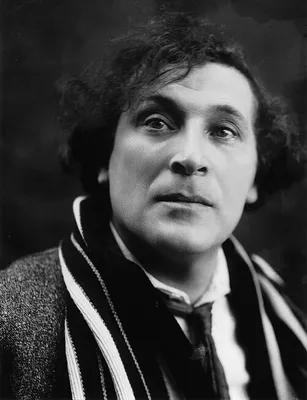
Marc Chagall, Evgenija Petrova, Aleksandra Shatskikh
Marc Chagall was a pioneering Jewish artist of the 20th century, known for his unique modernist style blending folklore, religious themes, and vibrant color.
Marc Chagall, born Moishe Shagal in 1887 near Vitebsk (now Belarus), was a Russian-French artist of Jewish heritage who became a significant figure in early modernism. His artistic journey began with a strong connection to Eastern European and Jewish folklore, which he uniquely integrated into his diverse body of work. This included painting, illustration, stained glass, and stage design.
Chagall's early life was marked by his Jewish upbringing within the Pale of Settlement and the restrictions faced by Jewish children in the Russian Empire. Despite these challenges, he pursued art education, initially at a Jewish religious school and later with a local artist, Yehuda Pen. His artistic development was deeply influenced by his Hasidic Jewish roots, which he chose to embrace and express publicly through his art, a path that set him apart. He experienced periods of artistic activity in Saint Petersburg, Paris, and Berlin, developing a distinctive style that drew upon Cubism, Symbolism, and Fauvism, while consistently retaining his profound connection to his Jewish identity and childhood memories of Vitebsk.
Early Life and Artistic Awakening
Born Moishe Shagal in 1887 in Lyozna, near Vitebsk, Marc Chagall hailed from a Jewish family in a region then part of the Russian Empire. His childhood was steeped in the traditions of Hasidic Judaism, a culture he later recognized as a vital source for his art. Growing up in a predominantly Jewish community, Chagall experienced firsthand the societal restrictions and occasional hostility directed towards Jews. His father worked laboriously to provide for the family, a sacrifice Chagall poignantly recalled. Despite initial limitations on Jewish education, Chagall's mother secured his admission to a regular high school. A pivotal moment occurred when he witnessed a fellow student drawing, sparking an intense desire to become an artist, a path he pursued by enrolling in the studio of realist painter Yehuda Pen.
Embracing Jewish Identity in Art
In the context of Imperial Russia, where Jewish artists often felt compelled to conceal their heritage, Chagall chose a different path: to openly celebrate and integrate his Jewish roots into his artistic expression. This decision was not only an act of self-assertion but also a principled stance. Biographers note that the spirit of Hasidism remained a foundational element throughout his career. Even as he became a globally recognized artist, his work consistently drew from the imagery of his childhood in Vitebsk, imbuing scenes of snowy streets, wooden houses, and fiddlers with intense emotional resonance through recurring symbols and ideograms. This deep connection to his origins ensured his art remained uniquely personal and spiritually grounded.
A Modernist Synthesist
Chagall's artistic career saw him navigate various European art centers, including Saint Petersburg, Paris, and Berlin, before and after World War I. He developed a highly personal style, often described as a synthesis of major modernist movements such as Cubism, Symbolism, and Fauvism, with influences that also touched upon Surrealism. Despite his engagement with these avant-garde styles, his work was consistently anchored in his Jewish identity and the dreamlike memories of his native Vitebsk. Art critics have recognized him as a key figure of early modernism and a quintessential Jewish artist of the 20th century, with Pablo Picasso famously remarking on Chagall's profound understanding of color.
Key Ideas
- Integration of Jewish folklore and Hasidic spirituality into modernist art
- Art as a means of self-assertion and expression of Jewish identity
- Synthesis of diverse artistic styles (Cubism, Symbolism, Fauvism) with personal imagery
- The enduring influence of childhood memories and native landscape on artistic vision
Notable Quotes
“I felt at every step that I was a Jew—people made me feel it”
“The street lamps are out. I feel panicky, especially in front of butchers' windows. There you can see calves that are still alive lying beside the butchers' hatchets and knives”
“My pockets are empty, my fingers sensitive, my legs weak and they are out for blood. My death would be futile. I so wanted to live”
“All right! Get along!”
“I want to be a painter”
Books by Marc Chagall, Evgenija Petrova, Aleksandra Shatskikh
2 free public domain books · Read online or download