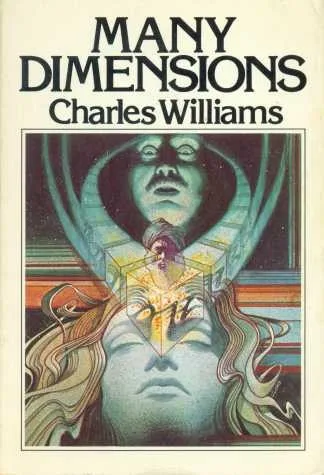
Many Dimensions

 73
73

Many Dimensions
Charles Williams’s "Many Dimensions" is a dense, often startling exploration of how the divine can irrupt into ordinary life. The introduction of the Stone of Suleiman, an artifact capable of bending space and time, serves as a potent catalyst for examining human resistance to grace and the terrifying freedom that true spiritual engagement offers. Williams excels at rendering theological concepts as tangible forces, making the abstract almost visceral. A particular strength lies in his depiction of characters grappling with the Stone’s influence – their spiritual pride, fear, and eventual, often reluctant, acceptance. However, the novel’s allegorical nature can sometimes overshadow character development, leaving some figures feeling more like personified doctrines than fully realized individuals. The passage describing Lord Weathers's encounter with the Stone’s power, wherein his worldly concerns are rendered utterly meaningless, is a stark and memorable illustration of the book’s central concerns. "Many Dimensions" offers a unique, challenging vision of spiritual reality's intrusion into the material.
📝 Description
73
Charles Williams published Many Dimensions in 1931, a novel centered on an ancient artifact.
Charles Williams's 1931 novel, Many Dimensions, uses a supernatural artifact, the Stone of Suleiman, to examine theological and metaphysical questions. The story unfolds on an English country estate where the stone's introduction disrupts the ordinary lives of its residents. This object has the power to break through physical boundaries and change how people perceive reality. Rather than follow a conventional plot, the book functions as a deep consideration of divine grace, individual choice, and the fundamental nature of existence.
Readers interested in theological fiction and philosophical allegories will find this work engaging. It shares common ground with authors like C.S. Lewis and G.K. Chesterton, who also used narrative to explore Christian doctrine and human psychology. The novel is for those curious about how supernatural elements can reveal spiritual truths and question our standard views of the universe. Those looking for typical genre fiction might find its allegorical depth and focus on abstract ideas more challenging.
Published in 1931, Many Dimensions appeared during a period of heightened interest in spiritualism and occultism, influenced by movements like Theosophy and figures such as Aleister Crowley. Williams, associated with the Oxford Group, wrote alongside Inklings members like Tolkien and Lewis, but his fictional approach to Christian apologetics was unique. The era's fascination with non-material realities and unseen forces shaped the book's engagement with themes that contrasted with the growing scientific rationalism.
💡 Why Read This Book?
• Gain insight into Charles Williams's unique theological fiction, distinct from his Inkling peers like C.S. Lewis, by examining his 1931 novel "Many Dimensions" and its specific exploration of supernatural artifacts. • Understand the concept of "interpenetration of worlds" as presented in the book, learning how spiritual forces can alter perceived reality and human consciousness. • Explore the narrative device of the "Stone of Suleiman," a fictional object that serves as a tangible representation of divine power and its disruptive effect on mundane existence.
⭐ Reader Reviews
Honest opinions from readers who have explored this book.
❓ Frequently Asked Questions
When was Charles Williams's "Many Dimensions" first published?
Charles Williams's "Many Dimensions" was first published in 1931, placing it within a period of significant interest in esoteric and theological literature.
What is the primary supernatural artifact in "Many Dimensions"?
The primary supernatural artifact in "Many Dimensions" is the "Stone of Suleiman," an object with the power to transcend physical laws and alter human perception of reality.
Who were some of Charles Williams's contemporaries?
Charles Williams was a contemporary of J.R.R. Tolkien and C.S. Lewis, with whom he shared intellectual circles, though his theological fiction had a distinct style and focus.
What philosophical concept does "Many Dimensions" explore through its narrative?
The novel explores concepts such as the nature of grace, free will, and the "interpenetration of worlds," illustrating how spiritual forces can interact with the material realm.
Is "Many Dimensions" an allegory?
Yes, "Many Dimensions" functions as a theological allegory, using supernatural events and characters to explore complex spiritual and metaphysical ideas rather than focusing solely on plot.
What is the significance of the Stone of Suleiman?
The "Stone of Suleiman" in "Many Dimensions" represents divine power and its capacity to disrupt ordinary existence, forcing characters to confront spiritual truths and their own limitations.
🔮 Key Themes & Symbolism
The Irruption of the Supernatural
The novel hinges on the introduction of the "Stone of Suleiman," a relic that does not merely grant wishes but fundamentally alters the fabric of reality around it. This event forces characters to confront dimensions of existence beyond their everyday experience. It serves as a narrative device to explore how divine or supernatural power can disrupt mundane assumptions, revealing the limitations of purely materialist perspectives. The Stone's presence compels individuals to reconsider their place in the cosmos and the nature of their own wills when faced with forces that transcend human control.
The Nature of Authority and Will
"Many Dimensions" scrutinizes different forms of authority, from earthly power to divine command. Characters are forced to reconcile their personal wills with a higher, often incomprehensible, power represented by the Stone. The work questions the efficacy of coercive or self-serving ambition when confronted with true spiritual force. It suggests that genuine authority lies not in domination but in alignment with a greater cosmic order, and that true freedom comes from surrendering personal will to a divine purpose, a concept explored through the characters' varied reactions to the Stone's influence.
The Interpenetration of Realms
A central theme is the idea that spiritual and material realities are not separate but can merge and influence one another. The "Stone of Suleiman" acts as a conduit, allowing aspects of the divine or otherworldly to manifest in the English countryside. This "interpenetration of worlds" challenges the characters' rationalist viewpoints and forces them to accept a more complex, multi-layered universe. The novel posits that spiritual truths can become manifest, transforming the ordinary and revealing the potential for a richer, albeit more challenging, existence when one acknowledges these interconnected dimensions.
The Dialogue of the Soul with God
Williams portrays spiritual growth not as a passive reception of doctrine but as an active, often difficult, "dialogue of the soul with God." This dialogue is facilitated by the disruptive presence of the Stone, which strips away superficial concerns and compels introspection. Characters must engage with their inner lives and their relationship to the divine, often through trials and profound moments of realization. The novel suggests that this engagement, however arduous, is the path to true understanding and spiritual transformation, moving beyond mere intellectual assent to a lived experience of faith.
💬 Memorable Quotes
Direct passages from the work, attributed to the author.
“Evil is the negation of good, but it has no independent existence.”
— This concept highlights a common theological perspective. It suggests that evil is not a creative force in itself but rather a lack or absence of divine goodness, implying that confronting evil involves reinforcing and expanding the presence of good.
“The universe is a conversation between God and His creation.”
— This interpretation frames existence as a continuous, dynamic exchange between the divine and the created. It suggests that reality itself is infused with divine communication, inviting conscious participation from beings within it.
💡 Key Ideas
Editorial paraphrase of the work's core concepts — not direct quotes.
The Stone is a great deal more than a mere relic; it is a key, a door, a window, and a gate.
This paraphrase captures the Stone of Suleiman's many-sided role. It is not just an object but a transformative agent, symbolizing access to deeper realities and spiritual understanding, thus unlocking new perspectives and pathways of consciousness.
To be in the world but not of it is the great challenge.
This paraphrase emphasizes the difficulty of maintaining spiritual integrity within material existence. It points to the struggle of living according to divine principles while working through the temptations and distractions of worldly life.
True power is found in surrender, not control.
This paraphrase articulates a core spiritual paradox presented in the book. It suggests that the greatest strength and efficacy come not from asserting personal dominance but from yielding to a higher will or cosmic order.
🌙 Esoteric Significance
Tradition
Williams's work draws implicitly from Christian mysticism and Neoplatonic thought, traditions that emphasize the interconnectedness of the spiritual and material realms and the possibility of divine revelation. While not strictly aligned with Theosophy or Hermeticism, it shares their interest in hidden realities and the transformative potential of sacred objects or divine encounters. "Many Dimensions" functions as a unique articulation within modern Christian esoteric thought, using imaginative fiction to explore theological concepts often confined to academic or devotional contexts.
Symbolism
The "Stone of Suleiman" is a primary symbol, representing divine power, ultimate truth, and the disruptive force of the sacred that can break through material limitations. It acts as a conduit for the "interpenetration of worlds." Other symbolic motifs include the country estate, representing the mundane world suddenly confronted by the extraordinary, and the characters themselves, who embody different human responses to spiritual reality – pride, fear, curiosity, and ultimately, a potential for grace.
Modern Relevance
Contemporary writers and thinkers exploring the intersection of faith and speculative fiction, or those interested in theological allegory, often find Williams's work prescient. His exploration of how supernatural elements can illuminate spiritual truths appeals to modern urban fantasy and literary fiction that engages with metaphysical themes. The concept of "interpenetration of worlds" finds echoes in various spiritual movements that seek to integrate transcendent experiences into daily life, making Williams's 1931 novel a continued reference point for those exploring the boundaries of reality and belief.
👥 Who Should Read This Book
• Readers interested in theological fiction and allegorical narratives, particularly those who appreciate the works of C.S. Lewis or G.K. Chesterton, will find "Many Dimensions" a compelling exploration of Christian themes. • Students of esoteric Christianity and modern mystical literature can gain insight into Williams's unique approach to integrating spiritual concepts into imaginative storytelling. • Those curious about how supernatural elements can be used to examine philosophical questions about free will, divine authority, and the nature of reality will find the novel a rich source of contemplation.
📜 Historical Context
First published in 1931, "Many Dimensions" arrived during a vibrant, yet often fragmented, literary and intellectual landscape. The influence of Theosophy, with its syncretic approach to world religions and esoteric knowledge, remained strong, while figures like Aleister Crowley continued to push the boundaries of occultism. Williams, though sometimes associated with the Inklings (J.R.R. Tolkien, C.S. Lewis), forged a distinct path in theological fiction. His work engaged with Christian doctrine through allegorical narratives, offering a counterpoint to the growing secularism and the stark rationalism prevalent in some intellectual circles. While writers like Aldous Huxley explored similar themes of altered states and spiritual seeking in "The Doors of Perception" (though published later in 1954, Huxley's interest was evident earlier), Williams's focus was more explicitly on divine intervention and the mechanics of grace within a traditional Christian framework, albeit one expressed through fantastical means.
📔 Journal Prompts
The Stone of Suleiman's capacity to alter reality, prompting reflection on personal beliefs about the supernatural.
Lord Weathers's initial dismissal of the Stone's power, considering how one might react to undeniable evidence of the transcendent.
The concept of the 'interpenetration of worlds' and its implications for perceiving everyday surroundings.
Characters' struggles with the 'dialogue of the soul with God,' examining personal experiences of spiritual questioning or seeking.
The idea of true power residing in surrender, contemplating instances where letting go leads to greater strength.
🗂️ Glossary
Stone of Suleiman
A fictional artifact in "Many Dimensions" possessing supernatural powers, capable of bending space, time, and altering human perception, serving as a catalyst for spiritual revelation.
Interpenetration of Worlds
A concept suggesting that the spiritual and material realms are not entirely separate but can merge and influence each other, allowing transcendent realities to manifest in the physical world.
Dialogue of the Soul with God
Williams's term for the active, often challenging, process of spiritual growth and understanding that occurs through personal engagement with the divine.
Allegory
A literary work where characters, events, and settings represent abstract ideas or moral qualities, used extensively in "Many Dimensions" to explore theological concepts.
Grace
In the context of the novel, divine assistance or blessing that enables human beings to overcome sin and achieve spiritual transformation, often depicted as disruptive yet ultimately beneficial.
Free Will
The capacity of individuals to make choices independently of external or predetermined forces, a key theme explored as characters grapple with the Stone's influence and divine will.
Transubstantiation (Metaphorical)
While a theological term for the Eucharist, Williams uses the idea metaphorically to describe how spiritual forces can fundamentally change the nature of objects or persons.
🔮 Readers Also Liked
Browse all →









More by Charles Williams
All books →




More Free Spiritual Development Books
View all →