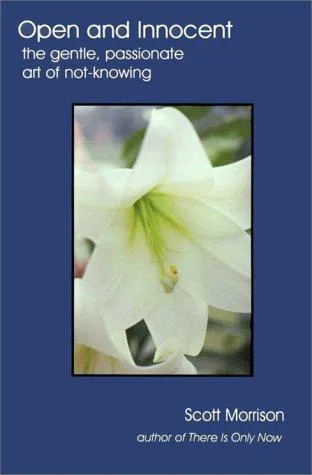
Open and innocent
 74
74

Open and innocent
Scott Morrison's "Open and Innocent" presents a challenging yet rewarding examination of consciousness. The strength of the work lies in its unflinching commitment to describing subjective experience with a rare clarity, particularly its dissection of how thought structures our reality. Morrison's ability to articulate the nature of an "unconditioned awareness" is commendable, pushing the reader beyond familiar mental habits. However, the book's abstract nature can be a double-edged sword; at times, the prose becomes so rarefied that it risks becoming inaccessible to those not already deeply immersed in contemplative philosophy. A passage detailing the subtle but pervasive influence of memory on present perception, for instance, is particularly insightful but requires significant reader effort to fully unpack. Ultimately, "Open and Innocent" is a text for the dedicated explorer of the inner world, demanding patience but offering a unique perspective on the nature of being.
📝 Description
74
Scott Morrison's "Open and Innocent" was published in 2000, examining consciousness beyond conventional psychology.
First published in 2000, Scott Morrison's "Open and Innocent" looks into less explored areas of consciousness and perception. It steps away from standard psychological ideas to consider subjective experience from a particular viewpoint. The book does not give direct instructions but offers observations and questions about awareness itself. It works as a text for contemplation, encouraging readers to think about their own inner states. This book is for people who want to understand subjective reality and how perception works more deeply. It will appeal to those already interested in philosophical thinking, meditation, or different views on consciousness. Readers who prefer thoughtful, internal examination over clear guidance will find it useful. It suits those willing to engage with complex ideas that are not immediately resolved.
Published at the turn of the millennium, "Open and Innocent" emerged during a time when interest in consciousness studies and the merging of Eastern philosophy with Western thought was growing. While not strictly part of the New Age movement, it shared the period's focus on inner experience. Its release predated the widespread online communities for these subjects, making it a more individual, text-based encounter with ideas like non-duality and the observer effect. It distinguishes itself from more rigid spiritual writings of the era by concentrating on phenomenological description.
💡 Why Read This Book?
• Understand the concept of "unconditioned awareness" as presented by Morrison, gaining insight into pure perception before conceptual overlay, a perspective distinct from standard mindfulness techniques. • Grasp the idea of the "innocent mind," learning how to recognize and potentially deconstruct the habitual judgments that color your perception of everyday events. • Explore the philosophical underpinnings of subjective reality as discussed in the book, offering a unique counterpoint to empirical models of consciousness prevalent since the early 2000s.
⭐ Reader Reviews
Honest opinions from readers who have explored this book.
❓ Frequently Asked Questions
What is the core philosophy behind "Open and Innocent"?
The core philosophy centers on the nature of consciousness and perception, exploring the idea of an "unconditioned awareness" that exists prior to mental constructs and ego identification, as detailed in the work's early chapters.
When was "Open and Innocent" by Scott Morrison first published?
"Open and Innocent" was first published in the year 2000, a period marked by growing interest in consciousness studies and introspective philosophies.
Does the book offer practical exercises for achieving a different state of mind?
While not a manual of prescriptive exercises, the book encourages a shift in perspective through its detailed exploration of mental processes, inviting readers to observe their own awareness, particularly in sections discussing the "innocent mind."
Who might find "Open and Innocent" challenging?
Readers accustomed to direct, action-oriented self-help or those new to abstract philosophical concepts may find the book's introspective and descriptive style challenging.
What esoteric traditions, if any, does "Open and Innocent" draw upon?
The book engages with concepts that echo traditions like Advaita Vedanta and certain schools of Mahayana Buddhism, focusing on non-duality and the nature of pure consciousness, without explicitly adhering to a single lineage.
Is "Open and Innocent" considered a part of the New Age movement?
While published during the New Age era and sharing an interest in consciousness, "Open and Innocent" distinguishes itself through its more rigorous philosophical inquiry and avoidance of overt New Age dogma or prescriptive practices.
🔮 Key Themes & Symbolism
Unconditioned Awareness
This theme explores the fundamental nature of consciousness as it exists without the filter of personal history, beliefs, or conceptual frameworks. Morrison posits this as a state of pure reception, a direct apprehension of reality. The text investigates how the mind's habitual reactions and interpretations obscure this natural state. It suggests that recognizing the conditioning is the first step toward experiencing awareness in its original, unadulterated form, a concept echoed in various contemplative traditions seeking direct insight into being.
The Innocent Mind
The concept of the "innocent mind" refers to a mode of perception characterized by directness and freedom from the accumulated biases of experience. It is the mind that encounters phenomena freshly, without the overlay of judgment or expectation. Morrison examines how this innocence is lost and how it might be regained, not through a return to ignorance, but through a sophisticated awareness of the mechanisms of thought. This theme encourages a re-evaluation of how we process information and relate to the world, emphasizing presence over presumption.
Observer and Observed
A central inquiry in "Open and Innocent" is the perceived separation between the subject who perceives and the object being perceived. The work challenges this duality, suggesting that in states of unconditioned awareness, this division dissolves. Morrison analyzes how language and cognitive habits reinforce this separation, leading to a sense of alienation from reality. The exploration invites readers to investigate the nature of this perceived boundary and its implications for understanding reality, drawing parallels to philosophical discussions on non-duality.
The Nature of Perception
This theme studies the mechanics of how we construct our reality through sensory input and mental processing. Morrison scrutinizes the subjective nature of perception, arguing that what we experience is not a direct mirroring of external reality but an interpretation shaped by our internal landscape. The book dissects the role of memory, emotion, and cognitive biases in this process. It prompts a critical examination of our own perceptual filters and their impact on our understanding of ourselves and the world around us.
💬 Memorable Quotes
Direct passages from the work, attributed to the author.
“Awareness is not something that is acquired; it is that in which all experience arises.”
— This statement highlights the intrinsic nature of consciousness, suggesting it's not a product of effort or learning but the very ground of all phenomenal experience. It implies that our true nature is already present, waiting to be recognized rather than cultivated.
“The mind’s tendency is to name and categorize, thereby obscuring the direct encounter.”
— This highlights how our cognitive processes, while useful, can act as barriers to direct experience. By labeling phenomena, we create distance and lose the immediacy of encountering something for the first time, free from preconceived notions.
“Innocence is not ignorance, but a clear seeing prior to the imposition of concepts.”
— This clarifies the concept of the 'innocent mind' as presented in the book. It's not about a lack of knowledge, but a state of perception that is unclouded by habitual thinking and interpretation, allowing for a more direct apprehension of reality.
“The division between the seer and the seen is a construct, not an inherent reality.”
— This points to the non-dualistic perspective explored in the text. It suggests that the perceived separation between the individual consciousness and the external world is a mental fabrication that can be seen through.
“To observe the observer is to begin the process of understanding the conditioning of awareness.”
— This prompts self-inquiry. It suggests that by turning attention inward and examining the nature of the one who is aware, we can start to uncover the layers of mental conditioning that shape our experience.
🌙 Esoteric Significance
Tradition
The work draws implicitly from traditions that emphasize non-duality and the nature of pure consciousness, such as Advaita Vedanta and certain schools of Mahayana Buddhism, particularly Zen. It aligns with the Hermetic principle of 'As Above, So Below' by examining the internal landscape as a reflection of a deeper reality. However, "Open and Innocent" departs from strict adherence to any single lineage, focusing instead on a direct, phenomenological investigation of awareness that transcends specific doctrines or rituals.
Symbolism
While not heavily reliant on overt symbolism, the title itself functions metaphorically. 'Openness' suggests a receptive, non-resistant state of consciousness, while 'innocence' signifies a purity of perception free from the stains of judgment and prior conditioning. The recurring motif of 'seeing' or 'observing' represents the act of pure awareness, distinct from the conceptualizing mind. These elements collectively point towards a state of being where direct experience is paramount.
Modern Relevance
Contemporary thinkers and practitioners interested in neurophenomenology, contemplative science, and non-dual philosophies often find resonance with Morrison's work. Schools of thought that bridge Eastern contemplative practices with Western scientific inquiry, such as those explored by figures like Francisco Varela, echo the book's focus on the subjective experience of awareness. Modern mindfulness and meditation movements, while often more pragmatic, still engage with the foundational ideas of de-conditioning and direct perception that "Open and Innocent" investigates.
👥 Who Should Read This Book
• Students of comparative philosophy and consciousness studies seeking to understand non-dualistic perspectives beyond traditional religious frameworks. • Individuals engaged in long-term contemplative practices looking for a text that articulates the subtle nuances of awareness and perception. • Philosophically inclined readers interested in challenging their assumptions about reality and the nature of the self, particularly those who appreciate introspective and analytical writing.
📜 Historical Context
Published in 2000, Scott Morrison's "Open and Innocent" emerged within a cultural landscape increasingly interested in consciousness. The preceding decades had seen the popularization of Eastern philosophies and psychological theories, such as those promoted by figures like Alan Watts and the growing interest in mindfulness, influenced by scholars like Thich Nhat Hanh. However, Morrison's work distinguished itself by focusing on a more philosophical and phenomenological exploration of awareness, eschewing the more overtly therapeutic or spiritual instruction common in much of the New Age literature of the time. It offered a nuanced counterpoint to the burgeoning self-help industry and the rise of empirical consciousness research. The book arrived at a time when the internet was beginning to facilitate global dialogues on these topics, yet its introspective nature made it a more solitary intellectual pursuit for its readers, distinct from the collaborative or community-driven spiritual movements.
📔 Journal Prompts
The experience of the "innocent mind" in relation to a recurring daily event.
Reflections on the perceived "observer and observed" during moments of intense focus.
Identifying instances where naming or categorizing obscured direct perception.
Exploring the feeling of "openness" in consciousness without judgment.
Tracing the influence of past experience on present sensory input.
🗂️ Glossary
Unconditioned Awareness
A hypothetical state of consciousness that exists prior to or independent of any mental conditioning, beliefs, personal history, or conceptual frameworks. It is seen as pure, direct perception.
Innocent Mind
A mode of perception characterized by directness and freedom from accumulated biases, judgments, and expectations. It signifies encountering phenomena freshly, without the overlay of prior experience.
Conditioning
The process by which an individual's thoughts, feelings, and perceptions are shaped by external influences, past experiences, societal norms, and personal history.
Conceptual Framework
A system of ideas, beliefs, and categories through which an individual understands and interprets reality. It includes language, theories, and personal assumptions.
Phenomenological Inquiry
A philosophical method that focuses on the direct study of conscious experience and the structures of consciousness, aiming to describe phenomena as they appear to awareness.
Non-duality
A philosophical or spiritual concept that posits the ultimate reality is a single, indivisible whole, challenging the perceived separation between subject and object, mind and matter, or the self and the divine.
Direct Encounter
Experiencing something immediately and without mediation, free from interpretation, judgment, or the influence of preconceived notions or past experiences.
🔮 Readers Also Liked
Browse all →









More Free Spiritual Development Books
View all →