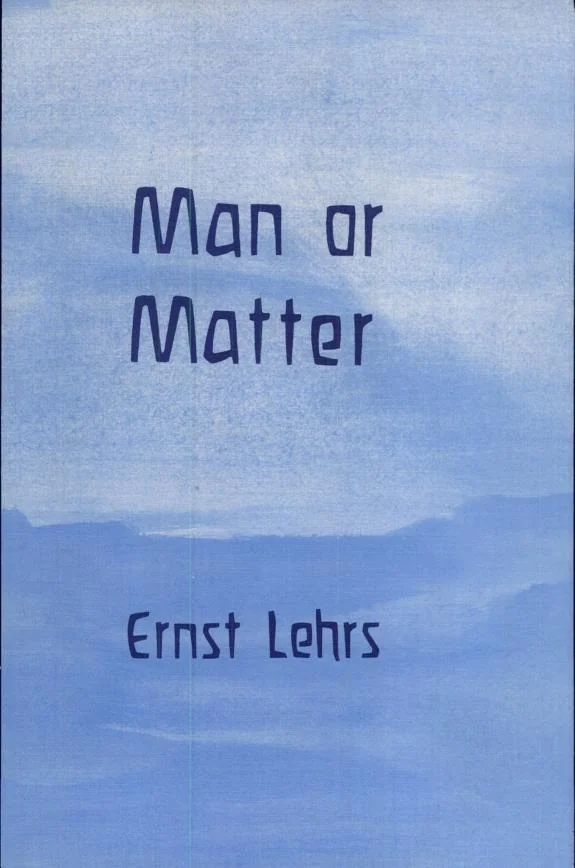
Man or Matter
 84
84

Man or Matter
Ernst Lehrs’s Man or Matter offers a compelling, if sometimes dense, argument for a spiritually informed view of the cosmos. The strength of the book lies in its sustained attempt to logically articulate a worldview that transcends simple materialism, particularly in its exploration of formative forces. Lehrs’s dissection of scientific concepts, such as the nature of light and gravity, from an Anthroposophical standpoint provides a unique lens. However, the text can be challenging due to its highly specific terminology and the assumption of familiarity with Rudolf Steiner's extensive corpus, which may alienate readers new to these ideas. A particularly striking passage details the concept of 'living ether' as a force mediating between spiritual archetypes and physical manifestation, illustrating Lehrs's ambitious synthesis. While not an easy read, Man or Matter rewards persistent engagement with a coherent, albeit specialized, esoteric framework.
📝 Description
84
Ernst Lehrs's 1958 book, Man or Matter, examines the connection between consciousness and the material world.
Man or Matter offers a philosophical examination of the relationship between consciousness and the material world. Ernst Lehrs argues against purely mechanistic views of existence, proposing instead a dynamic interplay where spiritual forces shape physical reality. The book dissects fundamental concepts of science and philosophy, seeking to bridge the perceived gap between the observable and the immeasurable.
This work is intended for the serious student of esoteric philosophy, those who question reductionist scientific paradigms and seek a more holistic understanding of cosmology and human potential. Readers should possess an interest in Anthroposophy or related spiritual science movements, and a willingness to engage with complex arguments that challenge conventional materialism. It is for individuals seeking to reconcile spiritual insights with scientific inquiry.
First published in 1958, Man or Matter emerged during a period of intellectual ferment regarding the nature of reality. Following the rise of mechanistic science and concurrent interest in spiritual movements like Theosophy and Anthroposophy, Lehrs articulated a spiritual-scientific perspective. His work engaged with the ideas of Rudolf Steiner, proposing a spiritual cosmology and responding to prevailing scientific materialism. Lehrs's contribution is its systematic approach to integrating spiritual perception with empirical observation.
💡 Why Read This Book?
• Gain a perspective on formative forces that challenge purely mechanistic biology, offering insight into how spiritual archetypes might shape physical structures, as detailed in Lehrs's discussion of 'living forms'. • Understand the Anthroposophical view of etheric forces, providing a framework for seeing subtler energies at play in biological processes beyond conventional scientific measurement. • Explore the evolution of consciousness through a spiritual-scientific lens, as presented by Lehrs, which offers a distinct pathway for contemplating humanity's place in the cosmos.
⭐ Reader Reviews
Honest opinions from readers who have explored this book.
❓ Frequently Asked Questions
What is the central thesis of Man or Matter by Ernst Lehrs?
The central thesis is that matter is not inert but is actively shaped by spiritual-scientific forces and 'living forms'. Lehrs argues for a dynamic, conscious universe, challenging purely materialistic scientific viewpoints.
What is the historical context of Man or Matter's publication?
First published in the mid-20th century, the book emerged during a period of interest in spiritual movements like Theosophy and Anthroposophy, seeking to provide a spiritual-scientific alternative to prevailing scientific materialism.
Who was Rudolf Steiner and what is his connection to Man or Matter?
Rudolf Steiner (1861-1925) was an Austrian philosopher and esotericist who founded Anthroposophy. Lehrs's work is deeply influenced by Steiner's teachings and seeks to elaborate on his spiritual scientific cosmology.
What are 'living forms' as discussed by Lehrs?
In Lehrs's context, 'living forms' refer to spiritual archetypes or organizational principles that actively impress themselves upon matter, giving structure and life to the physical world, rather than matter arising from random processes.
Is Man or Matter accessible to someone unfamiliar with Anthroposophy?
While accessible to dedicated students, the book assumes some familiarity with Anthroposophical concepts. Readers new to the subject may find it beneficial to consult introductory texts on Rudolf Steiner's work first.
What is the significance of 'etheric forces' in Lehrs's work?
Lehrs posits 'etheric forces' as subtler energies that animate and organize matter in living organisms, mediating between spiritual impulses and the physical body, going beyond the four classical physical forces.
🔮 Key Themes & Symbolism
Formative Forces in Nature
Lehrs posits that physical reality is not merely a collection of inert particles but is actively shaped by 'living forms' and spiritual-scientific forces. He contrasts this with mechanistic biology, suggesting that these formative forces, akin to vital energies, are responsible for the organization and development of living organisms. This perspective invites readers to reconsider the fundamental nature of matter and life, moving beyond purely physical explanations to embrace a more dynamic, conscious universe where spirit actively participates in creation.
Consciousness and Materiality
A central theme is the intricate relationship between consciousness and the material world. Lehrs argues against the idea that consciousness is merely an epiphenomenon of complex matter. Instead, he explores how consciousness, in various forms, is fundamental to the structure and evolution of the cosmos. The book investigates the capacity of human consciousness to perceive and interact with subtle spiritual realities, suggesting a reciprocal relationship where spirit influences matter and matter provides a vessel for spirit.
Spiritual Science vs. Materialism
Man or Matter serves as a critique of 20th-century scientific materialism. Lehrs presents a case for 'spiritual science' – a way of knowing that complements empirical observation with spiritual perception and intuitive understanding. He seeks to demonstrate that the observable world is only one aspect of a larger, multidimensional reality. By analyzing scientific concepts through a spiritual lens, Lehrs aims to provide a more complete and coherent picture of existence than that offered by a purely materialistic worldview.
Evolution of Being
The book touches upon the evolutionary trajectory of both the cosmos and human consciousness. Lehrs suggests that evolution is not solely a biological process driven by random mutation and natural selection but is guided by spiritual impulses and an inherent developmental purpose. He explores how human consciousness has evolved and the potential for further development through engagement with spiritual realities, offering a perspective on humanity's role and destiny within the grand cosmic unfolding.
💬 Memorable Quotes
Direct passages from the work, attributed to the author.
“Matter is not dead; it is living in a spiritual sense.”
— This statement expresses Lehrs's core argument that the material world possesses an inherent vitality and is not merely inert substance. It suggests that a deeper, spiritual dimension imbues matter with life and purpose, challenging conventional scientific views.
“The forms we see in nature are expressions of inner spiritual activity.”
— This highlights Lehrs's concept of 'living forms,' asserting that the physical structures we observe are manifestations of underlying spiritual archetypes or forces, rather than purely physical constructions.
“Etheric forces are the carriers of life processes.”
— This interpretation points to Lehrs's exploration of subtle energies, suggesting that 'etheric forces' are essential, non-physical agents responsible for animating and organizing living organisms beyond simple chemical reactions.
“Science must expand its scope to include spiritual perception.”
— This signifies Lehrs's call for a broader epistemology, advocating that true understanding requires integrating empirical methods with the capacity for spiritual insight and perception, thereby creating a more complete 'spiritual science'.
💡 Key Ideas
Editorial paraphrase of the work's core concepts — not direct quotes.
Consciousness is the fundamental reality from which matter arises.
This paraphrased concept reflects Lehrs's idealist leanings, proposing that consciousness is primary and that the material world is a manifestation or expression of this fundamental spiritual reality.
🌙 Esoteric Significance
Tradition
Man or Matter is firmly rooted in the tradition of Spiritual Science, particularly as developed by Rudolf Steiner and Anthroposophy. It seeks to extend Steiner's cosmological and anthropological insights by providing a detailed philosophical exploration of the relationship between the spiritual and material realms. Lehrs's work departs from purely speculative esoteric systems by attempting to ground its claims in a form of rigorous, albeit unconventional, observation and logical deduction, aiming for a verifiable spiritual understanding of nature and humanity.
Symbolism
Key symbolic motifs include the concept of 'living forms' – spiritual archetypes that structure physical matter, akin to Platonic Forms but imbued with vital energy. Another significant concept is 'etheric forces,' representing subtle energies that animate life, often visualized as flows or currents that mediate between the spiritual and physical. The book also implicitly uses the symbol of the human being as a microcosm, reflecting the structure of the cosmos and embodying the interplay of spiritual and material forces.
Modern Relevance
Contemporary thinkers in fields like integral psychology, transpersonal studies, and certain branches of ecological philosophy draw on Lehrs's work. His arguments for a conscious, living cosmos and his critique of materialism resonate with those seeking alternative paradigms to modern scientific reductionism. Researchers exploring consciousness studies and the nature of life beyond purely biochemical explanations find his conceptual frameworks valuable for further investigation.
👥 Who Should Read This Book
• Students of Anthroposophy seeking a deeper philosophical engagement with Rudolf Steiner's spiritual science, particularly concerning cosmology and the nature of matter. • Researchers in comparative philosophy of science interested in non-materialistic approaches to understanding the natural world and consciousness. • Individuals questioning reductionist scientific paradigms and looking for structured arguments that propose a more holistic, spiritually informed worldview.
📜 Historical Context
Man or Matter emerged from the intellectual milieu of the mid-20th century, a period marked by both advanced scientific discovery and a significant resurgence of interest in spiritual and esoteric thought. Ernst Lehrs was deeply influenced by the spiritual science initiated by Rudolf Steiner, the founder of Anthroposophy. While mainstream science largely adhered to a materialistic and mechanistic worldview, movements inspired by Steiner, such as the Waldorf education and biodynamic agriculture, sought to integrate spiritual insights into practical life and scientific understanding. Lehrs's work positioned itself as a rigorous philosophical and scientific articulation of these principles, aiming to demonstrate the validity of spiritual perception as a means of understanding reality. He was part of a generation of thinkers who sought to reconcile the perceived limitations of empirical science with a broader, more holistic understanding of existence, responding directly to the reductionist tendencies prevalent in academic thought.
📔 Journal Prompts
The concept of 'living forms' and their impact on material manifestation.
Reflections on the role of etheric forces in biological processes.
An analysis of how consciousness might actively shape perceived reality.
Comparing Lehrs's view of matter with a purely materialistic scientific model.
The potential for spiritual perception to complement empirical observation.
🗂️ Glossary
Spiritual Science
A term used by thinkers like Rudolf Steiner and Ernst Lehrs to describe a field of knowledge that investigates the spiritual dimensions of reality through methods that engage intuition and spiritual perception, complementing empirical science.
Living Forms
In Lehrs's philosophy, these are spiritual archetypes or organizational principles that actively impress themselves upon matter, giving structure, life, and specific characteristics to physical phenomena, especially in the biological realm.
Etheric Forces
Subtle energies or formative forces that Lehrs and other Anthroposophists describe as animating and organizing living organisms. They are seen as mediating between the spiritual world and the physical body, responsible for processes like growth and reproduction.
Materialism
A philosophical viewpoint that asserts matter is the fundamental substance in nature, and that all phenomena, including consciousness and mental states, are results of material interactions. Lehrs critiques this as an incomplete view of reality.
Consciousness
In Lehrs's context, consciousness is not merely a product of the brain but a fundamental aspect of reality, potentially existing independently and playing an active role in shaping the material world.
Anthroposophy
A spiritual philosophy founded by Rudolf Steiner, seeking to understand the spiritual nature of the human being and the universe through a combination of intellectual inquiry and spiritual perception.
Mechanistic Worldview
A perspective that views the universe and its phenomena as governed by mechanical laws, akin to a complex machine, with all events explainable through physical cause and effect without recourse to spiritual or vitalistic principles.
🔮 Readers Also Liked
Browse all →








More by Ernst Lehrs
All books →
More Free Occult Philosophy Books
View all →