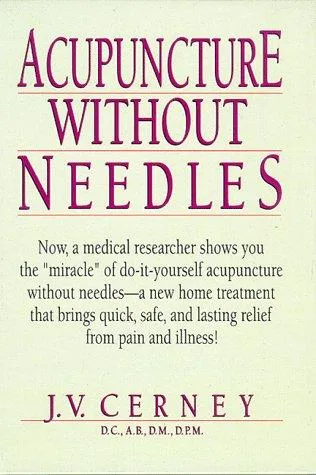
Acupuncture without Needles
 72
72

Acupuncture without Needles
J. V. Cerney’s "Acupuncture without Needles" offers a remarkably practical approach to acupressure, demystifying a complex system for the layperson. The strength of this book lies in its clear, step-by-step instructions, which make the application of finger pressure feel genuinely accessible. Cerney’s explanation of how pain can manifest in seemingly unrelated areas, and how targeting specific points can bring relief, is particularly effective. For instance, the section detailing pressure point application for headaches is direct and actionable. However, the book's limitation is its somewhat dated presentation; while the core principles remain valid, the updated edition could benefit from more contemporary visual aids or expanded explanations on the psychosomatic aspects of pain, which are more widely discussed today. Despite this, it remains a valuable resource for self-care. It provides a solid foundation for anyone wishing to explore acupressure for common discomforts.
📝 Description
72
Published in 1999, J. V. Cerney's Acupuncture without Needles offers a self-administered approach to acupressure.
This volume translates the principles of traditional Chinese acupuncture into a practical guide for home use, focusing on self-application of finger pressure to specific body points. It aims to alleviate pain and address various ailments without the need for needles or professional training. The book details how to locate these points and apply pressure effectively, making the concepts accessible to a general audience interested in personal wellness.
Cerney's work emphasizes the body's energetic pathways and how manipulating them can restore balance. Readers learn to identify acupoints and understand their connection to different bodily pains. The core idea is to unblock or redirect vital energy, known as Qi, to promote healing and well-being.
The book is intended for individuals seeking non-invasive, self-directed methods for pain management and general health improvement. It appeals to those interested in natural remedies, alternative therapies, and the practical application of Traditional Chinese Medicine concepts, serving as a how-to manual for personal acupressure routines.
Acupressure draws from the ancient Chinese medical system, a tradition that views the body as an energetic system. This book revisits and modernizes these techniques, making them available for personal use. The practice is rooted in the understanding of meridians, channels through which vital energy (Qi) flows. By stimulating specific points along these meridians, practitioners aim to restore energetic balance, which is believed to be fundamental to health and well-being. This approach aligns with broader esoteric traditions that explore mind-body connections and natural healing modalities.
💡 Why Read This Book?
• Learn to identify and stimulate specific acupoints for pain relief, as detailed in the practical, step-by-step techniques presented for home use. • Understand the fundamental concept of meridians and how applying finger pressure along these pathways can influence energy flow, as explained by Cerney's method. • Gain a self-help tool for managing common ailments by applying the principles derived from Traditional Chinese Medicine, as outlined in the book's updated 1999 edition.
⭐ Reader Reviews
Honest opinions from readers who have explored this book.
❓ Frequently Asked Questions
What is acupressure and how does it differ from acupuncture?
Acupressure is a healing art derived from Traditional Chinese Medicine that uses finger pressure on specific points of the body to stimulate the flow of vital energy (Qi). Unlike acupuncture, it does not involve needles, making it a non-invasive self-care practice.
Can "Acupuncture without Needles" help with chronic pain?
The book provides techniques that may offer relief from various types of pain, including chronic discomfort. It guides users to locate points that can send soothing sensations to the source of pain and discomfort.
Is J. V. Cerney a recognized authority in acupressure?
J. V. Cerney authored "Acupuncture without Needles," which has become a recognized guide in the field of acupressure for home healing. The book has been revised and updated, indicating its continued relevance.
What kind of conditions can acupressure address according to this book?
The book suggests that acupressure can address a range of discomforts, from headaches and muscle tension to digestive issues and fatigue, by encouraging the body's natural healing abilities through targeted pressure.
When was "Acupuncture without Needles" first published?
The original publication date for "Acupuncture without Needles" by J. V. Cerney was June 1, 1999. The book has since seen revisions and updates.
Do I need any prior knowledge of Traditional Chinese Medicine to use this book?
No prior knowledge is required. The book is designed as a practical, step-by-step guide for beginners, explaining concepts like meridians and acupoints in an accessible manner for home application.
🔮 Key Themes & Symbolism
Self-Administered Healing
The central tenet of "Acupuncture without Needles" is empowering individuals to take charge of their own well-being. Cerney frames acupressure not as a medical treatment requiring external practitioners, but as an accessible skill. By detailing specific finger-pressure techniques, the book guides readers to directly interact with their body's energy pathways, fostering a sense of agency in managing pain and discomfort. This approach aligns with broader trends in alternative health that emphasize personal responsibility and home-based wellness practices.
Meridian Pathways and Acupoints
Central to the book's methodology is the concept of meridians, the energetic channels described in Traditional Chinese Medicine. Cerney illustrates how Qi, the vital life force, flows through these pathways and how blockages or imbalances can lead to illness. The text identifies key acupoints along these meridians, explaining that stimulating these specific points with pressure can help restore the smooth flow of Qi. This understanding forms the practical basis for applying the techniques to alleviate specific symptoms.
Pain Mapping and Relief
A significant aspect of Cerney's approach is the exploration of how pain manifests and can be addressed. The book teaches readers to identify the origin of pain and understand how it may present in other parts of the body. By correlating specific acupoints with common ailments and pain locations, "Acupuncture without Needles" provides a framework for targeted self-treatment. The emphasis is on sending "soothing relief" by applying precise finger pressure, making the complex system of acupressure understandable for practical application.
💬 Memorable Quotes
Direct passages from the work, attributed to the author.
“Find relief from pain and illness through the healing art of acupressure—a home-healing variation on the 5,000-year-old tradition of Chinese acupuncture.”
— This foundational statement highlights the book's core purpose: to democratize a complex ancient practice. It positions acupressure as an accessible, needle-free method for self-care, drawing legitimacy from its roots in a time-honored healing tradition.
“Newly revised and updated, this modern health classic guides you step-by-step through the simple finger-pressure techniques.”
— This emphasizes the book's practical, instructional nature and its updated format. It assures the reader that the information is current and presented in an easy-to-follow, sequential manner suitable for beginners.
“The simple finger-pressure techniques that send soothing relief surging to the sources of pain and discomfort.”
— This highlights the direct, sensory experience of acupressure. The phrase 'soothing relief surging' evokes a palpable, comforting response within the body, achieved through straightforward manual application.
“A home-healing variation on the 5,000-year-old tradition of Chinese acupuncture.”
— This positions acupressure as an evolution of acupuncture, adapted for personal use. It frames the practice within a long historical lineage, lending it credibility while emphasizing its contemporary accessibility.
💡 Key Ideas
Editorial paraphrase of the work's core concepts — not direct quotes.
Learn how to determine where pain begins, how it may show up in other parts of the body, and how to make it disappear with a touch of a finger.
This paraphrased concept underscores the diagnostic and therapeutic elements within the book. It suggests that understanding the body's interconnectedness allows for targeted intervention, transforming localized discomfort through simple manual application.
🌙 Esoteric Significance
Tradition
While not explicitly tied to a single Western esoteric lineage like Hermeticism or Kabbalah, "Acupuncture without Needles" engages with principles common in various esoteric traditions, particularly those influenced by Eastern philosophies. It operates within the framework of vital energy (Qi), a concept resonant with notions of prana (Hinduism) or vital force (Western vitalism). The book's focus on energetic pathways (meridians) and their manipulation for healing aligns with the esoteric interest in the subtle body and its influence on physical health, offering a practical, material application of energetic principles.
Symbolism
The primary symbolic concept is the meridian system itself, representing invisible energetic highways within the body. These pathways symbolize interconnectedness and the flow of life force. Specific acupoints, often referred to by names like 'Hegu' (LI4) or 'Zusanli' (ST36), function as symbolic gateways or control points along these meridians. Applying pressure to these points symbolizes the act of rebalancing, harmonizing, or unblocking the flow of energy, much like adjusting energetic currents in a more abstract esoteric context.
Modern Relevance
Contemporary practices in holistic health, wellness coaching, and even some forms of physical therapy draw upon the principles popularized by books like Cerney's. Thinkers and practitioners exploring somatic experiencing, mind-body connection, and self-empowerment in health often reference or implicitly utilize acupressure techniques. Its relevance persists in the ongoing global interest in accessible, non-pharmacological approaches to pain management and well-being, fitting within modern discussions on integrative health and preventative self-care.
👥 Who Should Read This Book
• Individuals seeking practical, non-invasive methods for managing everyday aches and pains, who want to learn techniques they can apply themselves at home. • Students and practitioners of Traditional Chinese Medicine or alternative healing arts looking for accessible resources on acupressure principles and point location. • Anyone interested in exploring the connection between the body's energetic pathways and physical well-being, seeking to understand how to influence their health through simple manual stimulation.
📜 Historical Context
Published in its revised edition on June 1, 1999, J. V. Cerney's "Acupuncture without Needles" emerged during a period of significant Western engagement with Eastern healing modalities. The late 20th century saw a growing interest in practices like acupuncture and acupressure, partly fueled by figures like Dr. Andrew Weil, who championed integrative medicine, and the broader New Age movement's exploration of holistic health. This era was characterized by a desire for natural, non-invasive therapies as an alternative or complement to conventional Western medicine. While Traditional Chinese Medicine (TCM) was gaining traction, it often faced skepticism from the established medical community. Cerney's work aimed to bridge this gap by presenting acupressure in a practical, accessible format for home use, sidestepping the need for formal TCM training or professional acupuncture services, thereby democratizing access to these ancient techniques.
📔 Journal Prompts
The concept of meridians and Qi flow as explained in the text.
How the book maps pain presentation to specific acupoint stimulation.
The effectiveness of finger-pressure techniques for personal pain relief.
The 5,000-year-old tradition of Chinese acupuncture as a foundation for acupressure.
The practical application of identifying acupoints for home healing.
🗂️ Glossary
Acupressure
A therapeutic technique derived from Traditional Chinese Medicine that involves applying firm finger pressure to specific points on the body to stimulate energy flow and promote healing.
Acupuncture
An ancient Chinese healing practice involving the insertion of fine needles into specific points on the body to stimulate energy flow (Qi) and restore balance, thereby treating illness and pain.
Qi (Chi)
In Traditional Chinese Medicine, Qi is understood as the vital life force or energy that flows through the body, animating it and maintaining health. Imbalances or blockages in Qi flow are considered the cause of illness.
Meridians
The network of pathways or channels through which Qi is believed to flow throughout the body in Traditional Chinese Medicine. Acupoints are located along these meridians.
Acupoints
Specific locations on the body, typically found along the meridians, that are believed to be particularly sensitive and responsive to stimulation, such as by acupressure or acupuncture.
Home-healing
Refers to practices and techniques that individuals can perform on themselves or for family members within their own home environment to address health concerns and promote well-being.
Traditional Chinese Medicine (TCM)
A complete system of medical theory and practice developed in China over thousands of years, encompassing acupuncture, acupressure, herbal medicine, dietetics, and Qigong.


















![Secret Societies of the Middle Ages [by T. Keightley]](/img/thumb/secret-societies-of-the-middle-ages-by-t-keightley-thomas-keightley-272139.webp)