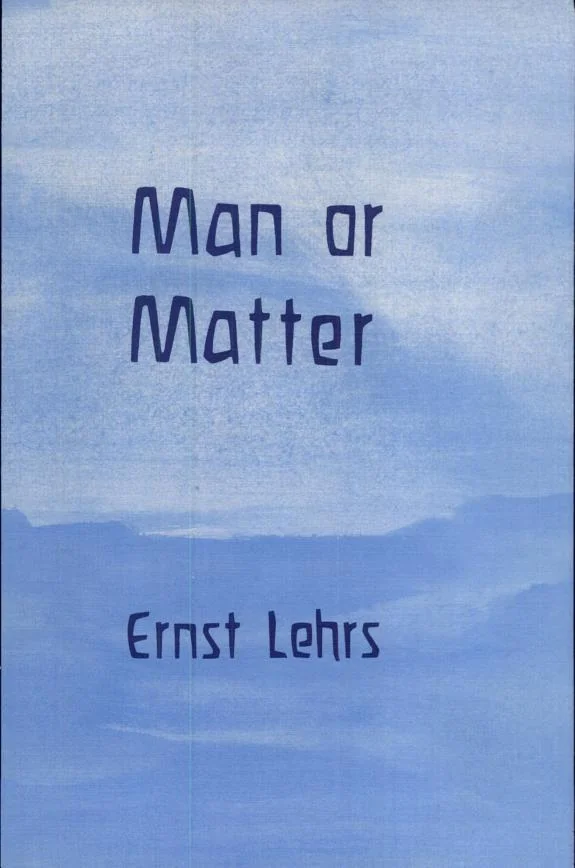
Man Or Matter
 75
75

Man Or Matter
Lehrs' "Man or Matter" offers a bracing critique of the scientific method as it has calcified into a dogma of materialism. His detailed historical tracing of how this dogma arose, particularly from the 17th century onwards, is a significant strength. He meticulously exposes the inherent limitations of a purely quantitative approach to understanding life. While the book's dense prose can be challenging, its exploration of Goethe's method of "training observation" provides a vital counterpoint to sterile scientific reductionism. Lehrs' examination of the concept of "force" is particularly clear, demonstrating how it became a placeholder for phenomena science could not otherwise grasp. The work is essential for anyone seeking to reconcile scientific inquiry with a sense of living reality, though its accessibility requires dedication. It is a formidable intellectual challenge to the prevailing scientific worldview.
📝 Description
75
Ernst Lehrs' 1985 book, Man or Matter, challenges the scientific worldview's core assumptions.
Ernst Lehrs' "Man or Matter" critiques the mechanistic and materialistic foundations of modern science. Published in 1985, the book traces how these assumptions, which separate consciousness from the material world, lead to a distorted understanding of reality. Lehrs calls for a reevaluation of our observational methods and thought processes, suggesting that science has become detached from direct experience.
The work is aimed at readers interested in the philosophical basis of science and a more integrated view of existence. It speaks to those who find reductionist explanations insufficient and seek a spiritual science approach to personal growth. Students of Goethean science and anthroposophy will likely find its perspective particularly relevant. Lehrs dissects how concepts like "force" and "energy" are treated as abstract entities rather than dynamic aspects of living processes. He underscores the observer's consciousness in shaping perceived reality, advocating for "training observation" to grasp the subtle qualities and formative forces within nature.
This book emerged from a tradition that sought to bridge the gap between the spiritual and material realms, often in contrast to dominant positivist thought. Lehrs' method, influenced by Goethe's natural philosophy, offered an alternative to purely mechanistic paradigms. It engaged with philosophical questions about the mind-body connection and the limits of empirical observation, drawing from a lineage that viewed nature not just as inert matter but as a realm of living forces and formative processes.
⭐ Reader Reviews
Honest opinions from readers who have explored this book.
❓ Frequently Asked Questions
What is Ernst Lehrs' primary critique of modern science in "Man or Matter"?
Lehrs argues that modern science, by adhering strictly to mechanistic and materialistic principles, has created illusions about reality. It divorces consciousness from matter and fails to grasp the qualitative, formative forces inherent in living processes.
What is the "Goethe's Method of Training Observation" mentioned in the book?
It is an approach to studying nature that emphasizes careful, non-prejudiced observation of phenomena. It aims to train the observer's consciousness to perceive the dynamic qualities and underlying principles of life, moving beyond mere quantitative analysis.
When was "Man or Matter" first published?
The book "Man or Matter" by Ernst Lehrs was first published in 1985.
Who would benefit most from reading "Man or Matter"?
Readers interested in the philosophy of science, spiritual science, anthroposophy, and those seeking a deeper, more qualitative understanding of nature beyond reductionist explanations would find this book particularly valuable.
How does Lehrs suggest correcting misconceptions derived from modern education?
Lehrs suggests correcting misconceptions by engaging in "training observation" and refining one's thought processes to perceive the living qualities of nature, thereby counteracting the abstract and mechanistic views instilled by current educational systems.
What historical period does Lehrs examine to explain the development of scientific illusions?
Lehrs examines the historical trajectory of scientific thought, particularly focusing on the development of mechanistic and materialistic worldviews originating from around the 17th century onwards.
🔮 Key Themes & Symbolism
Critique of Scientific Materialism
Lehrs systematically deconstructs the prevailing scientific worldview, arguing that its exclusive focus on quantifiable, mechanistic processes has led to a profound misunderstanding of reality. He traces how concepts like 'force' and 'matter' became abstract reifications, detached from the living phenomena they were meant to describe. The work contends that this materialistic bias, deeply ingrained through modern education, prevents individuals from perceiving the subtler, qualitative aspects of existence and the formative forces at play in the natural world.
Goethean Method of Training Observation
Central to Lehrs' thesis is the advocacy for Goethe's empirical method. This approach demands a rigorous cultivation of the observer's perceptual and cognitive faculties. It involves moving beyond passive reception of data to an active, imaginative engagement with phenomena. By training observation, the reader is guided to perceive the dynamic qualities and essential forms within nature, thereby correcting the distortions introduced by a purely analytical and materialistic lens. This method seeks to bridge the gap between the inner world of consciousness and the outer world of nature.
The Observer's Role in Perception
This theme explores the intricate relationship between consciousness and the perceived world. Lehrs argues that the observer is not a detached, neutral entity but an active participant in shaping the reality they apprehend. The illusions of modern science, he posits, stem partly from a failure to recognize this co-creative role of consciousness. The book encourages a self-awareness regarding one's own perceptual habits and thought forms, suggesting that a transformation of the observer is key to a more accurate understanding of both 'man and matter'.
Historical Development of Scientific Thought
Lehrs provides a historical survey of how the dominant scientific paradigms have evolved, particularly from the 17th century onward. He identifies key figures and intellectual movements that contributed to the rise of mechanism and materialism, showing how these ideas became entrenched. This historical perspective is crucial for understanding the origins of current scientific limitations and illusions, illustrating how specific conceptual shifts led to a progressively more abstract and less vitalistic understanding of the cosmos.
💬 Memorable Quotes
Direct passages from the work, attributed to the author.
“Science has been inescapably led to the illusions it holds today.”
— This statement expresses Lehrs' core critique: that the established scientific method, despite its successes, has developed blind spots and generated a distorted view of reality due to its inherent materialistic biases.
“The reader may correct in himself these misconceptions brought into his world view through modern education.”
— Lehrs offers a path toward correcting the flawed perceptions instilled by conventional schooling. The emphasis is on internal transformation through a refined mode of observation and thinking, rather than simply acquiring new information.
“A Spiritual Understanding of Nature on the Basis of Goethe's Method of Training Observation and Thought.”
— This phrase, drawn from the blurb, outlines the book's central project: to achieve a non-materialistic grasp of nature by employing Goethe's disciplined approach to perception and conceptualization.
“How science has been inescapably led to the illusions it holds today.”
— This highlights Lehrs' detailed historical analysis. He aims to show that the current state of scientific understanding is not an accidental outcome but a logical, albeit flawed, consequence of its historical development.
“The fundamental text for those seeking a "Spiritual Understanding of Nature."”
— This positions the book as a foundational resource for individuals aiming to integrate spiritual or vitalistic perspectives into their comprehension of the natural world, moving beyond purely physical explanations.
🌙 Esoteric Significance
Tradition
Lehrs' work is deeply embedded within the tradition of spiritual science, particularly as influenced by Goethe's approach to nature and further developed through figures like Rudolf Steiner. It represents a departure from purely materialistic science by seeking to perceive and understand the spiritual or formative forces that underlie physical phenomena. This lineage emphasizes the interconnectedness of all things and the role of consciousness in apprehending reality beyond the purely sensory or measurable.
Symbolism
While not heavily reliant on overt symbolic language in the manner of Hermetic texts, the book's core concepts function symbolically. 'Matter' represents the perceived, quantifiable, and often inert aspect of existence, while 'Man' signifies the conscious, perceiving, and potentially spiritual being. The 'training of observation' itself acts as a symbolic process, representing the alchemical transformation of the individual's perception from a materialistic fixation to a more vitalistic and spiritual apprehension of the world.
Modern Relevance
In contemporary discourse, Lehrs' critique of scientific reductionism finds resonance with emergent fields like consciousness studies, complexity theory, and ecopsychology. Thinkers exploring the limitations of purely objective measurement and advocating for more holistic, participatory modes of inquiry often echo his concerns. His emphasis on the observer's role and the qualitative aspects of nature aligns with contemporary calls for a science that is more integrated with human experience and ecological awareness.
👥 Who Should Read This Book
["• Students of Goethean science and Anthroposophy: Those familiar with these fields will find Lehrs' rigorous application of Goethe's method to scientific history and philosophy to be a vital extension and clarification of core principles.", "• Philosophers of science: Individuals questioning the assumptions and limitations of the modern scientific method will benefit from Lehrs' detailed historical critique and his proposed alternative observational approach.", "• Seekers of holistic understanding: Readers dissatisfied with purely mechanistic explanations of life and consciousness can explore Lehrs' arguments for a more integrated, spiritual understanding of the natural world."]
📜 Historical Context
Published in 1985, "Man or Matter" emerged during a period where the hegemony of scientific materialism, though challenged by developments in quantum physics and systems theory, remained largely unchallenged in mainstream discourse. Lehrs' work offered a profound counter-argument rooted in the tradition of Goethean science, a lineage distinct from the dominant Newtonian and later Einsteinian physics. While thinkers like Rudolf Steiner had already explored similar themes in the early 20th century, Lehrs provided a more direct engagement with the history and philosophy of science itself. The book's reception was primarily within circles interested in spiritual science and alternative epistemologies, rather than broad academic science, which largely continued to operate within its established materialistic frameworks. It engaged implicitly with the philosophical debates on consciousness and reality that were gaining renewed attention, offering a vitalistic perspective that contrasted sharply with reductionist approaches.
📔 Journal Prompts
The concept of "training observation" as described by Lehrs: What specific habits of perception must be altered?
Reflect on the historical development of the concept of "force" as discussed in the text. How does this abstract notion obscure living reality?
Consider the "illusions" of modern science presented by Lehrs. Which of these resonates most strongly with your own experience or education?
Analyze the relationship between "Man" and "Matter" as presented in the book. How does consciousness mediate this relationship?
How does the "Spiritual Understanding of Nature" proposed by Lehrs differ from conventional scientific understanding?
🗂️ Glossary
Training Observation
A method, rooted in Goethe's scientific approach, that cultivates the observer's capacity to perceive the qualitative, dynamic, and formative aspects of natural phenomena beyond mere quantitative measurement.
Mechanistic Worldview
The perspective that views the universe and its components as analogous to a complex machine, operating according to fixed, predictable laws, with all phenomena reducible to physical interactions.
Materialism
The philosophical position that matter is the fundamental substance in nature, and that all phenomena, including mental states and consciousness, are ultimately explainable as effects of material interactions.
Formative Forces
In the context of spiritual science, these are the underlying, non-physical energies or principles that shape and guide the development and organization of living organisms and natural processes.
Reification
The process by which abstract concepts or hypothetical constructs (like 'force' or 'energy') are treated as if they were concrete, real entities or things.
Qualitative Aspects
Characteristics of phenomena that describe their nature, quality, or type, as opposed to their quantity or numerical measure. Lehrs emphasizes these for a fuller understanding of nature.
Goethe's Method
An empirical approach to studying nature, pioneered by Johann Wolfgang von Goethe, emphasizing careful observation, the study of transformation and metamorphosis, and the perception of underlying archetypes.
This book appears in 1 collection
🔮 Readers Also Liked
Browse all →








From the “Anthroposophy” Collection
View all →






More Free Theosophy & Anthroposophy Books
View all →