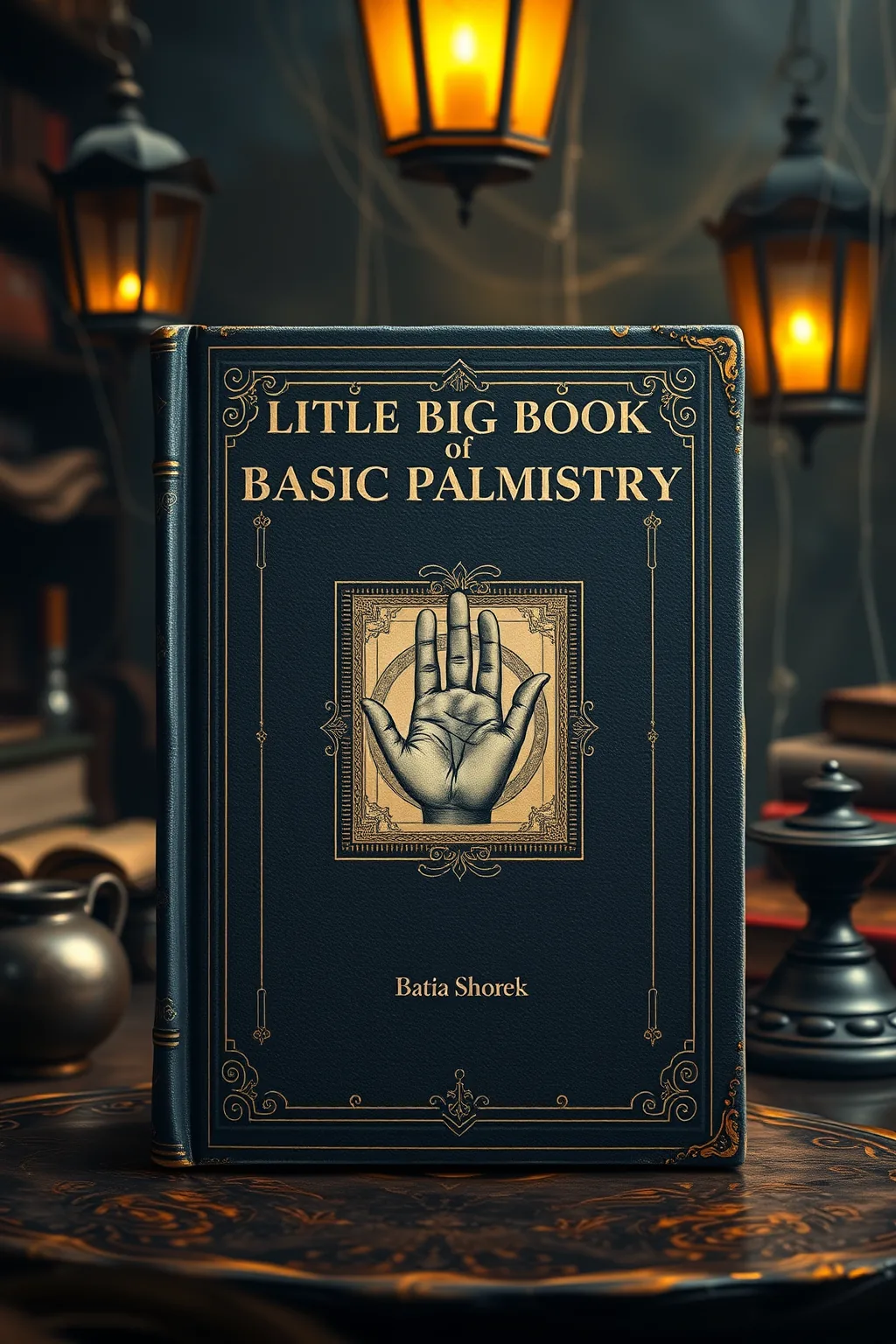
Little Big Book of Basic Palmistry
 77
77

Little Big Book of Basic Palmistry
Batia Shorek’s *Little Big Book of Basic Palmistry* arrives as a refreshingly no-nonsense primer in a field often cluttered with elaborate jargon. Its strength lies in its clarity; Shorek meticulously dissects the palm, presenting the hand's geography and the language of its lines with admirable precision. The chapter on hand shapes, categorizing them into elemental types, offers a particularly useful framework for immediate application. However, the book occasionally feels overly systematized, perhaps sacrificing some of the intuitive nuance that seasoned palmists cultivate. A passage discussing the subtle variations in the Head Line, for instance, clearly outlines different intellectual approaches but could benefit from further exploration of how these manifest in lived experience. Despite this slight rigidity, Shorek provides a solid foundation for anyone looking to understand the fundamental principles of chiromancy. It is a functional guide that delivers on its promise of basic instruction.
📝 Description
77
Batia Shorek's 1998 book breaks down the core components of palmistry for new readers.
This volume explains the practice of palmistry, the art of reading character and potential future events from the hand. It simplifies the interpretation of lines, mounts, and hand shapes. The book acts as a practical guide to the basic principles of palmistry, a practice followed for centuries. Shorek presents this information in a format that is easy for beginners to understand.
The *Little Big Book of Basic Palmistry* is for anyone interested in self-discovery, esoteric arts, or divinatory methods. It is suitable for students of occult traditions, amateur graphologists, and those seeking a simple introduction to reading palms. Readers interested in comparative mysticism or ancient methods of personal insight will find its contents useful.
Palmistry, or chiromancy, has roots in ancient India, China, and Greece, with a history spanning millennia. Shorek's work, published in 1998, emerged during a period of increased interest in esotericism following the New Age movements. This era saw many accessible guides to occult disciplines that synthesized traditional knowledge for a contemporary audience. Shorek's book offered a simplified version of palmistry within this growing body of popular esoteric literature.
💡 Why Read This Book?
• Gain a clear, structured understanding of palmistry's core elements, including the specific interpretation of the Heart Line and the meaning of the Mount of Venus, offering foundational knowledge not found in generalized esoteric introductions. • Learn to identify and interpret the four primary hand shapes—Earth, Air, Fire, Water—as defined by Shorek, providing a concrete framework for immediate self-analysis and understanding of others. • Decode the significance of the major palm lines—Life, Head, Heart, Fate—and their common variations, equipping you with specific analytical tools that go beyond superficial hand-reading techniques.
⭐ Reader Reviews
Honest opinions from readers who have explored this book.
❓ Frequently Asked Questions
When was Batia Shorek's *Little Big Book of Basic Palmistry* first published?
Batia Shorek's *Little Big Book of Basic Palmistry* was first published in 1998, marking its entry into the late 20th-century resurgence of interest in esoteric and divinatory practices.
What are the main components of palmistry covered in this book?
The book covers the interpretation of major hand lines (Life, Head, Heart, Fate), the mounts at the base of the fingers, and the classification of hand shapes into elemental types (Earth, Air, Fire, Water).
Is this book suitable for absolute beginners to palmistry?
Yes, the *Little Big Book of Basic Palmistry* is specifically designed for beginners, presenting the fundamentals of palm reading in an accessible and structured manner.
Does the book discuss the historical origins of palmistry?
While focusing on practical application, the book implicitly references the ancient roots of palmistry, acknowledging its long history across various cultures.
What is the significance of the Mount of Venus in palmistry?
According to the principles discussed in the book, the Mount of Venus, located at the base of the thumb, is associated with love, passion, vitality, and sensuality.
How does Shorek's book approach the interpretation of the Fate Line?
The book explains that the Fate Line, when present, reflects influences and events that shape a person's life path, often relating to career and destiny.
🔮 Key Themes & Symbolism
Interpreting Hand Lines
The book meticulously details the primary lines found on the palm: the Life Line, Head Line, Heart Line, and Fate Line. Each is presented not as a rigid prediction but as an indicator of psychological tendencies, vital energy, mental processes, and emotional disposition. Shorek explains how variations in these lines—their depth, clarity, breaks, or chains—offer nuanced insights into an individual's character and potential life experiences, providing a systematic approach to reading these fundamental palmographic features.
The Significance of Hand Shapes
A core concept explored is the categorization of hands into elemental types: Earth, Air, Fire, and Water. Each shape is linked to specific personality archetypes and general life orientations. For instance, Earth hands suggest practicality and groundedness, while Air hands indicate intellect and communication. Shorek's exposition on these shapes provides a broad, accessible framework for initial character assessment, allowing readers to quickly grasp the fundamental nature of an individual based on their hand's general form.
Understanding Palm Mounts
Beyond lines and shapes, the book addresses the mounts—fleshy pads located at the base of the fingers and palm. These include the Mount of Venus, associated with love and passion; the Mount of Jupiter, linked to ambition and leadership; and others like Saturn, Apollo, and Mercury. Shorek explains how the prominence or deficiency of these mounts can modify the interpretations of the lines and hand shape, adding another layer of complexity and detail to the practice of palmistry.
Chiromancy as Self-Discovery
The *Little Big Book of Basic Palmistry* frames chiromancy not merely as a predictive tool but as a method for self-understanding and personal development. By examining the patterns on one's own hands, the book suggests, individuals can gain awareness of their strengths, challenges, and inherent potentials. This perspective aligns with broader esoteric traditions that emphasize introspection and self-knowledge as pathways to spiritual growth and a more fulfilled life.
💬 Memorable Quotes
Direct passages from the work, attributed to the author.
“The Life Line shows vitality and physical well-being.”
— This straightforward statement expresses the book's approach: direct explanations of what each major palm feature signifies. It highlights the connection between physical health and the body's own map, suggesting that our physical state is reflected in the lines etched onto our palms.
“The Mount of Venus relates to love, sensuality, and enthusiasm.”
— This highlights the emotional and energetic dimensions explored in palmistry. It connects a specific physical feature of the hand to core human experiences like love and passion, framing the palm as a field of our inner emotional and vital forces.
“Hand shapes offer a general indication of character.”
— This concept underscores the book's foundational principle that the overall form of the hand provides a broad overview of personality. It’s presented as a starting point for deeper interpretation, offering an immediate classification of an individual's core traits.
“Breaks in the Fate Line may signify major life changes or disruptions.”
— This interpretation addresses the dynamic nature of palmistry, acknowledging that lines are not static. It suggests that interruptions in the Fate Line can point to significant shifts in one's life direction or experience, indicating periods of transition.
💡 Key Ideas
Editorial paraphrase of the work's core concepts — not direct quotes.
A clear Head Line indicates a logical and organized mind.
This quote points to the cognitive aspects revealed by palmistry. It suggests that the clarity and straightness of the Head Line are directly correlated with one's ability to think rationally and structure thoughts effectively, a key element in understanding intellectual capacity.
🌙 Esoteric Significance
Tradition
Palmistry, or chiromancy, aligns broadly with the Hermetic tradition's interest in correspondences—the idea that the macrocosm (universe) is reflected in the microcosm (human being). It is also connected to divination practices found across various cultures, seeking to understand divine will or future events through symbolic interpretation. Shorek's work, while modern in presentation, draws from this ancient lineage of reading the human body as a text of hidden knowledge, fitting within a broader esoteric landscape that seeks meaning beyond the purely material.
Symbolism
Key symbols in palmistry, as detailed in the book, include the lines themselves: the Heart Line (emotions, relationships), the Head Line (intellect, thought processes), and the Life Line (vitality, physical health). The mounts, such as the Mount of Venus (love, passion) and Mount of Jupiter (ambition, leadership), also function symbolically, representing specific energies and potentials. Hand shapes—Earth, Air, Fire, Water—are symbolic archetypes representing fundamental human temperaments and approaches to life.
Modern Relevance
Contemporary practices in psychological astrology and somatic psychology sometimes draw parallels with palmistry's focus on physical manifestation of inner states. Modern spiritual seekers interested in self-awareness and personal growth continue to explore palmistry as a tool for introspection, often integrating its principles with other forms of divination or mindfulness. The accessibility of Shorek's book makes it a relevant entry point for individuals exploring these modern interpretations of ancient divinatory arts.
👥 Who Should Read This Book
• Aspiring practitioners of divination arts seeking a structured introduction to palmistry, looking to learn specific techniques for interpreting hand lines and shapes. • Individuals interested in comparative mysticism and esoteric traditions, who want to understand a historical method of self-analysis and character reading. • Readers exploring personal development and self-awareness, who are open to symbolic interpretations of the human form for gaining insight into their own potential and tendencies.
📜 Historical Context
Batia Shorek's *Little Big Book of Basic Palmistry*, first published in 1998, emerged during a period of significant popular resurgence for esoteric subjects. Following the peak of the New Age movement, there was a sustained demand for accessible guides to practices like astrology, tarot, and chiromancy. This era saw authors synthesizing complex historical traditions into digestible formats for a Western audience often unfamiliar with their origins. Palmistry, with its roots in ancient India and Greece, and popularized in Europe by figures like Adolphe Desbarolles in the 19th century, found a new audience seeking personal insight. Shorek's work engaged with this tradition by offering a simplified, practical introduction, differentiating itself from more academic or historically dense treatises. It appeared at a time when competing self-help and spiritual development books flooded the market, with palmistry offering a tangible, visual method of self-exploration that appealed to those looking for concrete, yet mystical, answers.
📔 Journal Prompts
The prominence of the Mount of Venus and its relation to personal expression.
Variations in your own Head Line and their correlation with your thought patterns.
Reflecting on the meaning of your primary hand shape archetype.
The presence or absence of a distinct Fate Line and its perceived impact.
Interpreting the subtle markings on your Life Line as indicators of vitality.
🗂️ Glossary
Chiromancy
The practice of fortune-telling or diagnosing character through the study of the palm of the hand, also known as palmistry.
Life Line
The semi-circular line encircling the base of the thumb; commonly interpreted as indicating vitality, physical health, and major life events.
Head Line
The horizontal line across the palm below the Heart Line, typically interpreted as representing intellectual capacity, learning style, and mental approach.
Heart Line
The uppermost horizontal line, running across the palm below the fingers; it is associated with emotional nature, romantic relationships, and heart health.
Fate Line
A vertical line, often starting near the wrist and running upwards towards the fingers; it is interpreted as reflecting career, life direction, and external influences.
Mounts
The fleshy, raised areas on the palm located at the base of the fingers and the edge of the palm, each associated with a planetary influence and specific human traits.
Hand Shapes
The general classification of hands into elemental types (Earth, Air, Fire, Water) based on palm and finger proportions, used to determine fundamental personality characteristics.
🔮 Readers Also Liked
Browse all →









More by Batia Shorek
All books →




More Free Occult Philosophy Books
View all →