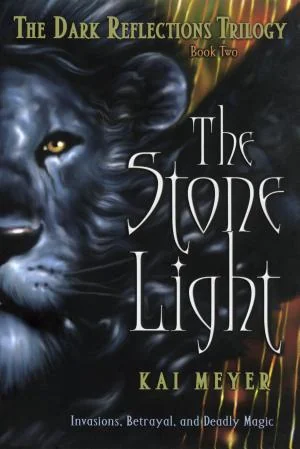
The Stone Light
 81
81

The Stone Light
Kai Meyer’s "The Stone Light" doesn’t shy away from the shadows cast by its predecessor. The sequel plunges Merle and Serafin deeper into a world where trust is a fragile commodity and evil wears many guises. Meyer excels at creating an atmosphere of pervasive unease, particularly in scenes where characters must confront the unsettling realization that their closest companions might harbor darker intentions. A notable strength lies in the author's ability to maintain narrative tension, making the reader constantly question who is an ally and who is an antagonist. However, the intricate plotting, while compelling, occasionally borders on convoluted, demanding significant reader attention to track all the threads of deception. A passage where Serafin rereads old correspondence, searching for a hidden meaning, exemplifies the book's focus on uncovering buried truths. Ultimately, "The Stone Light" delivers a satisfying, if demanding, continuation of the series.
📝 Description
81
Kai Meyer's 2007 novel, The Stone Light, continues Merle and Serafin's story.
The Stone Light, published in 2007, is the second novel in Kai Meyer's "Mirror" series. It picks up the narrative threads from its predecessor, "The Water Mirror," following the protagonists Merle and Serafin. Their world remains one where deception is common and alliances shift unexpectedly. The central conflict involves confronting malevolence whose true form is not easily discerned. The story delves into the consequences of hidden truths and the personal toll of facing unseen powers.
Readers will find Merle and Serafin navigating a precarious existence, forced to question their surroundings and the people they encounter. The narrative focuses on the struggle to distinguish genuine threats from false appearances. This installment appeals to those who enjoy fantasy narratives that weave in elements of mystery and explore darker thematic territory. It is particularly suited for readers who appreciated the first book in the series and are interested in stories that examine moral ambiguity and the nature of perception within a richly imagined setting.
Published in 2007, The Stone Light arrived during a period of renewed interest in esoteric themes within popular fiction. Meyer's work engages with concepts often found in occult traditions, such as the idea that reality is not always what it seems and that hidden forces influence events. The narrative explores the psychological impact of grappling with such ideas, placing it within a lineage of fantasy that uses supernatural elements to examine deeper philosophical questions about perception and the nature of existence. This aligns with a broader trend in early 21st-century literature that incorporated more complex world-building and darker, more philosophical undertones.
💡 Why Read This Book?
• Gain insight into the nature of deception by examining Merle and Serafin's struggle to discern truth from falsehood, a core element first explored in "The Water Mirror. • Experience the tension of confronting hidden malevolence, a key theme that continues from the prior book, pushing characters to question their surroundings. • Understand the narrative consequences of betrayal, as the sequel directly builds on the characters' decisions and the fallout from past events.
⭐ Reader Reviews
Honest opinions from readers who have explored this book.
❓ Frequently Asked Questions
Is "The Stone Light" a standalone novel or part of a series?
"The Stone Light" is the second novel in Kai Meyer's "Mirror" series, published in 2007. It directly follows the events of "The Water Mirror" and is best enjoyed after reading the first book.
What are the main themes explored in "The Stone Light"?
The novel delves into themes of betrayal, the deceptive nature of appearances, hidden truths, and the consequences of past actions. It explores how evil can manifest in unexpected forms and from unlikely sources.
Who are the main characters in "The Stone Light"?
The central characters are Merle and Serafin, whose journey and evolving understanding of their world form the backbone of the narrative. Their interactions and individual discoveries drive the plot forward.
What is the genre of "The Stone Light"?
"The Stone Light" blends elements of fantasy, mystery, and esoteric fiction. It features a richly imagined world with complex characters facing supernatural or hidden dangers.
When was "The Stone Light" first published?
Kai Meyer's "The Stone Light" was first published on October 16, 2007, as the sequel to "The Water Mirror."
Does "The Stone Light" contain explicit esoteric or occult concepts?
While primarily a fantasy-mystery, the novel engages with esoteric themes such as hidden knowledge, the subjective nature of reality, and the exploration of unseen forces, aligning with its categorization as esoteric fiction.
🔮 Key Themes & Symbolism
The Shifting Nature of Evil
The core of "The Stone Light" lies in its exploration of how malevolence is not always overt but can be deeply insidious, lurking within trusted figures and seemingly benign situations. Meyer forces readers to question the very definition of 'evil' as Merle and Serafin encounter betrayals from unexpected quarters. This theme challenges the simplistic dichotomy of good versus evil, suggesting that darkness often wears a familiar face, making discernment and vigilance paramount for survival and understanding.
Perception vs. Reality
Central to the narrative is the idea that what appears to be true is often a carefully constructed facade. Merle and Serafin must constantly re-evaluate their understanding of people, events, and their environment. The 'stone light' concept, though abstract, implies a truth that is not readily apparent, requiring effort and insight to uncover. This theme appeals to esoteric traditions that emphasize the illusory nature of the material world and the importance of inner vision to perceive deeper realities.
Consequences and Reckoning
As a sequel to "The Water Mirror," "The Stone Light" directly addresses the lingering effects of past decisions and actions. Characters are forced to confront the repercussions of choices made, highlighting a narrative of accountability. The escalating stakes underscore that navigating a world of secrets and deception carries a significant personal cost. This emphasizes a worldview where actions, whether intentional or not, set in motion chains of events that demand eventual reckoning.
The Power of Hidden Knowledge
The pursuit and revelation of hidden knowledge are driving forces within the plot. Merle and Serafin's quest often involves uncovering secrets that have been deliberately concealed, suggesting that true power or understanding lies beneath the surface. This aligns with esoteric principles where initiation and gnosis involve accessing veiled information, crucial for navigating complex spiritual or existential landscapes. The narrative suggests that ignorance is a vulnerability exploited by those who hold secrets.
💬 Memorable Quotes
Direct passages from the work, attributed to the author.
“Evil may take many shapes.”
— This concise statement expresses the novel's central thematic concern: the deceptive and many-sided nature of malevolence. It suggests that antagonists are not always easily identifiable monsters but can be those closest to the protagonists, forcing a constant re-evaluation of trust and perception.
“Betrayal lurking in unexpected places.”
— This phrase highlights the narrative's emphasis on surprise twists and the subversion of expectations. It points to a plot where the source of conflict and danger originates from individuals or circumstances that initially appear safe or trustworthy, creating suspense and psychological tension.
“Startling revelations.”
— This points to key moments in the plot where long-held assumptions are shattered, and crucial information comes to light. These revelations are designed to shock the characters and the reader, fundamentally altering the understanding of the story's conflict and stakes.
“Breathtaking sequel.”
— This descriptor suggests that the novel offers a continuation of the story that is both exciting and dramatically compelling, building upon the foundation of the first book to deliver a heightened sense of adventure and intrigue.
“Learn that evil may take many shapes.”
— This concept emphasizes the characters' growth through adversity, as they gain a more nuanced and less naive understanding of the world. It implies a learning curve where the protagonists evolve by confronting and recognizing the diverse manifestations of darkness.
🌙 Esoteric Significance
Tradition
While not strictly adhering to a single esoteric lineage, "The Stone Light" draws upon Gnostic and Hermetic currents, particularly in its emphasis on hidden knowledge and the deceptive nature of the material world. The narrative suggests that true understanding requires looking beyond superficial appearances, a core tenet in traditions that posit a veil obscuring a deeper, often spiritual, reality. The series explores the idea that individuals are often trapped by illusion, and liberation comes through a form of enlightenment or gnosis – a direct, experiential knowing.
Symbolism
The titular 'stone light' can be interpreted as a symbol of hard-won illumination or truth, something that is not naturally radiant but must be discovered or extracted, perhaps through arduous effort or by examining the seemingly inert. The theme of betrayal, often symbolized by masks or hidden daggers, represents the esoteric concept of the 'archons' or illusion-casters who seek to keep humanity ignorant of its true potential or the nature of reality. The shifting alliances and deceptive appearances function as metaphors for the Kali Yuga or the 'dark age' where truth is obscured.
Modern Relevance
Contemporary interest in narrative psychology and the exploration of archetypes in fiction finds echoes in "The Stone Light." Thinkers and practitioners exploring shadow work or the integration of the shadow self might find resonance in the novel's depiction of hidden darkness within characters and societies. Furthermore, in an age saturated with information and disinformation, the book’s focus on discernment and the challenge of perceiving truth speaks to modern anxieties about authenticity and the manipulation of perception, relevant to fields like critical media studies and post-structuralist thought.
👥 Who Should Read This Book
• Fans of dark fantasy and mystery seeking intricate plots and morally ambiguous characters. • Readers interested in narratives that explore the psychological impact of betrayal and deception. • Enthusiasts of esoteric themes who appreciate stories that question the nature of reality and hidden truths.
📜 Historical Context
Kai Meyer’s "The Stone Light," published in 2007, arrived during a vibrant period for speculative fiction. The early 21st century saw a growing appetite for fantasy narratives that moved beyond simple heroism, incorporating darker themes, complex moral ambiguity, and intricate world-building. This era was also marked by a resurgence of interest in esoteric and occult ideas filtering into mainstream literature, a trend Meyer’s work engaged with. Authors like Neil Gaiman and China Miéville were pushing genre boundaries, creating space for works like "The Stone Light" that explored psychological depth alongside fantastical elements. While direct engagement with specific esoteric schools wasn't always explicit in popular reviews, the thematic undercurrents of hidden realities and deceptive appearances aligned with broader cultural explorations of mysticism and the unknown. The reception of such works often focused on their imaginative scope and narrative complexity, reflecting a readership eager for more challenging and layered storytelling.
📔 Journal Prompts
The nature of hidden malevolence in "The Stone Light."
Merle and Serafin's evolving trust.
The concept of 'stone light' as hard-won truth.
Confronting the consequences of past actions.
Identifying deceptive appearances in the narrative.
🗂️ Glossary
The Water Mirror
The first book in Kai Meyer's series, establishing the world, characters, and initial conflicts that are continued and expanded upon in "The Stone Light."
Merle
A central protagonist in "The Stone Light" whose journey involves navigating complex relationships and uncovering hidden truths amidst deception.
Serafin
Another key character, often working alongside Merle, who faces similar challenges related to trust, revelation, and the nature of evil.
Betrayal
A recurring motif and plot device in the novel, highlighting the theme that danger often comes from unexpected sources and trusted individuals.
Startling Revelations
Key plot points in the narrative where significant, often shocking, truths are uncovered, altering the characters' understanding of their situation.
Stone Light
A metaphorical or literal concept within the book, suggesting illumination, truth, or knowledge that is difficult to attain or is revealed through unconventional means.
Esoteric Fiction
A genre that incorporates mystical, occult, or metaphysical themes, often exploring hidden knowledge, symbolism, and alternative realities, as seen in "The Stone Light."
🔮 Readers Also Liked
Browse all →








More Free Occult Philosophy Books
View all →