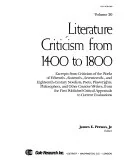
Literature Criticism from 1400 to 1800
 76
76

Literature Criticism from 1400 to 1800
James E. Person's compilation, *Literature Criticism from 1400 to 1800*, offers a panoramic view of how seminal works from this transformative epoch were received and analyzed. The strength of this volume lies in its breadth, drawing from an impressive array of primary and secondary sources, from ephemeral pamphlets to scholarly journals. One particularly illuminating section details early reactions to John Milton's *Paradise Lost*, contrasting contemporary awe with later, more academic appraisals. A limitation, however, is the sheer density of material, which can at times feel overwhelming for the uninitiated reader. The editorial curation, while comprehensive, does not always provide extensive connective tissue between disparate critical viewpoints. Nevertheless, for serious students of literary history, this collection serves as a vital compendium of historical critical discourse.
📝 Description
76
James E. Person's 1400-1800 literature criticism collection appeared in 1987.
This compilation gathers critical essays on literature from 1400 to 1800. It draws upon a diverse range of sources, including academic journals, popular magazines, books, reviews, diaries, broadsheets, pamphlets, and scholarly papers. The collected criticism covers reactions from the authors' lifetimes to later interpretations, with significant attention given to contemporary scholarly views.
Scholars and advanced students of early modern and Enlightenment literature will find this volume useful for understanding how canonical works were received and interpreted. It is especially helpful for those researching specific authors or literary movements of the period, as it presents a wide array of critical perspectives and approaches. Researchers looking for primary source material on literary opinion between the 15th and 18th centuries will also find value here.
The period from 1400 to 1800 saw major changes in literary theory and practice, moving from Renaissance humanism through Neoclassicism and into early Romantic ideas. This era marked the development of literary criticism as a field, with figures like Samuel Johnson making influential statements. The essays reflect these shifts, showing debates about poetic language, dramatic form, and the author's role in a time when literary taste was shaped by various social and printed discussions.
While not explicitly esoteric, this collection engages with the historical development of literary analysis during a period that laid groundwork for later, more specialized critical traditions. The focus on the formation of critical discourse, the shaping of taste through salons and print, and the evolution of authorship studies touches on themes that resonate with the deep historical inquiry characteristic of esoteric scholarship. The volume's attention to the 'changing understanding of authorship' and 'literary opinion across different social strata' can inform broader studies into how meaning and authority were constructed and contested in pre-modern European culture.
💡 Why Read This Book?
• Learn about the evolving reception of canonical texts, such as understanding how John Milton's *Paradise Lost* was viewed by his contemporaries versus later critics, providing a concrete example of shifting critical paradigms. • Gain insight into the diverse critical methodologies employed between 1400 and 1800 by examining essays drawn from varied sources like diaries, broadsheets, and scholarly papers. • Understand the historical context of literary analysis by exploring how critical essays reflect the intellectual currents and debates of specific periods, such as the Neoclassical era.
⭐ Reader Reviews
Honest opinions from readers who have explored this book.
❓ Frequently Asked Questions
What is the primary focus of *Literature Criticism from 1400 to 1800*?
The book focuses on presenting critical essays about literary works from the period 1400-1800, showcasing how these works were interpreted and debated across centuries and by various sources.
What types of sources are included in the critical essays?
The collection utilizes a wide range of sources, including academic journals, magazines, books, reviews, personal diaries, broadsheets, pamphlets, and scholarly papers.
Does the book include only modern criticism on older works?
No, it includes both early views from the authors' lifetimes and later perspectives, with a substantial focus on contemporary (relative to the book's publication) analysis.
Who would benefit most from reading this collection?
Scholars, students of literature, and researchers interested in literary history, criticism, and the reception of works from the Renaissance through the Enlightenment period would find this valuable.
What is the historical timeframe covered by the literary works discussed?
The works discussed were produced between the years 1400 and 1800, spanning significant literary movements from the Renaissance to the pre-Romantic era.
When was *Literature Criticism from 1400 to 1800* first published?
The book was first published in 1993.
🔮 Key Themes & Symbolism
Evolution of Critical Thought
This volume maps the shifting field of literary evaluation from the late medieval period through the Enlightenment. It demonstrates how critical lenses, influenced by philosophical shifts and changing societal values, were applied to texts. For instance, early critiques might focus on moral instruction or adherence to classical forms, while later analyses, especially those from the 20th century, might engage with New Historicism or post-structuralist readings, providing a dynamic view of interpretive history.
Reception of Canonical Authors
A core element is tracking how major authors and their works, such as those of Shakespeare or Milton, were perceived across different eras. The collection showcases the variability in critical reception, moving from immediate commentary during an author's life to subsequent generations’ re-evaluations. This theme highlights how cultural memory and scholarly trends reshape the understanding and significance of literary figures over time.
The Role of Diverse Sources
The compilation emphasizes that literary criticism is not solely an academic pursuit. By including excerpts from diaries, broadsheets, and personal correspondence, the book illustrates how literary opinions were disseminated and debated across a wider public sphere. This approach underscores the interconnectedness of scholarly discourse with broader cultural conversations and the accessibility of literary commentary.
Defining Literary Value
The essays collectively engage with the perennial question of what constitutes literary merit. They reveal how criteria for judging poetry, drama, and prose evolved, reflecting the aesthetic philosophies of different periods. The book implicitly explores the tension between aesthetic judgment and historical context, showing how contemporary standards influenced evaluations of past and present works.
💬 Memorable Quotes
Direct passages from the work, attributed to the author.
“Early critical views often focused on the moral utility of a text.”
— This highlights a key difference in historical critical priorities, where didactic purpose was often paramount, contrasting with modern emphasis on aesthetic or psychological dimensions.
“Contemporary analysis provides extensive collections of interpretive perspectives.”
— This points to the value of recent scholarship in offering a wide array of viewpoints, reflecting the ongoing engagement with and reinterpretation of historical literature.
“Criticism spans from the author's lifetime to later views.”
— This emphasizes the temporal breadth of the collected criticism, allowing readers to trace the reception history and evolving critical understanding of literary works.
“Essays are selected from leading sources, including journals and diaries.”
— This indicates the diverse origins of the critical material, showcasing that literary opinion was, and is, found in both formal academic settings and more personal or public ephemeral formats.
“The book presents criticism on works from 1400 to 1800.”
— This clearly defines the temporal scope of the literary output under examination, situating the criticism within the significant historical and cultural developments of the late medieval, Renaissance, and Enlightenment periods.
🌙 Esoteric Significance
Tradition
While not explicitly esoteric, the criticism herein engages with texts that often contain mystical or proto-esoteric elements, particularly those from the Renaissance and early modern periods. Works touching upon alchemy, Hermetic philosophy, or Neoplatonism, even if not the primary focus of the criticism, are subject to analysis that reflects the intellectual milieu. The critical approaches, particularly those that study symbolism or allegory, can inadvertently touch upon esoteric interpretations prevalent in earlier centuries.
Symbolism
The critical essays indirectly illuminate symbolic systems prevalent in the literature of 1400-1800. For example, analyses of Renaissance poetry might explore recurring motifs like the 'divine proportion' or alchemical imagery, even if the criticism itself is secular. The interpretation of allegorical figures or mythological allusions within these works often carries layers of meaning that resonate with Hermetic or Kabbalistic traditions, depending on the source text's context.
Modern Relevance
Contemporary scholars interested in the historical reception of texts that later became foundational for esoteric traditions (e.g., certain works by Pico della Mirandola or Giordano Bruno, though not explicitly central here) find value in tracing early interpretations. The volume's focus on diverse sources also informs modern approaches to reception history and the sociology of literature, relevant to understanding how ideas, including those that might be considered esoteric, gain traction or are suppressed.
👥 Who Should Read This Book
• Students of literary history seeking to understand the development of critical theory from the Renaissance through the Enlightenment, gaining context for modern analytical frameworks. • Researchers investigating the reception and interpretation of specific authors or works from the 1400-1800 period, accessing a broad spectrum of historical viewpoints. • Scholars of comparative literature or intellectual history who need to trace the evolution of aesthetic standards and critical discourse across centuries.
📜 Historical Context
The period between 1400 and 1800 represents a foundational era for Western literary criticism, evolving from Renaissance humanism's engagement with classical antiquity to the Neoclassical emphasis on order and reason, culminating in the early stirrings of Romanticism. This volume captures that transition. Criticism during this era was profoundly shaped by figures like Samuel Johnson, whose *Lives of the Poets* (1779-1781) offered influential assessments. The reception of works was also debated in public forums, from coffee houses to printed pamphlets, sometimes leading to controversy or censorship, though specific events for this compilation are not detailed. The intellectual currents included debates on poetic diction, the imitation of nature, and the very definition of genius. This compilation matters because it reconstructs the discourse surrounding literary texts, showing how their perceived value and meaning shifted dramatically over these four centuries, often in response to prevailing philosophical and social ideologies.
📔 Journal Prompts
The evolution of critical vocabulary across the 1400-1800 period.
Contrasting early versus later views on a specific author discussed.
The influence of Samuel Johnson's critical assessments.
How diverse sources shape the understanding of literary reception.
The criteria for defining literary merit in the Neoclassical era.
🗂️ Glossary
Neoclassical Era
A period in European art and literature (roughly late 17th to late 18th century) characterized by a revival of classical styles and emphasis on reason, order, and balance.
Renaissance Humanism
An intellectual movement in Europe that emphasized the study of classical antiquity, human potential, and secular concerns alongside religious ones.
Allegory
A literary device where characters, events, or settings represent abstract ideas or moral qualities, conveying a deeper meaning beyond the literal narrative.
Didacticism
The principle or practice of teaching or intending to teach a moral lesson as an ulterior motive.
Enlightenment
An 18th-century European intellectual and cultural movement emphasizing reason, individualism, and skepticism towards traditional authority.
Literary Canon
A body of literary works considered by scholars and critics to be the most important, influential, or representative of a particular period or genre.
Reception History
The study of how a particular work of art, literature, or music has been received and interpreted by audiences and critics over time.
This book appears in 1 collection
🔮 Readers Also Liked
Browse all →







From the “Ritual Magic” Collection
View all →






More Free Magic & Ritual Books
View all →