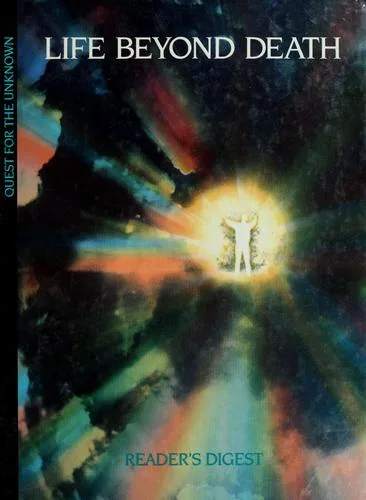
Life beyond death
 76
76

Life beyond death
The 1992 publication, attributed to an Unknown author, offers a sober examination of life beyond death. Unlike many contemporary texts that rely on anecdotal evidence or fervent pronouncements, this work grounds its arguments in philosophical reasoning and theoretical exploration. A notable strength is its structured approach to a topic often mired in unsubstantiated claims. The author, or authors, meticulously dissects the conceptual challenges of defining consciousness independent of a physical form. However, the book's primary limitation is its inherent speculative nature; while intellectually stimulating, it ultimately provides no definitive proof, only reasoned possibilities. The discussion concerning the continuity of identity, particularly in the chapter exploring "Evolving Egos," highlights the author’s sophisticated engagement with philosophical puzzles. It is a valuable resource for those who prefer reasoned discourse over dogma, but it will not satisfy those seeking empirical certainty.
📝 Description
76
Published in 1992, Life Beyond Death examines consciousness after physical death.
This book, first appearing in 1992, undertakes a detailed examination of consciousness and its potential persistence after the cessation of biological life. It moves beyond simple pronouncements of an afterlife, instead engaging with philosophical arguments and speculative theories. The author avoids sensationalism, focusing on a methodical consideration of various possibilities and conceptual frameworks for post-mortem existence.
Readers drawn to the fundamental questions surrounding life and death will find ample material for thoughtful consideration. The work is best suited for those approaching these subjects with intellectual curiosity, prioritizing reasoned inquiry over mere emotional solace. Individuals already familiar with or interested in the philosophy of mind, comparative theology, and esoteric thought will find particular resonance within its pages.
Emerging in the early 1990s, a period where New Age ideas were gaining wider traction, this book sought to articulate complex spiritual and philosophical concepts for a broader audience. It reflects a continuation of public interest in consciousness studies and near-death experiences, building on earlier work in the field. The text attempts to bridge speculative thought with philosophical inquiry, positioning itself within the broader esoteric tradition that seeks to understand existence beyond conventional materialist frameworks.
💡 Why Read This Book?
• Gain a framework for understanding consciousness beyond biological limitations, as explored through the book's detailed analysis of 'soul survival' concepts. • Explore philosophical arguments regarding personal identity after death, moving beyond simple affirmation to consider the logical implications of continued existence. • Understand the intellectual climate of the early 1990s regarding consciousness studies, contextualized by the book's publication date and its engagement with then-current thought.
⭐ Reader Reviews
Honest opinions from readers who have explored this book.
❓ Frequently Asked Questions
What is the primary focus of 'Life beyond death'?
The book primarily focuses on philosophical and theoretical explorations of consciousness and the possibility of existence beyond physical death, rather than relying on anecdotal accounts.
When was 'Life beyond death' first published?
'Life beyond death' was first published in 1992.
Does the book offer empirical evidence for life after death?
No, the book does not claim to offer empirical evidence. Instead, it presents reasoned arguments and speculative frameworks for understanding post-mortem consciousness.
Who is the author of 'Life beyond death'?
The author is listed as Unknown, with the work first appearing in print in 1992.
What kind of reader would benefit most from 'Life beyond death'?
Readers interested in philosophical inquiry, esoteric thought, and the nature of consciousness, who appreciate a structured, non-dogmatic approach to the subject.
Does the book discuss near-death experiences?
While the book emerged during a period of interest in near-death experiences, its focus is broader, delving into theoretical constructs of post-mortem existence rather than specific NDE accounts.
🔮 Key Themes & Symbolism
Continuity of Consciousness
The work critically examines the assumption that consciousness is solely a product of the physical brain. It posits that awareness might possess an independent existence, capable of persisting after bodily demise. This exploration looks at the metaphysical underpinnings required for such continuity, questioning the materialist paradigm prevalent in scientific discourse and offering conceptual models for an enduring self.
Nature of Non-Physical Realms
Beyond mere survival, the book speculates on the characteristics and potential experiences within post-mortem states. It discusses how subjective realities might be constructed or perceived in environments lacking physical constraints. The text considers various conceptualizations of these realms, drawing parallels with philosophical idealism and certain esoteric traditions without committing to a singular dogma.
Identity and Selfhood
A core theme involves the philosophical problem of personal identity. How can one maintain a sense of self if the physical body and memories are no longer accessible in the usual way? The book dissects this dilemma, exploring whether identity is tied to a continuous stream of consciousness, a unique energetic signature, or a combination of factors that transcend physical embodiment.
Existential Implications
The implications of life beyond death extend to our understanding of purpose, meaning, and morality. The work touches upon how the potential for continued existence might alter human behavior, ethical considerations, and the search for ultimate truth. It prompts reflection on how a belief in post-mortem continuity shapes our present lives and aspirations.
💬 Memorable Quotes
Direct passages from the work, attributed to the author.
“The cessation of biological function does not automatically equate to the dissolution of awareness.”
— This statement challenges the common assumption that death, understood as the end of bodily processes, necessarily means the end of consciousness itself. It suggests that awareness could be an independent phenomenon.
“Identity is not merely a record of past experiences, but an ongoing process of subjective affirmation.”
— This interpretation of selfhood emphasizes the active, present nature of identity. It implies that even without a physical brain to store memories, a persistent 'self' could continue to assert its existence.
“The perceived limitations of physical existence may be self-imposed perceptual filters.”
— This concept suggests that our understanding of reality, including the boundaries of life and death, is shaped by our limited sensory apparatus and ingrained beliefs, rather than objective truth.
“The transition from physical life is less an end and more a change in the mode of being.”
— This phrasing reframes death not as an absolute conclusion, but as a transformation. It aligns with concepts of spiritual evolution or passage into different states of existence.
“To conceive of post-mortem consciousness requires re-evaluating the very definition of 'existence'.”
— This highlights the fundamental challenge the book addresses: our current definitions of existence are deeply tied to the material world, necessitating a conceptual shift to entertain non-physical realities.
🌙 Esoteric Significance
Tradition
This work fits within the broad Western Esoteric tradition, particularly drawing from philosophical idealism and speculative metaphysics that underpin many mystical paths. It engages with concepts that echo Gnostic ideas of a transcendent realm and Hermetic principles concerning the correspondence between different levels of reality. The text departs from more ritualistic or dogmatic traditions by focusing on rational argumentation about consciousness's nature.
Symbolism
While not overtly symbolic in its language, the book's core concepts function metaphorically. 'Death' itself acts as a symbol for transition, representing the shedding of limitations. 'Consciousness' symbolizes the irreducible spark of awareness, often depicted in esoteric thought as a divine or eternal principle. The 'non-physical realm' symbolizes a state of expanded potentiality, free from material constraints.
Modern Relevance
Contemporary discussions in transhumanism and the philosophy of mind, particularly those debating artificial general intelligence and the nature of subjective experience (qualia), find echoes in this book's arguments. Thinkers exploring consciousness outside the neuroscientific consensus, and practitioners of contemplative practices seeking to understand the mind's deeper potentials, may find its conceptual frameworks useful.
👥 Who Should Read This Book
• Students of comparative philosophy and religion seeking rigorous, non-dogmatic explorations of life after death theories. • Individuals engaged in personal spiritual or philosophical inquiry who wish to understand the intellectual arguments supporting consciousness continuity. • Researchers and writers interested in the evolution of ideas about consciousness and the afterlife from the late 20th century.
📜 Historical Context
Published in 1992, 'Life beyond death' emerged during a period of heightened interest in consciousness studies, influenced by developments in psychology, philosophy of mind, and various spiritual movements. The era saw continued exploration of parapsychology and Eastern philosophies, with authors like Ken Wilber gaining prominence for their attempts to synthesize spiritual and scientific thought. While figures like Carl Sagan championed a strictly materialist worldview in popular science, there was a parallel, albeit often marginalized, discourse engaging with ideas of non-physical consciousness. The book's approach, focusing on philosophical argumentation rather than explicit channeling or mediumship, positioned it within a more academic, though still esoteric, vein of inquiry. Its reception was likely within niche intellectual circles interested in perennial philosophy and the boundaries of consciousness research, potentially alongside works from thinkers like Stanislav Grof who explored altered states.
📔 Journal Prompts
The concept of awareness persisting beyond biological cessation.
Re-evaluating the definition of 'existence' in light of non-physical possibilities.
The subjective affirmation of identity as an ongoing process.
Perceptual filters limiting our understanding of reality's boundaries.
The transition from physical life as a change in the mode of being.
🗂️ Glossary
Consciousness
The state or quality of awareness, or of being aware of an external object or something within oneself. In this context, it refers to the potential for awareness to exist independently of a physical brain.
Soul Survival
The belief or theory that a part of the individual, often termed the soul or consciousness, continues to exist after the physical death of the body.
Materialism
The philosophical view that matter is the fundamental substance in nature, and that all phenomena, including mental states and consciousness, can be explained by matter and its interactions.
Identity
The quality or character of a particular person or thing that distinguishes them from others. The book explores whether personal identity can be maintained without a physical basis.
Non-Physical Realm
A hypothetical dimension or state of being that exists outside the constraints of the physical universe, often conceptualized as the domain of consciousness after death.
Subjective Affirmation
The act of confirming or asserting one's own existence or identity through internal experience, independent of external validation or physical manifestation.
Perceptual Filters
Mental or sensory mechanisms that shape or limit an individual's perception of reality, potentially restricting their ability to comprehend phenomena beyond conventional understanding.
🔮 Readers Also Liked
Browse all →








More by Unknown
All books →



More Free Occult Philosophy Books
View all →