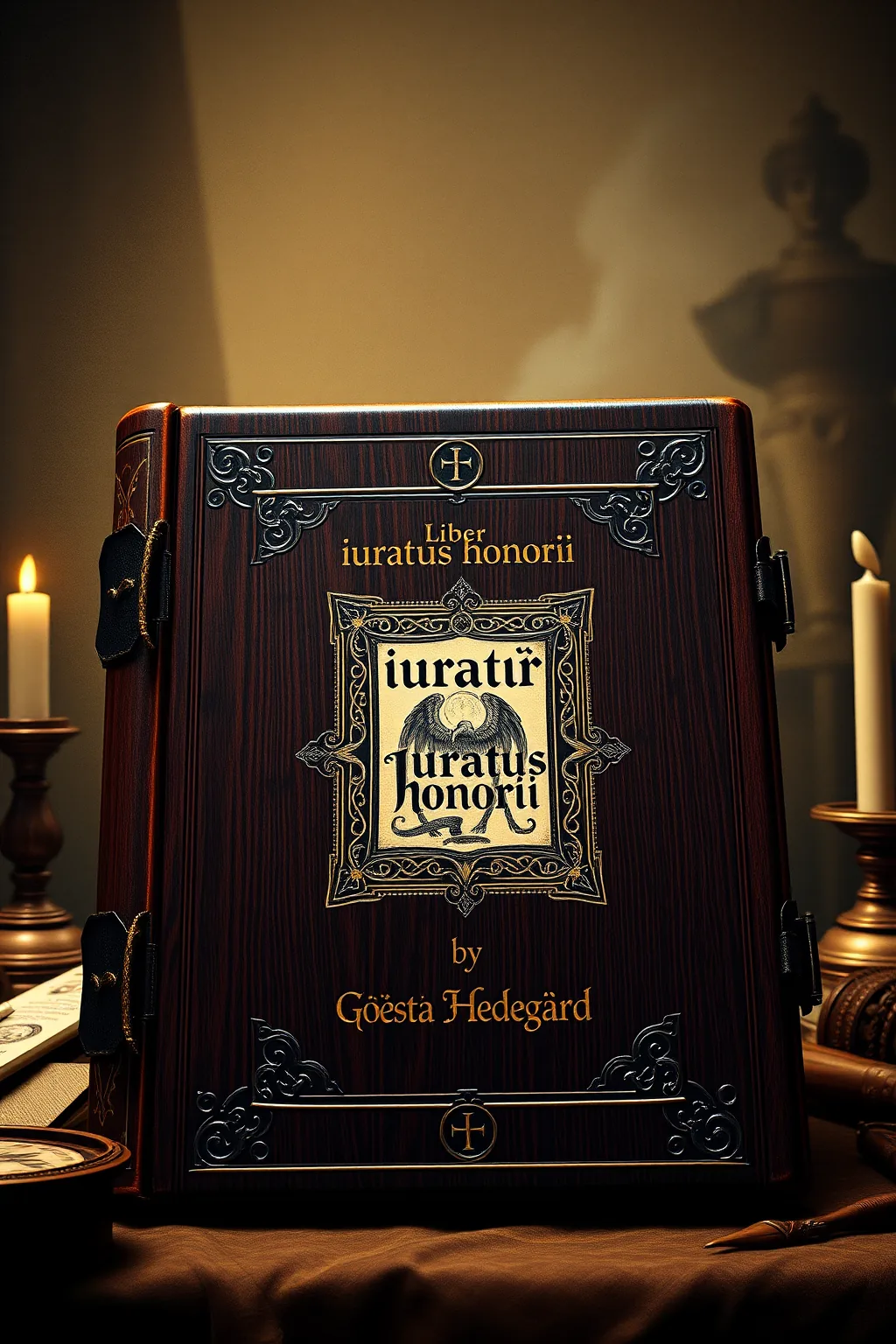
Liber iuratus honorii
 82
82

Liber iuratus honorii
Gösta Hedegård's 2002 edition of the *Liber iuratus honorii* offers a crucial scholarly gateway into a text that has long eluded widespread accessibility. The meticulous scholarly apparatus surrounding the translated text is its most significant asset, illuminating the dense, often obscure, ritualistic language. However, the inherent difficulty of the source material means this edition, while valuable, does not simplify the path for the uninitiated. A particularly striking passage concerns the detailed instructions for creating and consecrating magical instruments, underscoring the practical, hands-on nature of the magic described.
Hedegård's work provides a clear window into a complex medieval magical system. Its primary limitation is the sheer density of the source, which requires considerable prior knowledge to fully appreciate. This edition stands as an indispensable resource for serious researchers of ceremonial magic.
📝 Description
82
The *Liber iuratus honorii*, or Sworn Book of Honorius, details a system of ceremonial magic.
This medieval grimoire, attributed to Honorius of Thebes, outlines an elaborate system of ceremonial magic. Its precise origins and authorship are debated by scholars. The text details complex rituals, angelic correspondences, and specific invocations. It emerged in 14th-century Europe, blending Christian theology, Neoplatonic philosophy, and contemporary magical practices.
The grimoire's structure relies on celestial correspondences and angelic hierarchies, using a system of names and sigils. Rituals frequently involve conjuring angelic beings for various aims, from spiritual growth to material benefits. The central concept of the 'divine art' is presented as a way to comprehend creation through direct interaction with its angelic guardians. The *Liber iuratus honorii* circulated widely and influenced subsequent magical texts and traditions.
The *Liber iuratus honorii* is a significant text within the Western ceremonial magic tradition. It reflects a period where Christian elements were integrated with older philosophical and magical ideas. The book's focus on angelic conjuration and the 'divine art' places it within a lineage of practical magic aimed at understanding and interacting with the celestial order.
💡 Why Read This Book?
• Gain insight into a specific 14th-century magical system, understanding its elaborate angelic hierarchies and ritualistic demands that differ from earlier Solomonic traditions. • Comprehend the method of angelic conjuration as detailed in the *Liber iuratus honorii*, exploring the specific divine names and seals required for the practitioner. • Appreciate the historical synthesis of Christian esotericism and ritual magic, as exemplified by the text’s complex theological underpinnings and practical applications.
⭐ Reader Reviews
Honest opinions from readers who have explored this book.
❓ Frequently Asked Questions
When was the Liber iuratus honorii first widely circulated?
While exact dating is debated, the *Liber iuratus honorii* likely emerged in the 14th century and saw wider circulation through manuscript copies throughout the late medieval period and into the Renaissance.
Who is traditionally credited as the author of the Liber iuratus honorii?
The text is traditionally attributed to a figure named Honorius of Thebes, though this attribution is considered pseudepigraphical by modern scholars, serving to authenticate the work's antiquity.
What is the primary focus of the rituals described in the Liber iuratus honorii?
The primary focus is the conjuration of angelic beings through complex ceremonies, utilizing divine names, seals, and specific prayers, aimed at achieving various spiritual and practical ends.
How does the Liber iuratus honorii relate to other medieval grimoires?
It represents a significant development in ceremonial magic, distinct from earlier Kabbalistic or Solomonic traditions by its intricate angelic system and unique ritualistic structure.
Is Gösta Hedegård's edition of the Liber iuratus honorii a primary source or a translation?
Gösta Hedegård's 2002 publication is a scholarly edition that includes a translation of the Latin text, along with critical commentary and historical context.
What kind of knowledge is assumed for readers of the Liber iuratus honorii?
Readers are expected to have a foundational understanding of medieval theology, Neoplatonic philosophy, and general principles of ceremonial magic to grasp the text's complexities.
🔮 Key Themes & Symbolism
Angelic Hierarchies and Conjuration
The grimoire meticulously details a system of angelic hierarchies, assigning specific powers and roles to various celestial beings. The core practice involves the elaborate conjuration of these angels, often requiring the practitioner to understand and utilize specific divine names, seals, and prayers. This systematic approach to interacting with the angelic realms is central to the text's magical philosophy, aiming to manifest divine will or gain spiritual knowledge through these intermediaries.
The Divine Art and Celestial Science
The *Liber iuratus honorii* frames its magical practices as the "divine art" or "celestial science," positioning them as a means to comprehend God's creation and divine order. This perspective imbues the rituals with a theological weight, suggesting that true spiritual understanding is achieved not through passive contemplation alone, but through active engagement with the celestial mechanics of the universe. The text asserts that mastering these arts grants access to profound truths and divine favor.
Ritual Purity and Preparation
A significant emphasis is placed on the practitioner's spiritual and physical preparation before undertaking the complex rituals. This includes detailed instructions on purification rites, fasting, prayer, and the creation and consecration of magical tools. The grimoire posits that a state of ritual purity is essential for successful conjuration, ensuring that the practitioner is a worthy vessel for divine communication and capable of safely wielding the energies involved.
Theological Framework
Beneath the layers of ritual and angelic invocation lies a deeply Christian theological framework. The text frequently references biblical figures and concepts, integrating them into its magical system. The ultimate goal is often presented as aligning oneself with divine providence and understanding God's plan, rather than seeking power for its own sake. This integration highlights the complex relationship between esoteric practices and orthodox religious beliefs in the medieval period.
💬 Memorable Quotes
Direct passages from the work, attributed to the author.
“The art is called divine, and it is celestial science.”
— This highlights the grimoire's view of magic not as mere superstition, but as a sacred and divinely sanctioned discipline, integral to understanding the cosmos.
“One must be clean in body and soul before commencing the work.”
— This underscores the critical importance of ritual purity and spiritual readiness for the practitioner, essential for successful and safe engagement with angelic entities.
“The seals must be drawn with utmost precision according to the celestial conjunctions.”
— This points to the intricate astrological and symbolic nature of the grimoire, where accuracy in the creation of magical symbols is paramount for their efficacy.
“Invoke the angels in their proper order and by their rightful names.”
— This emphasizes the hierarchical structure of the angelic realms as understood by the text, and the necessity of correct appellations for effective invocation.
“Through this art, one can understand the secrets of the Creator.”
— This suggests the ultimate purpose of the magical practices described is not worldly gain, but a profound spiritual and intellectual apprehension of divine mysteries.
🌙 Esoteric Significance
Tradition
The *Liber iuratus honorii* occupies a unique position within Western esotericism, drawing heavily from Christian Neoplatonism and angelology while developing its own distinct ritualistic framework. It represents a significant evolution from earlier grimoire traditions, integrating a complex hierarchy of angels and divine names within a system framed as a "divine art." It is not strictly Kabbalistic or Hermetic, but rather a synthesis that reflects the specific spiritual and intellectual currents of late medieval Europe, emphasizing divine science and celestial correspondences.
Symbolism
Key symbols include the celestial intelligences themselves, approached through their specific divine names and seals, which act as symbolic keys to their power and essence. The use of geometric figures and precise diagrams in the ritual preparations also holds symbolic weight, representing cosmic order and the precise mapping of divine influence onto the material plane. The text often employs allegorical language to describe spiritual journeys and the attainment of knowledge, where figures and actions represent higher, divine realities.
Modern Relevance
Contemporary practitioners of Western ceremonial magic, particularly those interested in angelology and medieval ritual systems, continue to study and work with the *Liber iuratus honorii*. Its detailed approach to angelic hierarchies and conjuration has influenced modern magical orders and individual practitioners seeking to engage with pre-modern magical paradigms. Scholars of occult history also draw on it to understand the evolution of magical theory and practice across the centuries.
👥 Who Should Read This Book
• Students of medieval European magic seeking to understand the development of grimoire traditions beyond the "Key of Solomon". • Practitioners of ceremonial magic interested in detailed angelic conjuration techniques and their historical context. • Scholars of religious history and comparative occultism examining the intersection of Christian theology and esoteric practices in the late Middle Ages.
📜 Historical Context
The *Liber iuratus honorii* emerged from the rich, complex intellectual field of 14th-century Europe, a period marked by scholasticism, burgeoning humanism, and persistent esoteric traditions. While the precise year of its compilation is debated, its circulation reflects a desire for authoritative magical texts. It stands apart from earlier grimoires like the *Key of Solomon*, which often focused more on Solomonic lore, by presenting a more elaborate and distinct system of angelic conjuration rooted in a unique theological synthesis. The text was widely copied, indicating its significance within occult circles, though it also faced scrutiny from religious authorities concerned with heterodox practices. Its influence can be traced through subsequent centuries, shaping the development of Western ceremonial magic.
📔 Journal Prompts
The practitioner's need for ritual purity before commencing angelic conjuration.
The concept of the "divine art" as a path to celestial science.
The specific challenges of accurately replicating the seals and divine names.
Angelic hierarchies: their structure and invocation order.
The synthesis of Christian theology with ritualistic practices in the grimoire.
🗂️ Glossary
Grimoire
A textbook of magic, typically containing instructions on how to create magical tools, perform rituals, and cast spells, often including lists of spirits or deities that can be invoked.
Angelology
The study of angels and their role in theology and religious belief. In esoteric traditions, it often involves systems for invoking, communicating with, or understanding angelic beings.
Neoplatonism
A philosophical system originating in the 3rd century CE with Plotinus, based on Plato's ideas but incorporating mystical and theological elements. It emphasizes a hierarchical cosmos emanating from a supreme, ineffable 'One'.
Conjuration
A ritualistic act of invoking or calling upon a spirit, deity, or other supernatural entity, often through spoken words, prayers, or magical symbols.
Seals
In magical contexts, these are specific symbols or sigils, often associated with a deity, angel, or spirit, believed to hold a portion of that entity's power or essence.
Divine Names
Specific appellations or names of God or angelic beings considered to possess inherent power and efficacy when invoked correctly within magical rituals.
Pseudepigrapha
Writings or texts falsely attributed to an author or person of antiquity, often done to lend them greater authority or credibility.
🔮 Readers Also Liked
Browse all →









More by Gösta Hedegård
All books →
More Free Magic & Ritual Books
View all →