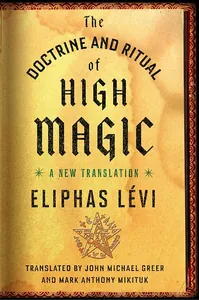
Dogma and Ritual of High Magic Part II
 80
80

Dogma and Ritual of High Magic Part II
Lévi's "Ritual of Transcendental Magic" continues to be a cornerstone for students of Western ceremonial magic, offering a dense, symbolic, and often challenging exploration of occult practice. The work's strength lies in its systematic approach, attempting to codify arcane knowledge into a structured system. Lévi's interpretation of Kabbalistic and Hermetic principles provides a unique lens through which to view magical operations. However, the text's prose, even in translation, can be dense and somewhat archaic, demanding considerable reader effort. The chapter "The Blazing Pentagram" offers a particularly potent example of Lévi's symbolic reasoning, detailing the pentagram's use in invocation and banishing. While its historical significance is undeniable, modern practitioners may find certain rituals require significant adaptation to contemporary contexts and understanding.
It remains an essential, if demanding, text for the serious occult student.
📝 Description
80
Eliphas Levi's "The Ritual of Transcendental Magic" was published in 1855 as a practical guide.
This volume, the second part of Eliphas Levi's "Dogma and Ritual of High Magic," serves as a direct manual for ritualistic practice. It follows the theoretical groundwork established in the first part, detailing specific operations, symbols, and the philosophical ideas a magician needs. Levi presents this not as a historical overview but as a set of instructions for those undertaking magical work.
It is aimed at serious students of ceremonial magic who have already studied the first part of "Dogma." The book offers a systematic, though old fashioned, method for occult practices. It will also interest those researching the history of magic, comparing occult traditions, and tracing the development of Western esotericism, providing a primary source for such studies. This is for the committed practitioner, not someone casually curious.
Published in 1855, this work appeared during a time of heightened interest in spiritualism and occultism across Europe. Levi, originally Alphonse Louis Constant, combined Kabbalah, Hermeticism, and other esoteric streams into a unified system. His writing emerged within an intellectual atmosphere that also saw Allan Kardec codifying Spiritism and a growing fascination with ancient Egyptian religion and its symbols. Levi sought to establish a rational basis for magic, moving beyond both purely materialistic viewpoints and rigid religious dogma.
💡 Why Read This Book?
• Understand the foundational principles of ceremonial magic as synthesized by Eliphas Lévi in the mid-19th century, particularly the concepts of the astral light and the symbolic power of the pentagram, which are detailed in "The Blazing Pentagram" chapter. • Gain insight into Lévi's unique integration of Kabbalah and Hermeticism into practical occult operations, a synthesis that significantly influenced later esoteric movements and is explored throughout the work. • Learn about specific ritualistic elements and their supposed efficacy, such as the "Triangle of Pantacles," offering a glimpse into the practical, albeit theoretical, aspects of high magic as understood in 1855.
⭐ Reader Reviews
Honest opinions from readers who have explored this book.
❓ Frequently Asked Questions
What specific magical operations are detailed in "Dogma and Ritual of High Magic Part II"?
Part II, "The Ritual of Transcendental Magic," details operations such as the use of the Triangle of Pantacles, the invocation and banishing rituals associated with the Blazing Pentagram, and the ceremonial practices for initiates.
When was Eliphas Lévi's "Dogma and Ritual of High Magic" first published?
Eliphas Lévi's "Dogma and Ritual of High Magic" was first published in Paris in 1855. This volume, Part II, focuses specifically on the ritualistic aspects.
Is "Dogma and Ritual of High Magic Part II" suitable for complete beginners to magic?
While it is a foundational text, Part II is best approached after reading Part I. It is dense and assumes some familiarity with occult concepts, making it more suitable for dedicated students than absolute beginners.
What is the significance of the "Blazing Pentagram" in Lévi's work?
The Blazing Pentagram is presented as a key symbol in Lévi's system, representing the microcosm and the human being. Its proper use is crucial for both invocation and banishing in ceremonial magic, as detailed in its dedicated chapter.
Does the book discuss the "Great Work"?
Yes, "The Great Work" is a subject covered in "Dogma and Ritual of High Magic Part II." Lévi discusses it as the ultimate goal of magical and spiritual endeavor, often interpreted as spiritual transformation or alchemical transmutation.
What historical esoteric traditions does Eliphas Lévi draw upon?
Lévi synthesizes various traditions, including Kabbalah, Hermeticism, Gnosticism, and earlier magical texts like the Key of Solomon. He aimed to present a universal science of magic.
🔮 Key Themes & Symbolism
Ceremonial Magic Framework
This section explores Lévi's structured approach to magic, presented as a science. He meticulously details the necessary preparations, tools, and symbolic understanding required for ritual work. The book emphasizes that magic is not mere superstition but a disciplined application of will and knowledge, particularly concerning the manipulation of the astral light and the use of divine names and planetary correspondences. It provides a blueprint for practitioners seeking systematic engagement with occult forces.
Symbolism of the Pentagram
A significant portion of the ritualistic aspect is dedicated to the Blazing Pentagram. Lévi views it as a powerful symbol representing the human microcosm, the four elements, and the divine spirit. The text elaborates on its use in both invoking positive forces and banishing negative influences, outlining specific gestures and mental visualizations for its effective manipulation in magical operations.
The Great Work and Initiation
The book addresses the ultimate aim of magical pursuit, "The Great Work," which Lévi often links to spiritual transformation and the attainment of gnosis. The "Ceremonial of Initiates" chapter guides the aspirant through stages of purification and knowledge acquisition. This theme underscores the transformative potential of high magic, positioning it as a path toward self-realization and union with the divine.
The Science of the Prophets
Lévi posits a "Science of the Prophets," which he connects to divine inspiration and prophetic ability. This involves understanding the language of symbols, dreams, and divine communications. The book suggests that through rigorous magical practice and adherence to esoteric principles, individuals can cultivate their inner sight and potentially access higher knowledge, akin to that of ancient prophets.
💬 Memorable Quotes
Direct passages from the work, attributed to the author.
“The triangle of pantacles is the seal of the great magical agent.”
— This statement highlights the central importance of the pantacle triangle in Lévi's system. It is presented not merely as a decorative element but as a fundamental tool or symbol that 'seals' or directs the primary magical force, the 'great magical agent' (often interpreted as the astral light or divine will).
“The Blazing Pentagram is the sign of the macrocosm and the microcosm.”
— This succinctly captures Lévi's symbolic interpretation of the pentagram. It signifies the relationship between the universe (macrocosm) and the individual human being (microcosm), representing the divine spark within humanity and its connection to the greater cosmic order.
“The writing of the stars is the language of divine science.”
— This suggests that celestial phenomena and astrological correspondences are not arbitrary but form a symbolic language through which divine truths can be understood. It links astrology to a higher form of knowledge accessible through occult study.
“Transmutations are the effects of the Great Work.”
— This interpretation connects the concept of transformation (transmutation) directly to the ultimate goal of magical and spiritual development, "The Great Work." It implies that profound inner and outer changes are the tangible results achieved through dedicated magical practice and spiritual evolution.
💡 Key Ideas
Editorial paraphrase of the work's core concepts — not direct quotes.
The key of occultism is the true understanding of the equilibrium of opposites.
This paraphrase emphasizes a core tenet of Lévi's philosophy: balance. Occult knowledge and practice depend on recognizing and harmonizing dualities – such as good and evil, spirit and matter, light and darkness – to achieve mastery and enlightenment.
🌙 Esoteric Significance
Tradition
Lévi's work is a core part of modern Western esotericism, primarily drawing from the Hermetic and Kabbalistic traditions. He sought to synthesize these ancient streams with a rationalist framework, creating a system that bridges theoretical understanding and practical application. "Dogma and Ritual" became a foundational text for many occult orders in the late 19th and early 20th centuries, establishing a common symbolic language and philosophical basis for ceremonial magic.
Symbolism
Central to Lévi's system are symbols like the pentagram, which he describes as the 'Blazing Pentagram,' representing the microcosm and the balance of elements. The Kabbalistic Tree of Life, though more detailed in Part I, underpins the structure of his magical philosophy. The 'Triangle of Pantacles' serves as a focal point for ritual operations, symbolizing the manifestation of divine will and the magician's control over elemental forces within a defined sacred space.
Modern Relevance
Contemporary practitioners of ceremonial magic, chaos magic, and various neo-pagan traditions continue to engage with Lévi's work. His systematic approach to ritual, his symbolic interpretations, and his emphasis on the magician's will remain influential. Thinkers and authors in the occult revival continue to cite and interpret Lévi's texts, adapting his concepts to modern magical paradigms and psychological understandings of esoteric practice.
👥 Who Should Read This Book
• Students of Western Esotericism: Those seeking to understand the historical development and core tenets of ceremonial magic, particularly its mid-19th-century formalization. • Practitioners of Ritual Magic: Individuals interested in detailed symbolic systems, ritual construction, and the theoretical underpinnings of magical operations as presented by a key historical figure. • Scholars of Comparative Religion and Occultism: Researchers looking for primary source material that synthesizes Kabbalistic, Hermetic, and Gnostic elements into a unique magical philosophy.
📜 Historical Context
Eliphas Lévi's "Dogma and Ritual of High Magic," first published in 1855, emerged during a fervent period of occult revival in Victorian Europe. The mid-19th century saw widespread fascination with spiritualism, mesmerism, and esoteric traditions, partly as a reaction against prevailing materialism and industrialization. Lévi, a French occultist, synthesized Kabbalah, Hermeticism, Gnosticism, and ceremonial magic into a coherent system, attempting to present magic as a rational science. His work provided a critical counterpoint to the more empirical or purely spiritualist movements of the time, such as those led by Allan Kardec. While not without its critics, Lévi's comprehensive approach and influential symbolism, particularly concerning the pentagram, profoundly shaped subsequent generations of occultists, including figures like Papus and the Hermetic Order of the Golden Dawn.
📔 Journal Prompts
The Blazing Pentagram's role in invocation and banishing.
Lévi's concept of the 'Science of the Prophets'.
The 'equilibrium of opposites' as a key to occultism.
The symbolic meaning of the 'Triangle of Pantacles'.
The 'Great Work' as a transformative process.
🗂️ Glossary
Astral Light
In Lévi's system, a universal, invisible fluid or medium that permeates all of creation. It is believed to be the vehicle for thought, imagination, and magical forces, and its manipulation is central to magical operations.
Pantacle
A magical object, often a disc inscribed with symbols, used for protection, invocation, or as a focus for magical will. The 'Triangle of Pantacles' refers to a specific ritualistic arrangement.
Microcosm
The concept that the human being is a small-scale reflection of the universe (macrocosm). Lévi heavily emphasizes this connection, particularly in relation to the pentagram.
Macrocosm
The universe considered as a complex, ordered whole, often seen as a reflection or counterpart to the microcosm (humanity).
Initiate
An individual who has undergone a formal process of instruction and ritual reception into a secret society or esoteric order, signifying advancement in spiritual or magical knowledge.
Great Work
The ultimate goal of alchemy and high magic, typically understood as spiritual perfection, enlightenment, or the transmutation of base nature into a higher spiritual state.
Ceremonial Magic
A structured form of magic involving elaborate rituals, specific tools, symbolic gestures, incantations, and the invocation of divine or elemental forces.