Lazarus
 81
81

Lazarus
Morris West's "Lazarus" offers a potent, if somewhat dated, exploration of what it means to be given a second chance, particularly when that chance feels divinely ordained or unnaturally bestowed. The novel's strength lies in its unflinching examination of the ego's response to perceived salvation and the subtle ways charisma can morph into manipulation. West masterfully portrays the internal struggles of his protagonist, a man resurrected in spirit if not entirely in flesh, and the magnetic pull he exerts. However, the narrative's adherence to a more traditional moral framework, typical of mid-20th-century Catholic literature, can feel restrictive to a contemporary reader. The climax, while dramatic, relies on a somewhat predictable unraveling of the protagonist's carefully constructed persona, a resolution that feels less surprising than it might have in 1960. Despite these limitations, the central question West poses—what is the true cost of a miracle?—remains a potent one. The work ultimately stands as a compelling character study and a thoughtful, if at times didactic, meditation on faith and its discontents.
📝 Description
81
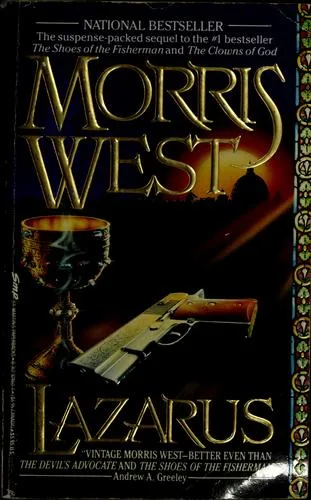
Morris West's 1960 novel Lazarus examines a man resurrected with a disturbing influence.
Morris West's 1960 novel Lazarus centers on a man brought back from the edge of death. This individual, after his near-fatal experience, acquires a strange power over others. The narrative questions the very idea of resurrection, not merely as a physical event, but as a psychic and social transformation. West, known for his careful studies of faith and authority, uses the story to explore the ambiguous nature of this resurrected man's healing or manipulative abilities.
The book's settings mirror the characters' inner states. Stark environments and rich interiors highlight themes of spiritual emptiness alongside the appeal of worldly possessions. This novel is for readers who like allegorical fiction and theological stories that confront big questions about belief, salvation, and the human condition. It will also interest those who read about the overlap between the sacred and the secular, especially through accounts of miracles or near-death events. Readers who prefer character-focused stories with moral complexity will find a space for thought here regarding the mixed blessings of second chances.
Published in 1960, Lazarus arrived during a period of cultural and religious questioning in the West. Existentialist ideas were prominent, challenging established doctrines and stressing individual responsibility for finding meaning. This backdrop, coupled with internal debates within the Catholic Church, created fertile ground for a story that probed the boundaries of miraculous intervention and spiritual authority. The novel engages with ideas of transformation and influence that resonate with certain occult traditions concerned with altered states of being and the nature of spiritual power.
💡 Why Read This Book?
• You will gain a nuanced perspective on the psychological impact of near-death experiences and perceived miracles, as explored through the protagonist's altered state following his "resurrection" in the novel. • You will encounter a critical examination of charisma and spiritual authority, learning how West dissects the fine line between genuine healing and manipulative influence, particularly in the context of the 1960s. • You will explore the complex relationship between faith, doubt, and societal expectation, understanding how the novel, set against a backdrop of post-war religious introspection, questions the nature of divine intervention.
⭐ Reader Reviews
Honest opinions from readers who have explored this book.
❓ Frequently Asked Questions
What is the central premise of Morris West's "Lazarus"?
The novel centers on a charismatic individual who, after a near-fatal experience, returns with a profound influence over others, prompting questions about resurrection, faith, and the nature of power.
When was Morris West's "Lazarus" first published?
Morris West's novel "Lazarus" was first published in 1960, a period marked by significant cultural and religious shifts in the Western world.
Does "Lazarus" have explicit religious themes?
Yes, "Lazarus" engages deeply with religious themes, exploring concepts of resurrection, faith healing, doubt, and the role of spiritual authority, drawing from a Catholic literary tradition.
Is "Lazarus" based on the biblical Lazarus?
The novel uses the biblical figure of Lazarus as an archetype for a man who returns from the brink of death, but it is a fictional narrative exploring the modern implications of such an event.
What kind of literary style can I expect from "Lazarus"?
Readers can expect a character-driven narrative with a strong allegorical bent, marked by West's sharp examination of moral ambiguities and spiritual struggles, typical of his mid-20th-century works.
Who are some contemporary authors to Morris West's "Lazarus"?
Morris West wrote during a time when authors like Graham Greene were also exploring complex Catholic themes and moral quandaries in their fiction, offering a similar vein of introspective religious literature.
🔮 Key Themes & Symbolism
The Nature of Resurrection
The novel reinterprets the concept of resurrection beyond a singular theological event, presenting it as a psychological and social rebirth. It probes the implications for an individual who returns from a state of near-annihilation, forever altered and imbued with a peculiar aura. This theme questions whether such a 'second life' is a divine gift or a profound burden, examining the protagonist's struggle to reconcile his former self with his new, influential existence. West uses this concept to explore existential questions about identity and purpose in the face of extraordinary circumstances.
Charisma and Manipulation
A central tenet of "Lazarus" is the examination of how profound personal experience, particularly a near-death one, can bestow an almost supernatural charisma. The narrative dissects how this charisma is perceived by others and how it can be wielded, intentionally or otherwise. West explores the fine line between genuine spiritual leadership and subtle manipulation, showing how followers are drawn to the protagonist's unique aura. This theme examines the ethical responsibilities that accompany such influence and the potential for exploitation, even in the name of healing or salvation.
Faith, Doubt, and Miracles
The novel navigates the complex interplay between unwavering faith and profound doubt, particularly in the context of miraculous occurrences. "Lazarus" scrutinizes the concept of faith healing, questioning the motivations behind it and the societal reaction to perceived miracles. It reflects the post-war era's broader religious introspection, where traditional doctrines were being re-examined. West presents characters grappling with their belief systems, highlighting the human tendency to seek extraordinary interventions while simultaneously questioning their authenticity and the source of such power.
Duality of Human Nature
West consistently presents characters, especially the protagonist, as embodying a profound duality. The narrative explores the capacity for both immense good and significant self-deception within individuals. The man resurrected in "Lazarus" is not presented as purely saintly or wholly corrupt, but as a complex figure whose actions are driven by a mixture of genuine altruism and egoistic desires. This theme underscores the novel's engagement with the complexities of the human psyche, suggesting that even those who experience transformative events remain subject to their inherent flaws and aspirations.
💬 Memorable Quotes
Direct passages from the work, attributed to the author.
“He had seen the face of God and found it terrible.”
— This interpretation suggests the protagonist's near-death experience was not a comforting encounter but a terrifying revelation, hinting at a darker, more challenging understanding of the divine or ultimate reality.
“The world accepted his miracle, but feared the man who performed it.”
— This highlights the societal paradox of embracing the extraordinary while remaining suspicious of the individual who embodies it, pointing to a deep-seated unease with power that transcends ordinary human experience.
“His power was the echo of an absence.”
— This interpretation suggests the protagonist's charisma and influence stem not from inherent strength, but from the void left by his death and subsequent return, a power derived from his unique liminal state.
💡 Key Ideas
Editorial paraphrase of the work's core concepts — not direct quotes.
He offered salvation, but charged a price in devotion.
This paraphrase indicates the protagonist's healing or transformative influence came at the cost of his followers' absolute loyalty, suggesting a form of spiritual control rather than pure benevolence.
Death had been an awakening, life a prolonged dream.
This quote frames the near-death experience as a true awakening, implying that the protagonist's subsequent life was less real or meaningful until his brush with mortality, inverting typical perceptions of life and death.
🌙 Esoteric Significance
Tradition
While not strictly aligned with a single esoteric lineage, "Lazarus" draws heavily from Christian Gnostic and Hermetic traditions. The concept of resurrection and a "second birth" speaks to Gnostic ideas of spiritual awakening and escape from material limitations. The protagonist's transformative experience and subsequent charismatic influence echo Hermetic principles of hidden knowledge and the potential for human apotheosis. West's work engages with these traditions by exploring the psychological and societal implications of achieving a state beyond ordinary human experience, often through a lens of moral questioning.
Symbolism
The primary symbol is the figure of Lazarus himself, representing the individual who returns from the void, fundamentally changed and bearing witness to a reality beyond mortal comprehension. The near-death experience functions as a threshold crossing, symbolizing a descent into the underworld and a subsequent ascent. The protagonist's charisma can be seen as a manifestation of inner illumination or, conversely, a deceptive allure, embodying the Hermetic concept of duality where potent forces can lead to both enlightenment and illusion.
Modern Relevance
Contemporary interest in "Lazarus" is fueled by ongoing discussions in fields like transpersonal psychology and consciousness studies. Thinkers exploring near-death experiences, altered states of consciousness, and the nature of spiritual authority find resonance in West's portrayal of a post-transformation individual. The novel's themes of charisma, belief, and the potential for manipulation remain highly relevant in an age of social media influencers and amplified spiritual narratives, making it a touchstone for examining the modern seeker's path and the figures who guide them.
👥 Who Should Read This Book
• Students of comparative religion and mythology will find value in how the novel reinterprets the biblical Lazarus narrative within a 20th-century context, exploring universal themes of rebirth. • Readers interested in psychological fiction and character studies will appreciate the deep dive into the protagonist's internal struggles and the impact of his extraordinary experience on his psyche and relationships. • Those exploring the intersection of faith, doubt, and the supernatural will engage with West's nuanced portrayal of miraculous events and the moral ambiguities they create, offering a thought-provoking exploration of spiritual phenomena.
📜 Historical Context
Published in 1960, Morris West's "Lazarus" emerged during a period of significant spiritual and intellectual reevaluation in the Western world. The post-World War II era was characterized by existentialist currents that challenged traditional religious frameworks, emphasizing individual freedom and the search for meaning in a seemingly absurd universe. Simultaneously, the Catholic Church, West's own background, was on the cusp of major reforms leading to the Second Vatican Council (1962-1965), a time of introspection and a questioning of established dogma. West's novel taps into this broader cultural milieu, exploring themes of faith, doubt, and the Church's relevance in a modernizing world. He was writing in a literary landscape where authors like Graham Greene were also grappling with Catholic themes and moral complexities, though West's focus often leaned more towards the overtly spiritual and allegorical. The novel's reception reflected the era's fascination with and apprehension towards profound spiritual experiences and the figures who claimed them.
📔 Journal Prompts
The protagonist's "resurrection" and its aftermath.
The nature of the protagonist's charisma and its effects.
Moments of doubt experienced by characters in "Lazarus".
The societal reception of the protagonist's miraculous return.
The concept of a 'second life' as presented in the novel.
🗂️ Glossary
Resurrection (novelistic)
In the context of "Lazarus," this refers not just to a physical return from death, but a profound psychological and spiritual transformation that alters an individual's perception and influence over others.
Charisma
The compelling attractiveness or charm that can inspire devotion in others, often interpreted as a supernatural or extraordinary quality in the novel's protagonist.
Faith Healing
The practice of praying for the sick or ill in the hope of receiving divine intervention to cure their ailments, a theme critically examined in the book.
Gnosticism
An ancient religious movement emphasizing spiritual knowledge (gnosis) for salvation, often involving a dualistic worldview and a belief in a divine spark within humans.
Hermeticism
A philosophical and religious tradition based primarily upon writings attributed to Hermes Trismegistus, emphasizing esoteric knowledge, divine wisdom, and the potential for human transformation.
Allegory
A story, poem, or picture that can be interpreted to reveal a hidden meaning, typically a moral or political one. "Lazarus" functions allegorically on multiple levels.
Existentialism
A philosophical movement emphasizing individual existence, freedom, and choice, often concerned with the search for meaning in a meaningless universe.
🔮 Readers Also Liked
Browse all →









More by Morris West
All books →

More Free Occult Philosophy Books
View all →