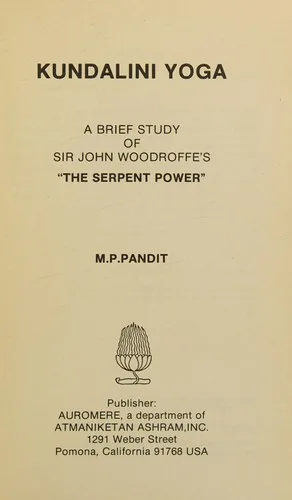
Kundalini yoga
 82
82

Kundalini yoga
Pandit’s "Kundalini Yoga" is a dense, academic treatment of a subject often clouded by sensationalism. Its strength lies in its methodical breakdown of the complex energetic mechanics involved, grounding the esoteric concepts in a framework of yogic physiology. The author meticulously details the ascent of Kundalini through the Sushumna, referencing specific yogic practices and their intended effects on the chakras. However, the prose, while precise, can be dry, demanding significant focus from the reader. A passage detailing the precise sequence of activations within the lower chakras, for instance, showcases this thoroughness but also the book's inherent challenge for the uninitiated. It offers a scholarly perspective, but lacks the experiential anecdotes that might illuminate the subjective nature of these profound states for a broader audience. This is a manual for the dedicated student, not a gentle introduction.
📝 Description
82
M. P. Pandit's 1968 book details Kundalini as a physiological and psychological force.
Published in 1968, M. P. Pandit's "Kundalini Yoga" approaches the subject not as metaphor but as a tangible force. The book maps the energy's ascent through the subtle body and the chakras, energetic centers that influence consciousness. Pandit outlines the mechanisms involved in awakening this serpentine power, which resides at the base of the spine.
The work is written for serious students of yoga and esoteric philosophy. It aims to provide a systematic understanding of Kundalini, moving beyond introductory material. Readers interested in the energetic and physiological aspects of spiritual growth, and those pursuing advanced yogic aims, will find value here. A basic familiarity with yoga principles is recommended for full comprehension of Pandit's detailed explanations.
Emerging in 1968, a time of growing Western interest in Eastern spirituality, Pandit's "Kundalini Yoga" offered a focused, systematic study of a specific yogic practice. While figures like Vivekananda had introduced Vedanta earlier and the Theosophical Society was established, this book concentrated on the physiological and psychological mechanics of Kundalini. It sought to bridge ancient yogic science with contemporary understanding, contributing to the intellectual discourse on spiritual development.
💡 Why Read This Book?
• Gain a systematic understanding of the Kundalini Shakti's mechanics, including its ascent through the Sushumna Nadi, as detailed in Chapter IV, offering clarity beyond metaphorical descriptions. • Learn about the specific functions and energetic significance of each of the seven primary chakras, as explained in Pandit's detailed analysis, providing a map for inner exploration. • Discover the foundational role of Pranayama and specific meditative techniques, as outlined in the early chapters, essential for preparing the physical and subtle bodies for energetic awakening.
⭐ Reader Reviews
Honest opinions from readers who have explored this book.
❓ Frequently Asked Questions
What is the primary focus of M. P. Pandit's "Kundalini Yoga"?
The book focuses on the scientific and physiological aspects of Kundalini Yoga, detailing the awakening and ascent of Kundalini energy through the central nervous system (Sushumna) and its interaction with the chakras.
When was "Kundalini Yoga" by M. P. Pandit first published?
M. P. Pandit's "Kundalini Yoga" was first published in 1968, reflecting a period of increased Western interest in Eastern spiritual practices.
Does the book offer practical exercises for Kundalini awakening?
Yes, while emphasizing preparation and understanding, the work discusses yogic practices like Pranayama and meditation that are considered essential prerequisites for the safe and effective awakening of Kundalini.
What level of yoga knowledge is assumed for readers of this book?
The book assumes a foundational knowledge of yoga principles and practices. It is written for serious students and practitioners aiming for a deeper, more systematic understanding of Kundalini.
How does Pandit's work compare to other books on Kundalini from the 1960s?
Pandit's "Kundalini Yoga" offers a more systematic and less anecdotal approach compared to some other popular works of the era, focusing on the mechanics and theory behind the energy's activation.
What is the significance of the Sushumna Nadi in this text?
The Sushumna Nadi is presented as the central channel within the subtle body through which the Kundalini energy ascends. Pandit elaborates on its role in facilitating spiritual transformation.
🔮 Key Themes & Symbolism
The Mechanics of Kundalini Shakti
Pandit meticulously details Kundalini as a dormant spiritual force, often visualized as a coiled serpent. The work focuses on its physical and energetic pathways, particularly the Sushumna Nadi, the central channel in the subtle body. It outlines the process of its awakening and ascent, emphasizing the necessity of preparation and controlled practice to avoid adverse effects. This systematic approach distinguishes it from more mystical or purely metaphorical treatments of the subject.
Chakras as Energetic Hubs
The book elaborates on the seven primary chakras, describing them not just as abstract energy centers but as crucial junctures in the Kundalini's journey. Pandit explains how the rising energy activates and purifies these centers, leading to shifts in consciousness and the manifestation of specific psychic abilities or spiritual states. Each chakra is linked to particular physiological and psychological functions.
Pranayama and Subtle Body Preparation
A significant portion of Pandit's exploration centers on the vital role of Pranayama (yogic breathing techniques) and other yogic disciplines. These practices are presented as essential tools for purifying the Nadis (energetic channels) and strengthening the subtle body, creating a safe conduit for the powerful Kundalini energy. The work stresses that direct attempts at awakening without this foundational preparation are ill-advised.
Spiritual Realization Through Energy Ascent
The ultimate goal presented is not merely the experience of Kundalini's power, but the attainment of spiritual liberation (Moksha) and self-realization. The ascent of Kundalini through the chakras, culminating in its union with the Sahasrara chakra (crown center), is depicted as the process by which individual consciousness merges with the Universal Consciousness. This aligns with classical yogic philosophy's aim.
💬 Memorable Quotes
Direct passages from the work, attributed to the author.
“Kundalini is the force of consciousness that manifests the universe.”
— This interpretation highlights Pandit's view of Kundalini not just as personal psychic energy but as a fundamental cosmic power, the very ground of existence and manifestation.
“The Sushumna is the main channel for the passage of Kundalini.”
— This emphasizes the critical anatomical focus of the book: the Sushumna Nadi is the primary pathway for the energy's upward journey, central to the yogic science described.
“Pranayama is essential for purifying the subtle body.”
— This interpretation underscores the importance Pandit places on breath control as a preparatory practice, necessary for clearing the energetic channels before Kundalini can safely rise.
💡 Key Ideas
Editorial paraphrase of the work's core concepts — not direct quotes.
Chakras are centers of consciousness and vital force.
This paraphrase points to the dual nature of the chakras as described by Pandit—both seats of psychic awareness and nodes for the flow of life-energy (Prana).
The awakening leads to higher states of consciousness.
This paraphrase captures the transformative potential discussed, indicating that the activation of Kundalini is intrinsically linked to profound shifts in awareness and spiritual development.
🌙 Esoteric Significance
Tradition
Pandit's work aligns with the Tantric and Hatha Yoga traditions, which systematically explore the manipulation of subtle energies (Shakti) for spiritual evolution. It builds upon classical yogic texts like the Hatha Yoga Pradipika and Upanishads, offering a detailed physiological interpretation of concepts like Kundalini, Nadis, and Chakras. While rooted in these ancient lineages, the book presents the material with a clarity and structure often associated with modern scientific discourse.
Symbolism
The primary symbol is the coiled serpent, representing dormant Kundalini Shakti, the primal creative energy. The Sushumna Nadi, the central energetic channel, acts as the axis or pathway for this energy's ascent. The Chakras are depicted as lotuses or wheels, signifying stages of consciousness and energetic transformation as Kundalini passes through them, culminating in the thousand-petaled lotus of the Sahasrara.
Modern Relevance
Pandit's detailed exposition continues to inform contemporary practitioners and scholars of yoga, particularly those interested in the energetic and physiological aspects of spiritual practice. His systematic approach influences modern yoga therapy and advanced Hatha Yoga studies. Thinkers and practitioners focusing on subtle anatomy, energy work, and the science of consciousness often reference his foundational explanations of Kundalini's mechanics.
👥 Who Should Read This Book
• Advanced yoga practitioners seeking to understand the energetic mechanics behind deeper yogic states and the ascent of Kundalini. • Students of esoteric philosophy interested in the physiological and scientific underpinnings of yogic traditions as presented by Pandit. • Comparative religion scholars examining the specific doctrines and practices within Tantric and Hatha Yoga lineages.
📜 Historical Context
M. P. Pandit's "Kundalini Yoga," released in 1968, emerged during a period of significant Western engagement with Eastern philosophies, spurred by figures like Swami Vivekananda and the Theosophical Society's earlier efforts. While popular interest often focused on meditation and basic yoga postures, Pandit’s work provided a more technical and systematic exposition of Kundalini, a subject often sensationalized or misunderstood. It appeared alongside a growing wave of spiritual literature, attempting to bridge ancient yogic science with contemporary understanding. Unlike more broadly philosophical Vedanta texts prevalent at the time, Pandit’s book zeroed in on the specific energetic mechanics of Kundalini, aiming for a scientific rather than purely devotional approach. Its publication helped to solidify a more detailed, physiological interpretation of these practices within the evolving field of Western esotericism.
📔 Journal Prompts
The energetic significance of the Sushumna Nadi in the Kundalini ascent process.
How the activation of specific chakras might manifest according to Pandit's descriptions.
The role of Pranayama in preparing the subtle body for energetic shifts.
Reflecting on the relationship between Kundalini Shakti and Universal Consciousness.
Identifying potential areas of personal practice that align with Pandit's foundational requirements.
🗂️ Glossary
Kundalini Shakti
The dormant spiritual energy, often symbolized as a coiled serpent, located at the base of the spine, believed to be the source of consciousness and creation.
Sushumna Nadi
The central, most important energetic channel within the subtle body, running along the spine, through which Kundalini is said to ascend.
Chakra
Energetic centers or 'wheels' located along the Sushumna, each associated with specific psychological states, physiological functions, and spiritual potentials.
Pranayama
The yogic practice of controlling the breath, considered essential for purifying the Nadis and preparing the body for the awakening of Kundalini.
Nadi
Energetic channels or pathways within the subtle body through which Prana (life force) flows. The Sushumna, Ida, and Pingala are considered the most important.
Moksha
Liberation or release from the cycle of birth and death; spiritual enlightenment and self-realization, often considered the ultimate goal of yoga.
Sahasrara Chakra
The crown chakra, the seventh primary chakra, located at the top of the head, associated with pure consciousness and spiritual union.
🔮 Readers Also Liked
Browse all →









More by M. P. Pandit
All books →

More Free Occult Philosophy Books
View all →