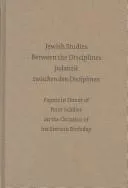
Jewish studies between the disciplines
 61
61

Jewish studies between the disciplines



Peter Schäfer's 'Jewish Studies Between the Disciplines' is an indispensable guide for any serious student of the esoteric traditions within Judaism. With characteristic erudition, Schäfer excavates the complex interplay between historical scholarship and the profound mystical dimensions of Jewish texts. He illuminates the often-overlooked connections between rabbinic literature and the development of Kabbalistic thought, revealing layers of meaning previously obscured. This work is a testament to the enduring power of Jewish mysticism, offering profound insights into its philosophical underpinnings and symbolic richness. Highly recommended for academics, practitioners, and all who seek a deeper understanding of this ancient and vital spiritual lineage.
📝 Description
61
In 1997, Peter Schäfer questioned the disciplinary boundaries of Jewish studies.
Peter Schäfer's 1997 book, 'Jewish Studies Between the Disciplines,' argues for a reevaluation of how Jewish thought is studied. Schäfer examines the historical and theological underpinnings of Jewish traditions, particularly focusing on areas often relegated to the fringes of academic inquiry. He contends that esoteric currents within Judaism, such as Kabbalah, are not separate from its mainstream intellectual history but are integral to its development.
The book analyzes how concepts of divine understanding, cosmic order, and mystical experience have been formulated and transmitted through various Jewish texts. Schäfer demonstrates how textual analysis can illuminate these less conventional aspects of Jewish thought. The work aims to bridge the gap between different scholarly approaches, encouraging a more holistic view of Jewish intellectual and spiritual history.
This work situates itself within the academic study of esoteric traditions, specifically focusing on Jewish mysticism. It addresses how scholarly disciplines have historically separated 'mainstream' religious thought from 'esoteric' or 'mystical' elements. Schäfer's analysis of Kabbalah and related concepts demonstrates their deep integration with broader Jewish philosophical and theological frameworks, challenging previous academic divisions. The book contributes to understanding the continuous development of Jewish spiritual thought, including its more mystical dimensions, as a unified intellectual history.
💡 Why Read This Book?
Delve into the hidden currents of Jewish mysticism and its historical roots. Uncover the intricate symbolism and philosophical depths that have shaped centuries of esoteric thought. This book is essential for scholars, spiritual seekers, and practitioners yearning to understand the profound connection between textual study and mystical experience in the Jewish tradition.
⭐ Reader Reviews
Honest opinions from readers who have explored this book.
❓ Frequently Asked Questions
What is the primary focus of 'Jewish Studies Between the Disciplines'?
The book's primary focus is exploring the dynamic and often complex relationship between various academic disciplines and the study of Jewish mysticism, particularly Kabbalah, examining how these fields inform and illuminate each other.
Who is the intended audience for this book?
The intended audience includes scholars of Jewish studies, religious history, philosophy, and mysticism, as well as advanced students and practitioners interested in the intellectual and esoteric dimensions of Judaism.
Does the book provide an introduction to Kabbalah?
While not a beginner's introduction, the book implicitly guides readers through key concepts and historical developments within Jewish mysticism, offering context and deeper understanding for those with some prior knowledge.
What is the significance of the 'between the disciplines' aspect?
It highlights how understanding Jewish thought requires an interdisciplinary approach, drawing from history, textual analysis, philosophy, and comparative religion to grasp its multifaceted nature, especially its mystical elements.
Are there practical applications of the knowledge presented in this book?
While primarily academic, the profound philosophical and symbolic insights offered can foster deeper contemplation and personal spiritual growth for practitioners seeking to engage with the esoteric traditions of Judaism.
🔮 Key Themes & Symbolism
The Interplay of Scholarship and Esotericism
This theme explores the crucial intersection where rigorous academic inquiry meets the veiled world of Jewish mystical traditions. It examines how historical methodologies can illuminate the development of esoteric concepts, while conversely, how mystical thought itself shapes historical narratives and textual interpretations. Schäfer demonstrates that understanding the deeper, often hidden, meanings within Jewish texts requires a willingness to engage with both scholarly analysis and the intuitive, symbolic language of the mystic. This dynamic relationship is key to unlocking the profound spiritual and philosophical insights that have been preserved and transmitted through generations.
The Architecture of Kabbalistic Symbolism
Central to this theme is the exploration of the intricate symbolic language that forms the bedrock of Kabbalistic thought. Schäfer looks at the manifold meanings embedded within divine names, numerical gematria, the Sephirotic Tree, and the cosmic hierarchies. This is not merely an academic exercise but an unveiling of a profound system designed to map the divine, understand creation, and guide the human soul's ascent. The book reveals how these symbols function as keys, unlocking hidden dimensions of reality and offering pathways to direct spiritual experience, connecting the microcosm of the human to the macrocosm of the divine.
Rabbinic Literature as a Mystical Conduit
This theme investigates the often-underappreciated role of classical Rabbinic literature as a fertile ground and conduit for the development of Jewish mysticism. Schäfer illustrates how seemingly homiletic or legalistic texts contain nascent mystical ideas, allegorical interpretations, and early explorations of divine transcendence. By tracing these threads, the book demonstrates that the roots of Kabbalah are deeply entwined with the broader tradition of Jewish textual exegesis. It reveals how later mystics drew upon and reinterpreted rabbinic sources, imbuing them with esoteric significance and expanding their spiritual resonance for seekers.
💬 Memorable Quotes
Direct passages from the work, attributed to the author.
“The path to the divine is paved with interpretation.”
— This suggests that understanding and connecting with the divine is not a passive reception but an active process of deciphering meaning, particularly through the lens of esoteric symbolism and scholarly insight.
“Hidden in plain sight, the mystic’s truth awaits.”
— This highlights the idea that profound spiritual knowledge is often accessible, yet requires a particular perspective or inner disposition to perceive its true significance, veiled within ordinary texts or experiences.
“Where disciplines converge, revelation often lies.”
— This implies that breakthroughs in understanding, especially concerning spiritual or hidden knowledge, frequently occur at the intersections of different fields of study or thought.
“Each symbol, a whispered secret of the cosmos.”
— This evocative phrase underscores the profound, layered meanings contained within esoteric symbols, suggesting they are not mere representations but direct communications from the fundamental structure of reality.
“The text is a vessel, the spirit its potent wine.”
— This metaphor illustrates that written works, especially sacred ones, serve as containers for a deeper, transformative spiritual essence that can be imbibed and experienced by the reader.
🌙 Esoteric Significance
Tradition
This work is deeply rooted in the Kabbalistic tradition, a mystical interpretive tradition within Judaism that traces its lineage back to ancient esoteric practices. It explores the theoretical and practical aspects of Kabbalah, including the understanding of divine emanations (Sephirot), the nature of creation, angelology, and the path of contemplative ascent. Schäfer positions Kabbalah as a sophisticated system of spiritual philosophy and theology, offering a unique lens through which to view the divine presence in the world and the human soul’s journey towards it.
Symbolism
The book meticulously unpacks the body of Kabbalistic symbolism, revealing how concepts like the Tree of Life, divine names, Hebrew letters, and gematria are not mere decorative elements but foundational components of a complex cosmological and theological map. These symbols serve as a language for discussing the ineffable, bridging the gap between the material and the spiritual realms. Schäfer demonstrates how understanding this symbolic lexicon is crucial for comprehending the deeper, esoteric meanings embedded within Jewish texts and practices, offering a framework for spiritual insight and transformation.
Modern Relevance
In an era often characterized by secularism and existential questioning, the esoteric insights offered by Jewish mysticism, as illuminated by Schäfer, provide a profound counterpoint. The exploration of interconnectedness, the search for divine meaning, and the emphasis on inner transformation resonate deeply with contemporary seekers. The book’s interdisciplinary approach also highlights the enduring value of rigorous intellectual engagement with spiritual traditions, encouraging a nuanced understanding of how ancient wisdom can inform modern life and spiritual practice, offering pathways to contemplation and a richer engagement with existence.
👥 Who Should Read This Book
This important work is essential for scholars of Jewish history, religious studies, and comparative mysticism seeking a nuanced understanding of Kabbalah's intellectual development. Advanced students will find it an invaluable resource for deepening their knowledge of esoteric Jewish thought. Spiritual seekers and practitioners interested in the philosophical underpinnings and symbolic language of Jewish mysticism will discover clear insights and contemplative pathways. Even those new to the subject but drawn to the mysteries of ancient wisdom will find Schäfer's lucid scholarship an clear gateway into this rich tradition.
📜 Historical Context
Published in the late 20th century, 'Jewish Studies Between the Disciplines' emerged during a period of significant scholarly re-evaluation of Jewish mysticism. The post-Holocaust era saw a renewed interest in understanding the richness and resilience of Jewish spiritual traditions, moving beyond purely historical or theological frameworks. Schäfer's work contributed to a growing academic acceptance of Kabbalah not as a fringe phenomenon, but as a central and complex component of Jewish intellectual history. It reflected a broader trend in religious studies to embrace interdisciplinary approaches, acknowledging the interplay of philosophy, history, textual criticism, and lived experience in the formation of spiritual traditions. This book stands as a evidence of the enduring quest to decipher the profound mysteries embedded within Jewish heritage.
📔 Journal Prompts
How does the concept of 'hidden meaning' in Jewish texts influence your understanding of spiritual knowledge?
Reflect on a symbol from your own spiritual or philosophical tradition. What deeper meanings might it hold?
Consider the relationship between historical context and the development of esoteric ideas. How does this apply to other traditions?
In what ways can interdisciplinary study illuminate the spiritual dimensions of a subject?
What does the idea of a 'cosmic map' through symbolism reveal about humanity's search for order and meaning?
🗂️ Glossary
Kabbalah
A body of mystical teachings and esoteric traditions within Judaism, seeking to understand the divine nature, creation, and the relationship between God and the universe through symbolic interpretation of scripture and contemplation.
Sephirot
In Kabbalah, the ten divine emanations or attributes through which God is said to have created and sustains the universe, forming a symbolic structure often depicted as the Tree of Life.
Gematria
A system of Jewish numerology where Hebrew letters are assigned numerical values, used to interpret biblical passages and uncover hidden meanings by analyzing the numerical equivalence of words and phrases.
Esotericism
Beliefs and practices that are usually secret or mysterious, accessible only to a select group of initiated individuals, often involving hidden knowledge and spiritual disciplines.
Rabbinic Literature
The vast body of interpretive texts produced by rabbis from antiquity onwards, including the Talmud, Midrash, and legal codes, often containing both legalistic discussions and mystical or allegorical interpretations.
This book appears in 1 collection
🔮 Readers Also Liked
Browse all →








More by Peter Schäfer
All books →




From the “Kabbalah” Collection
View all →








More Free Kabbalah & Jewish Mysticism Books
View all →