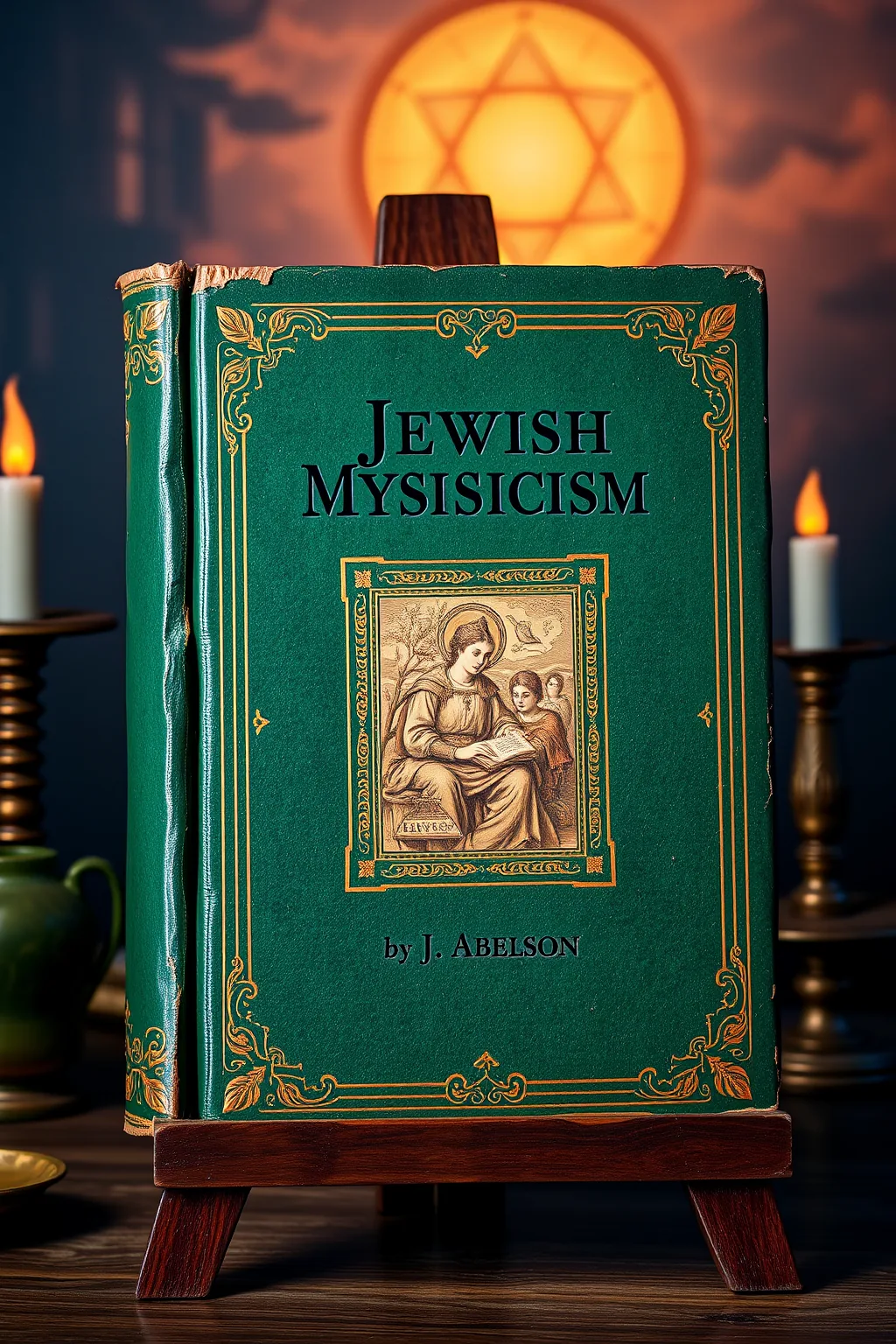
Jewish Mysticism
 61
61

Jewish Mysticism


Celeste Moreau (Divination & Symbolism Reviewer) — J. Abelson’s 'Jewish Mysticism' stands as a beacon for understanding the esoteric dimensions of Jewish thought. Abelson meticulously deciphers the complex symbolism and philosophical underpinnings of Kabbalah, offering profound insights into divine names, angelic hierarchies, and the nature of creation. This work is particularly valuable for its clear exposition of intricate concepts, making the mystical accessible without sacrificing its depth. It is an essential read for scholars of comparative mysticism, practitioners seeking a deeper theoretical framework, and anyone fascinated by the profound spiritual quest embedded within Jewish tradition.
📝 Description
61
J. Abelson's 'Jewish Mysticism' was published in 1913, offering an early scholarly overview of Kabbalistic thought.
First published in 1913, J. Abelson's 'Jewish Mysticism' serves as an introduction to the complex symbolic language and theological concepts within Jewish esoteric traditions. The book examines the structure of the Kabbalah, including the sefirot, or divine emanations, and the various schools of thought that developed around these ideas. Abelson details the mystical experiences and contemplative practices associated with Jewish mysticism, aiming to make these often-obscure elements accessible to a wider audience.
The work covers key figures and texts, outlining the historical development of Kabbalistic thought. It discusses the philosophical underpinnings that connect Jewish mysticism to broader theological discussions within Judaism. The author's intent was to provide a clear exposition of a tradition that was frequently misunderstood or misrepresented. This book remains a valuable resource for understanding the foundational elements of Jewish mystical thought and its place in religious history.
Jewish mysticism, particularly Kabbalah, developed over centuries with roots in ancient Hebraic traditions. Early forms like Merkabah mysticism focused on visionary ascent to the divine throne. Later, Kabbalah systematized these ideas, notably through texts like the Zohar in the 13th century, positing a complex structure of divine emanations (sefirot) that mediate between God and creation. Abelson's work, published in the early 20th century, represents an effort to synthesize and explain these historical developments and core doctrines for a modern audience, placing it within a lineage of academic study of esoteric traditions.
💡 Why Read This Book?
Embark on a transformative journey into the heart of Jewish mystical thought. 'Jewish Mysticism' by J. Abelson offers an unparalleled exploration of Kabbalistic wisdom, revealing hidden spiritual truths and profound symbolic language. Ideal for seekers yearning for deeper meaning, scholars delving into esoteric traditions, and practitioners aiming to enrich their spiritual practice with ancient insights.
⭐ Reader Reviews
Honest opinions from readers who have explored this book.
❓ Frequently Asked Questions
What is Kabbalah?
Kabbalah is the esoteric and mystical tradition within Judaism that seeks to understand the nature of God and the universe through symbolic interpretation of the Torah and contemplation of divine emanations.
Who was J. Abelson?
J. Abelson was a scholar and theologian known for his significant contributions to the study of Jewish mysticism, particularly his accessible and insightful works on Kabbalah.
Is this book suitable for beginners?
Yes, while the subject matter is profound, Abelson's clear prose makes 'Jewish Mysticism' a valuable starting point for those new to Kabbalistic concepts, offering a solid foundation for further exploration.
What are the main themes covered?
The book explores themes such as the Sefirot, divine names, creation cosmology, the nature of the soul, and the mystical path to God.
Can this book enhance spiritual practice?
Absolutely. By illuminating the underlying symbolism and philosophy of Jewish mysticism, the book provides a deeper context and understanding that can profoundly enrich personal spiritual practices and meditations.
🔮 Key Themes & Symbolism
The Tree of Life (Sefirot)
Central to Kabbalistic cosmology, the Sefirot represent ten divine emanations or attributes through which God interacts with creation. Abelson meticulously details each Sefirah, from Keter (Crown) to Malkhut (Kingdom), explaining their unique energies, symbolism, and interconnectedness. Understanding the Tree of Life is crucial for comprehending the divine blueprint of existence and the pathways of spiritual ascent, offering a map of consciousness and a framework for mystical experience.
Divine Names and Their Power
Jewish mysticism places immense significance on the power inherent in divine names. Abelson explores various sacred names of God, such as YHWH and Elohim, and their associated mystical properties. These names are not mere labels but conduits of divine energy, believed to unlock spiritual potential and facilitate connection with the divine. The book examines the practice of contemplating and invoking these names as a means of spiritual transformation and accessing higher areas of consciousness.
The Soul's Journey and Reincarnation
The concept of the soul's eternal nature and its cyclical journey through existence is a profound aspect of Jewish mysticism. Abelson examines the Kabbalistic understanding of the soul's origins, its descent into the physical world, and its ultimate return to the divine source. The book touches upon the intricate doctrines of reincarnation (gilgul neshamot) and the spiritual lessons learned across multiple lifetimes, offering a comprehensive perspective on human destiny and spiritual evolution.
💬 Memorable Quotes
Direct passages from the work, attributed to the author.
“The visible world is but a shadow of the invisible.”
— This reflects the mystical principle of emanation, suggesting that the material reality we perceive is a less perfect reflection of higher, spiritual planes of existence.
“To know God is to approach Him.”
— This emphasizes the active, experiential nature of true spiritual knowledge within mysticism, where intellectual understanding is inseparable from the practice of seeking divine connection.
“The Sefirot are the garments of God.”
— This poetic analogy illustrates the concept of the Sefirot as divine attributes or manifestations that God uses to interact with and reveal Himself to creation.
“The light which is the source of all things.”
— This refers to the concept of Ein Sof (the Infinite) and its primordial light, the ultimate source from which all existence emanates and to which all returns.
💡 Key Ideas
Editorial paraphrase of the work's core concepts — not direct quotes.
The whole of the Torah is nothing but the names of God.
This quote highlights the Kabbalistic view that the sacred text is not merely a historical or legal document, but a divine revelation alive with the very essence of God, encoded in its letters and names.
🌙 Esoteric Significance
Tradition
This work is deeply rooted in the Kabbalistic tradition, the mystical and esoteric branch of Judaism. It explores concepts like the Sefirot, divine emanations, the structure of the cosmos, and the nature of the soul as understood within this lineage. The book serves as a gateway to understanding the hidden dimensions of Jewish spiritual practice and theology, offering insights into a profound system of metaphysical thought and contemplative practice.
Symbolism
Jewish mysticism is rich with symbolism, and Abelson examines its core elements. Key symbols include the Tree of Life (Sefirot) as a map of divine manifestation, the Hebrew alphabet as a creative force, and divine names as potent energies. The book interprets these symbols not as mere allegories, but as keys to unlocking deeper spiritual realities and understanding the intricate relationship between the Creator and creation.
Modern Relevance
The esoteric wisdom contained within 'Jewish Mysticism' remains remarkably relevant today. In an age seeking deeper meaning and spiritual connection, the Kabbalistic exploration of consciousness, the soul's journey, and the interconnectedness of all things offers useful insights. The symbolic language and contemplative practices can guide individuals toward greater self-understanding, spiritual growth, and a more profound appreciation of the sacred in everyday life.
👥 Who Should Read This Book
This key work is essential for a broad spectrum of readers. **Beginners** to Jewish mysticism will find Abelson's clear exposition an invaluable introduction to the foundational concepts of Kabbalah. **Scholars** of religion, philosophy, and comparative mysticism will appreciate its detailed analysis and historical context. **Seekers** of spiritual truth and deeper meaning will find a rich source of contemplation and guidance. **Practitioners** of meditation and esoteric disciplines will discover profound frameworks for understanding divine principles and enhancing their inner work.
📜 Historical Context
J. Abelson's 'Jewish Mysticism' emerges from a rich intellectual milieu, drawing upon centuries of esoteric development within Judaism. The book primarily engages with the Kabbalistic traditions that flourished from the medieval period onwards, particularly influenced by the Zohar and the Lurianic Kabbalah. This era saw a profound exploration of divine mysteries, gematria, and the symbolic interpretation of scripture as pathways to spiritual enlightenment. The historical context is one of intense philosophical inquiry and mystical yearning, often arising in communities facing persecution, where esoteric knowledge offered solace, meaning, and a connection to the divine.
📔 Journal Prompts
Reflect on the concept of divine emanation. How does the idea of God extending into creation resonate with your personal understanding of the divine?
Consider the symbolism of one of the Sefirot. How might its attributes be present or expressed in your own life or the world around you?
Explore the significance of divine names. What power or essence do you associate with the names or titles you use for the divine or for yourself?
Ponder the journey of the soul. What spiritual lessons or growth do you believe you are currently undergoing or have undergone in your life?
How can the principle of interconnectedness, as explored in Jewish mysticism, inform your relationships and your perception of the world?
🗂️ Glossary
Kabbalah
The esoteric and mystical tradition within Judaism, focused on understanding the divine nature and the secrets of creation through symbolic interpretation and contemplation.
Sefirot
Ten divine emanations or attributes through which God manifests and interacts with the created universe, forming the structure of the Kabbalistic Tree of Life.
Ein Sof
The Kabbalistic term for God as the Infinite, Unknowable, and Absolute Being, beyond all comprehension or description.
Torah
The first five books of the Hebrew Bible, considered by Jewish tradition to be divinely revealed and containing profound spiritual and mystical secrets.
Gilgul Neshamot
The Kabbalistic doctrine of the transmigration or reincarnation of souls, which posits that souls may undergo multiple lives to complete their spiritual journey.
This book appears in 1 collection
🔮 Readers Also Liked
Browse all →








More by J. Abelson
All books →
From the “Kabbalah” Collection
View all →








More Free Kabbalah & Jewish Mysticism Books
View all →