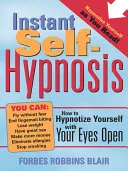
Instant Self-Hypnosis
 75
75

Instant Self-Hypnosis
Forbes Robbins Blair’s *Instant Self-Hypnosis* offers an intriguing premise: to make self-hypnosis as accessible as reading a book. The central conceit, that one can achieve a hypnotic state while reading with eyes open, is certainly attention-grabbing. Blair’s method, which eschews the need for pre-recorded scripts, is its strongest asset, appealing to those who find traditional self-hypnosis setups inconvenient. The text itself guides the reader through stages of relaxation and suggestion seamlessly. However, the effectiveness hinges heavily on the reader’s inherent suggestibility and focus; for some, the very act of reading and processing text might remain a barrier to deep trance. A passage describing the sensation of detachment while maintaining visual contact with the page illustrates the book's core promise, though its universality is debatable. Ultimately, *Instant Self-Hypnosis* is an innovative concept that, while not a universal panacea, provides a unique and potentially efficient pathway for those seeking self-directed mental change.
📝 Description
75
Forbes Robbins Blair's Instant Self-Hypnosis, published in March 2004, teaches readers to enter hypnotic states while reading.
Forbes Robbins Blair's 2004 book, Instant Self-Hypnosis, introduces a unique method for self-induced trance states. Unlike conventional techniques that often require memorized scripts or audio guides, Blair's approach integrates hypnosis directly into the act of reading. The reader can achieve a hypnotic state with their eyes open, remaining engaged with the text without interruption. This technique aims to remove the perceived complexity of hypnosis and make its benefits readily available to anyone.
The book is for individuals looking for practical, self-managed methods for personal improvement. It will appeal to those who found standard self-hypnosis approaches difficult or time-consuming. Readers interested in altering subconscious patterns to change behaviors, improve concentration, or develop specific mental attitudes will find this direct, integrated method useful. It also caters to those curious about hypnosis's effectiveness when presented in an unusual format.
Published before the widespread use of digital wellness tools, Instant Self-Hypnosis emerged during a time of increased interest in applied psychology and self-help. While hypnosis has a history dating back to Franz Mesmer and was further developed by figures like Milton H. Erickson, Blair's book was designed for a modern audience facing constant information and seeking efficient self-improvement tools.
Instant Self-Hypnosis fits within a broader esoteric interest in mind-body techniques and immediate personal transformation. While not strictly occult, its premise of directly influencing the subconscious through a text taps into traditions that explore mental discipline and altered states for personal growth. This connects to movements that sought to demystify or simplify access to inner states, moving beyond lengthy rituals or complex initiations to offer a more direct path to mental and emotional change, aligning with a modern, pragmatic approach to spiritual or psychological development.
💡 Why Read This Book?
• Learn a method for entering self-hypnosis directly through reading, a technique distinct from traditional audio-based or script-memorization approaches, as detailed in Blair's unique textual guidance. • Discover how to reprogram subconscious behaviors without needing to record your own voice or memorize lengthy affirmations, leveraging the direct suggestion method presented in the book. • Experience a unique form of focused consciousness by utilizing the "reading-while-hypnotized" concept, applying principles of immediate suggestibility discussed within the 2004 publication.
⭐ Reader Reviews
Honest opinions from readers who have explored this book.
❓ Frequently Asked Questions
Can I really hypnotize myself just by reading a book?
Forbes Robbins Blair's method in *Instant Self-Hypnosis* is designed precisely for this. By following the text's specific instructions and pacing, the book aims to guide the reader into a hypnotic state while their eyes remain open and engaged with the pages.
What if I'm not good at hypnosis or visualizing?
The book's approach is intended to be accessible even for beginners. It bypasses complex visualization requirements by integrating the hypnotic induction directly into the reading process itself, making it less dependent on traditional hypnotic skills.
How does this differ from other self-hypnosis books?
Unlike most self-hypnosis guides that require separate script recordings or memorization, *Instant Self-Hypnosis* allows you to achieve the state directly while reading the book, without putting it down or closing your eyes.
What kinds of changes can I expect from using this method?
The book suggests it can help reprogram unwanted behaviors, enhance focus, and cultivate desired mental states. The core idea is to influence the subconscious mind directly through the unique reading-based hypnotic technique.
When was Instant Self-Hypnosis first published?
Instant Self-Hypnosis by Forbes Robbins Blair was first published on March 1, 2004.
Is this book suitable for people who have never tried self-hypnosis before?
Yes, the book is specifically designed for ease of use. Its innovative method aims to make self-hypnosis accessible to newcomers by integrating the process directly into the act of reading.
🔮 Key Themes & Symbolism
Direct Suggestion Through Text
The core innovation of *Instant Self-Hypnosis* lies in its method of delivering hypnotic suggestions directly via the written word. Unlike conventional approaches demanding audio recordings or memorized affirmations, Forbes Robbins Blair's technique leverages the act of reading itself to induce a suggestible state. This bypasses the need for external aids, positioning the book as both the instruction manual and the hypnotic stimulus simultaneously. The effectiveness relies on the reader's engagement with the text, transforming passive reading into an active self-modification process.
Eyes-Open Hypnosis
A significant departure from traditional hypnosis, which often involves closed eyes and deep relaxation, this book explores the possibility of achieving trance states with the eyes open. This feature is crucial to its "instant" and integrated approach. It suggests that focused attention on the text can create an altered state of consciousness without requiring the reader to disengage from their immediate visual environment, making the practice more discreet and adaptable to various settings.
Subconscious Reprogramming
The underlying goal of *Instant Self-Hypnosis* is to empower readers to alter unwanted behaviors and thought patterns by directly influencing their subconscious mind. The book posits that through its unique reading-based hypnotic technique, individuals can implant new suggestions and reframe ingrained responses. This focus on internal change aligns with broader esoteric and psychological interests in the power of the subconscious to shape reality and personal experience.
Accessibility of Hypnosis
Forbes Robbins Blair sought to democratize the practice of self-hypnosis. By developing a method that requires no special equipment, prior training, or memorization, the book aims to make hypnosis accessible to a wider audience. The 2004 publication date places it in an era where self-help tools were becoming increasingly popular, and this book offered a particularly straightforward and immediate entry point into a practice often perceived as complex or inaccessible.
💬 Memorable Quotes
Direct passages from the work, attributed to the author.
“The only self-hypnosis book that allows you to hypnotize yourself as you read, with your eyes wide open, without putting down the book.”
— This statement expresses the book's unique selling proposition. It highlights the integrated, immediate, and accessible nature of the method, contrasting it sharply with conventional self-hypnosis techniques that require separate preparations.
“Hypnosis is a proven technique that allows people to reprogram their subconscious to change unwanted behaviors.”
— This is a foundational assertion within the book, framing hypnosis not as mere entertainment or esoteric mystery, but as a practical tool for psychological self-improvement and behavioral modification.
“Most books on self-hypnosis require the reader to memorize or record scripts...”
— This highlights the perceived drawback of existing methods, setting the stage for Blair's alternative approach. It identifies the inconvenience and barrier to entry that the book aims to overcome.
“The author's fail-proof method allows you to put yourself into a hypnotic state...”
— This emphasizes the confidence the author has in his technique, suggesting a high degree of reliability and ease of use for the reader seeking self-directed trance induction.
“...with your eyes wide open...”
— This detail underscores the unconventional nature of the method, differentiating it from traditional hypnosis practices that typically involve closing the eyes and focusing inward.
🌙 Esoteric Significance
Tradition
While not explicitly tied to a single esoteric lineage like Hermeticism or Kabbalah, *Instant Self-Hypnosis* taps into the broader Western Esoteric tradition's interest in consciousness alteration and the power of the mind. It aligns with practical occultism and magical traditions that emphasize focused will and suggestion for achieving desired outcomes. The book’s focus on self-directed mental manipulation can be seen as a modern, secular interpretation of techniques aimed at accessing deeper psychological or even spiritual potentials through disciplined mental states.
Symbolism
The book's primary symbolic mechanism is the text itself acting as a sigil or focal point for consciousness. The act of reading, typically a cognitive process, is transformed into a gateway for trance. The 'eyes wide open' concept can symbolize maintaining awareness of the external world while influencing the internal one—a form of operating within the mundane sphere while accessing altered states, perhaps reflecting an alchemical idea of transformation occurring within the existing vessel.
Modern Relevance
Blair's work speaks to contemporary interest in mindfulness, cognitive behavioral therapy (CBT), and self-directed neuroplasticity. While the book predates the widespread proliferation of mindfulness apps, its core principle of using focused attention for mental change is highly relevant. Modern practitioners in fields ranging from performance psychology to self-improvement coaching might find its direct approach a useful conceptual precursor to current techniques emphasizing accessible, in-the-moment mental state management.
👥 Who Should Read This Book
• Individuals seeking practical, self-administered methods for behavior modification who find traditional hypnosis techniques too time-consuming or complex. • Readers interested in the intersection of psychology and esoteric self-improvement, looking for unique approaches to accessing subconscious states without specialized equipment. • Skeptics curious about the potential of hypnosis, who may be more inclined to engage with a method that integrates directly into a familiar activity like reading.
📜 Historical Context
Forbes Robbins Blair's *Instant Self-Hypnosis*, published in March 2004, emerged during a burgeoning period for accessible self-help literature and alternative therapies. The early 2000s saw a continued public fascination with mind-body connections, influenced by earlier waves of the New Age movement and increasing research into neuroplasticity. While hypnosis itself has a long history, dating back to figures like Franz Mesmer in the late 18th century and evolving through the work of psychoanalysts and therapists like Milton H. Erickson in the 20th century, Blair's contribution focused on a specific, streamlined application. His method bypassed the established practices of many hypnotherapists who relied on verbal suggestion, recorded audio, or detailed scriptwork. The book’s innovation lay in its integration of the hypnotic process directly into the act of reading, presenting a unique challenge to the conventional understanding of trance induction. This approach offered a practical, DIY alternative to more formal therapeutic settings or complex self-study guides, catering to an audience seeking immediate results with minimal prerequisites.
📔 Journal Prompts
The concept of 'reading-while-hypnotized': How does focusing attention on text alter your usual state of consciousness?
Blair's method for bypassing script memorization: What barriers did you previously perceive to practicing self-hypnosis?
The goal of reprogramming subconscious behavior: Identify one specific unwanted behavior you wish to address using this technique.
The 'eyes wide open' aspect of trance: How does maintaining visual awareness while inducing suggestibility change the experience?
The fail-proof nature of the method: Reflect on moments where you doubted your ability to achieve a desired mental state.
🗂️ Glossary
Subconscious
The part of the mind that is inaccessible to the conscious mind but affects and influences one's behavior and actions. In self-hypnosis, it's considered the seat of habits and deep-seated beliefs.
Reprogramming
The process of altering ingrained patterns of thought, belief, or behavior by introducing new suggestions or ideas, typically aimed at the subconscious mind.
Hypnotic State
An altered state of consciousness characterized by heightened suggestibility, focused attention, and often deep relaxation, achieved through various induction techniques.
Suggestibility
The degree to which an individual is receptive to suggestions, particularly those made during a hypnotic trance or altered state of consciousness.
Induction
The process or technique used to guide a person into a hypnotic state.
Behavioral Patterns
Recurring sequences of actions or reactions that an individual typically exhibits in response to specific stimuli or situations.
Fail-proof Method
A technique or process that the author claims is highly reliable and consistently achieves the intended results, minimizing the possibility of failure for the user.