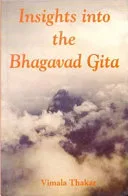
Insights into The Bhagavad Gita
 78
78

Insights into The Bhagavad Gita
Vimala Thakar's "Insights into The Bhagavad Gita" offers a refreshingly direct lens on this sacred text, eschewing convoluted exegesis for an emphasis on life's inherent unity. Her repeated assertion that the Gita deals with the 'organic wholeness of life' and its 'inbuilt complexity' is a powerful anchor. The strength lies in this persistent focus on the practical application of spiritual understanding, urging readers toward a constant state of communion with ultimate reality through action. However, the book’s structure, derived from spoken seminars, can sometimes feel a touch repetitive, and the absence of specific chapter references within the talks makes direct textual correlation challenging for a reader wanting to cross-reference Thakar’s points with specific verses of the Gita. A particularly resonant idea is the call to live in constant awareness of the interplay between the microcosm and macrocosm, not as a philosophical abstraction but as a lived reality. Ultimately, Thakar provides a vital, action-oriented perspective on the Bhagavad Gita for those weary of purely theoretical spiritual discourse.
📝 Description
78
Vimala Thakar spoke about the Bhagavad Gita in Italy between 1992 and 1993.
These talks by Vimala Thakar, recorded in Italy from 1992 to 1993, offer a distinct perspective on the Bhagavad Gita. Thakar moves beyond typical academic or devotional readings, focusing instead on how the scripture applies to all aspects of human life. She highlights its engagement with life's inherent complexity and the connections between things. The lectures are suited for individuals wanting a deeper, more complete grasp of spiritual texts. They will interest those drawn to philosophical questions that connect to everyday life, seeking to align their actions with a broader understanding of reality. Thakar's direct commentary challenges common spiritual ideas.
Thakar's interpretation emphasizes the Bhagavad Gita's view of life as an 'organic wholeness' with 'inbuilt complexity.' She points to the strong connection between individual experience and the larger universal order. A key idea is the need to stay connected to ultimate reality, not just through thought but through all actions and awareness. This approach encourages a unified way of being, where the inner life and outer actions are in harmony.
Vimala Thakar's lectures engage with the Bhagavad Gita, a central text in Hindu philosophy. Delivered in the early 1990s, these talks occurred as Eastern spiritual traditions gained more attention in the West. Thakar's work represents a contemporary engagement with ancient teachings. She aims to make its ideas relevant to modern people facing questions about wholeness and meaning in a world often perceived as broken. Her commentary seeks to reframe the scripture's message for a contemporary audience.
💡 Why Read This Book?
• Gain a practical framework for integrating spiritual awareness into daily actions, inspired by Thakar's focus on "everything that we do, at every moment" during her 1992-1993 Italian seminars. • Understand the Bhagavad Gita's emphasis on 'organic wholeness' and 'inbuilt complexity,' moving beyond intellectual grasp to a felt sense of interconnectedness. • Cultivate a constant union with ultimate reality, as Thakar proposes, by recognizing the dynamic interplay between the microcosm and macrocosm in your own life.
⭐ Reader Reviews
Honest opinions from readers who have explored this book.
❓ Frequently Asked Questions
What is the central message Vimala Thakar conveys about the Bhagavad Gita?
Vimala Thakar emphasizes that the Bhagavad Gita is sacred because it addresses the organic wholeness and inherent complexity of life, advocating for a continuous union with ultimate reality through all actions and moments.
When and where were Vimala Thakar's talks on the Bhagavad Gita originally given?
The talks that form "Insights into The Bhagavad Gita" were delivered in Italy during three separate seminars held in 1992 and 1993.
How does Thakar interpret the relationship between the individual and the universe?
She interprets the Bhagavad Gita as affirming the constant interplay between the microcosm (individual) and the macrocosm (universe), suggesting a deep connection that informs our existence.
Is this book a direct translation or commentary on the Bhagavad Gita?
No, "Insights into The Bhagavad Gita" is based on talks given by Vimala Thakar, offering her unique perspective and interpretation rather than a verse-by-verse commentary or translation.
What makes Thakar's approach to the Bhagavad Gita unique?
Her approach is unique in its focus on achieving union with ultimate reality not just intellectually, but through the entirety of one's actions and lived experience, emphasizing life's wholeness.
What does Thakar mean by the 'inbuilt complexity of life' in relation to the Gita?
She means that life is not simple but possesses an intricate, interwoven structure, and the Bhagavad Gita provides guidance on understanding and living within this inherent complexity.
🔮 Key Themes & Symbolism
Wholeness and Complexity
Thakar argues that the Bhagavad Gita's sacredness lies in its direct confrontation with life's 'organic wholeness' and 'inbuilt complexity.' This isn't a simple dichotomy, but a recognition of life's many-sided nature. The work suggests that true spiritual understanding arises from embracing this intricate structure, rather than seeking to simplify it. This theme encourages readers to perceive their existence not as a series of isolated events but as a unified, albeit complex, whole, deeply interconnected with the universal fabric.
Union with Ultimate Reality
A core message conveyed through Thakar's interpretation is the imperative to remain united with ultimate reality. This union is not presented as an esoteric goal achievable only through asceticism or deep meditation, but as a state to be maintained 'at every moment' and through 'everything that we do.' The Bhagavad Gita, in this light, becomes a guide for living in constant conscious connection, integrating spiritual awareness into the mundane activities of daily life.
Microcosm and Macrocosm
Thakar highlights the Bhagavad Gita's affirmation of the intricate interplay between the microcosm (the individual self) and the macrocosm (the universe or divine order). This concept suggests that our personal experiences and the grand cosmic processes are not separate but are in constant dialogue. Understanding this relationship is key to grasping the Gita's message of interconnectedness and the individual's place within the larger existential framework.
Action and Awareness
The interpretation strongly emphasizes that spiritual realization through the Bhagavad Gita is not confined to intellectual understanding. Instead, it necessitates a profound engagement through action. Thakar persuades readers that true connection with ultimate reality is forged through the conscious performance of one's duties and engagement with life. This theme underscores the idea that every action, performed with awareness, becomes a vehicle for spiritual growth and maintaining unity.
💬 Memorable Quotes
Direct passages from the work, attributed to the author.
“The Bhagavad Gita is sacred because it deals with the organic wholeness of life and the inbuilt complexity of life.”
— This statement frames the scripture not just as a religious text, but as a profound exploration of existence itself, acknowledging its intricate nature and interconnectedness as its core value.
“It affirms the interplay between the microcosm and macrocosm.”
— This highlights a fundamental esoteric principle: the idea that the individual experience mirrors and is connected to the larger universal order, a key concept for understanding one's place in the cosmos.
“It persuades us to remain united with the ultimate reality, not only to intellectual understanding but through everything that we do, at every moment.”
— This emphasizes a practical, lived spirituality, urging a continuous state of connection with the divine or absolute, integrated into every facet of daily action and awareness.
“The Bhagavad Gita deals with the inbuilt complexity of life.”
— This interpretation suggests the scripture acknowledges that life is not simple but possesses an intricate, interwoven structure, offering guidance on navigating this inherent intricacy.
“The work affirms the interplay between the microcosm and macrocosm.”
— This points to the scriptural validation of the connection between individual experience and the universal order, suggesting a reciprocal relationship that defines our existence.
🌙 Esoteric Significance
Tradition
While rooted in the Hindu tradition of the Bhagavad Gita, Thakar's interpretation leans into a universalist, experiential mysticism. It departs from rigid sectarianism, focusing on the Gita's potential to foster direct experience of ultimate reality. This aligns with broader perennialist philosophies that seek common threads across diverse spiritual paths, emphasizing the inner work and consciousness rather than adherence to specific dogmas or rituals.
Symbolism
The 'microcosm and macrocosm' is a key symbolic motif, representing the interconnectedness of the individual human being with the entire universe. Thakar's interpretation of the Bhagavad Gita emphasizes this relationship not as a metaphor but as a fundamental reality. Another implicit symbol is 'action' (karma yoga), which becomes a vehicle for spiritual realization, symbolizing the practical manifestation of inner truth in the external world.
Modern Relevance
Thakar's work speaks to contemporary seekers interested in non-dual philosophies and integrated living. It speaks to mindfulness practitioners and those exploring conscious capitalism or ethical business, who seek to align their actions with a deeper purpose. Thinkers and groups focused on embodied spirituality and the practical application of ancient wisdom in the face of modern challenges find her direct, non-dogmatic approach particularly relevant.
👥 Who Should Read This Book
• Students of comparative religion seeking non-traditional interpretations of foundational Eastern texts, particularly those interested in how ancient scriptures speak to modern existential concerns. • Individuals engaged in personal spiritual development who desire to bridge the gap between intellectual understanding and daily lived experience, aiming for a more integrated sense of self. • Seekers of practical philosophy who are looking for guidance on how to act in the world while maintaining a connection to a larger reality, moving beyond abstract spiritual concepts.
📜 Historical Context
Vimala Thakar's "Insights into The Bhagavad Gita," first published in 2005, draws from talks given in 1992 and 1993. This period saw a continued Western interest in Eastern philosophies, influenced by movements like the counterculture of the 1960s and the rise of New Age thought. While figures like Swami Vivekananda had introduced Vedantic concepts to the West decades earlier, Thakar's approach in the early 90s offered a distinct, action-oriented interpretation. Her emphasis on 'organic wholeness' and 'inbuilt complexity' distinguished her from more purely devotional or strictly academic commentaries prevalent at the time. Unlike scholarly interpretations that might focus on historical context or philosophical schools like Advaita Vedanta, Thakar's work prioritizes the direct, lived experience of spiritual principles. There is no record of significant censorship or widespread critical reception by named scholars directly engaging with this specific series of talks, but her style reflects a broader trend of seeking accessible, existential meaning in ancient texts.
📔 Journal Prompts
The interplay between the microcosm and macrocosm in your daily interactions.
Reflect on the concept of 'organic wholeness' as it applies to your life.
How does 'everything that we do, at every moment' connect you to ultimate reality?
Exploring the 'inbuilt complexity' of a recent challenge you faced.
Practicing union with ultimate reality through a mundane task.
🗂️ Glossary
Bhagavad Gita
An ancient Indian scripture forming part of the Hindu epic Mahabharata, featuring a dialogue between Prince Arjuna and his charioteer Lord Krishna on duty, life, and the nature of reality.
Microcosm
The small, individual world or human being, seen as a reflection or miniature of the larger universe (macrocosm).
Macrocosm
The great world or universe, considered as a whole, often seen as containing principles mirrored in the microcosm.
Organic Wholeness
The concept that life and existence are not fragmented but form a single, interconnected, living entity, much like a biological organism.
Ultimate Reality
The fundamental nature of existence, the supreme being, or the absolute principle underlying all phenomena, often the goal of spiritual seeking.
Inbuilt Complexity
The inherent intricate and many-sided nature of life and existence, suggesting it is not simple but possesses deep, interwoven structures.
Vimala Thakar
An Indian spiritual teacher known for her direct and challenging approach to spiritual inquiry, emphasizing self-awareness and the integration of spiritual principles into daily life.