I Ching
 62
62

I Ching



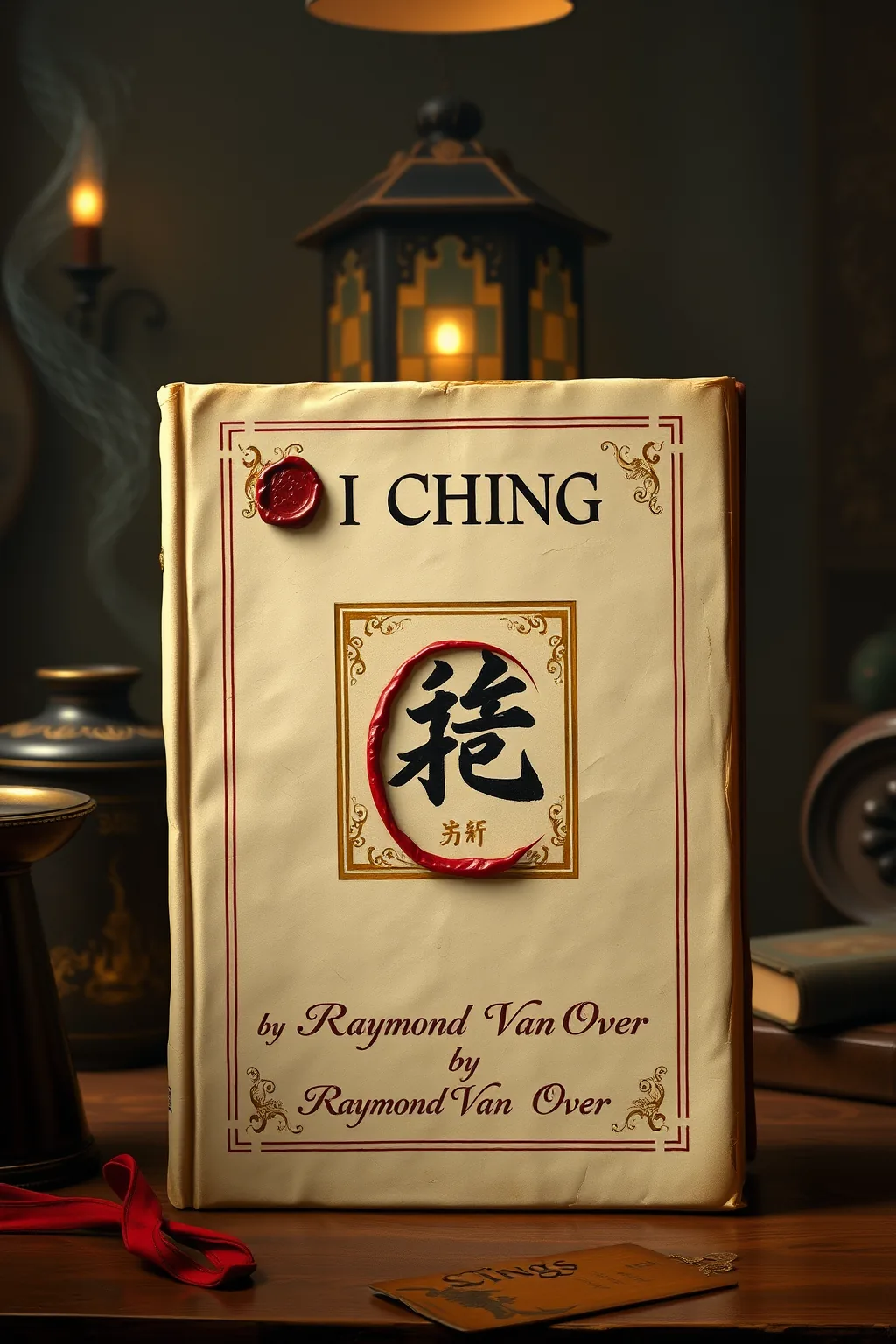
Raymond Van Over's rendition of the I Ching is a beacon for those navigating the labyrinthine paths of self-discovery and cosmic understanding. His insightful prose breathes life into the ancient texts, revealing layers of esoteric meaning often obscured in simpler translations. The strength of this edition lies in its ability to bridge the gap between archaic wisdom and contemporary application, making the profound insights of the Yi Jing accessible to both seasoned practitioners and earnest newcomers. Ophelia Vance, Mystical Literature Reviewer, finds this work an indispensable guide for anyone seeking to harness the oracle's wisdom for personal growth and spiritual enlightenment.
📝 Description
62
Raymond Van Over's 1995 interpretation of the I Ching aims to reveal its philosophical depth beyond mere divination.
This book presents Raymond Van Over's translation and commentary on the I Ching, the ancient Chinese Book of Changes. Van Over focuses on the 64 hexagrams not just as tools for fortune-telling, but as a complex philosophical framework. He illuminates the symbolism within the hexagrams, connecting them to the natural cycles and forces that shape existence.
The commentary seeks to make the I Ching accessible to those interested in understanding life's patterns. It discusses how the hexagrams can offer insight into personal situations and the broader interconnectedness of events. The goal is to help readers align their understanding with the principles the text describes.
The I Ching is a foundational text within Chinese philosophy and esoteric traditions, dating back over 3,000 years. It is used for divination, but also as a guide to understanding the principles of change and balance in the universe. Its hexagrams represent fundamental archetypes and situations, offering a symbolic language to interpret the flow of events. Many esoteric traditions view it as a map of cosmic order and human potential.
💡 Why Read This Book?
Unlock the secrets of the universe with the I Ching. Raymond Van Over's expertly guided exploration offers profound insights into destiny, change, and the Tao. Ideal for seekers of wisdom, practitioners of divination, and scholars of ancient philosophy, this book provides a powerful framework for understanding life's cycles and making aligned choices. Discover timeless truths and elevate your consciousness.
⭐ Reader Reviews
Honest opinions from readers who have explored this book.
❓ Frequently Asked Questions
What is the I Ching?
The I Ching, or Book of Changes, is an ancient Chinese divination text and philosophical classic, renowned for its wisdom on change and transformation. It uses 64 hexagrams, formed from combinations of yin and yang lines, to offer guidance and insight into life's myriad situations.
How is the I Ching used for divination?
Divination with the I Ching typically involves casting coins or yarrow stalks to generate a hexagram based on your question. This hexagram, along with its changing lines, is then interpreted using the text to provide guidance and reveal potential outcomes or underlying dynamics.
Who was Raymond Van Over?
Raymond Van Over was a respected scholar and author known for his translations and interpretations of significant Eastern philosophical and mystical texts, including his influential work on the I Ching.
Is this book suitable for beginners?
Yes, Raymond Van Over's I Ching is highly recommended for beginners due to its clear explanations and accessible commentary, which demystifies the complex symbolism and philosophical underpinnings of the text.
What does 'hexagram' mean in the context of the I Ching?
A hexagram is a symbol composed of six stacked horizontal lines, each representing either a solid (yang) or broken (yin) line. The 64 unique hexagrams in the I Ching are formed by combining these lines and are central to the text's divinatory and philosophical system.
🔮 Key Themes & Symbolism
The Immutable Nature of Change
The I Ching fundamentally posits that change is the only constant in the universe. This theme explores how understanding and embracing flux, rather than resisting it, is key to navigating life with wisdom and resilience. It studies the cyclical patterns of growth, decay, and renewal, offering a philosophical framework for accepting the impermanence of all things and finding harmony within the dynamic flow of existence. This perspective encourages adaptability and a deeper appreciation for the present moment, recognizing that every situation, like a hexagram, is a transient expression of a larger, unfolding cosmic process.
Cosmic Harmony and the Tao
At its heart, the I Ching is a guide to aligning oneself with the Tao, the fundamental principle of the universe. This theme examines the intricate web of interconnectedness between human affairs and the natural order. It reveals how the patterns within the hexagrams reflect universal laws, offering a blueprint for living in accordance with cosmic harmony. By understanding these principles, individuals can cultivate balance, make more insightful decisions, and foster a sense of unity with the greater whole, moving from chaos towards order and from ignorance towards enlightenment through direct experience.
The Oracle as a Mirror of the Soul
More than a mere predictive tool, the I Ching serves as a profound mirror to the inner self. This theme explores how the hexagrams, when consulted with genuine introspection, reveal hidden aspects of one's psyche, motivations, and potential pathways. It encourages self-awareness by presenting archetypal situations and forces that resonate with our personal journeys. The oracle acts as a catalyst for self-discovery, prompting reflection on our choices, reactions, and the underlying energies at play, thereby facilitating personal growth and the unfolding of one's true potential through conscious engagement.
💬 Memorable Quotes
Direct passages from the work, attributed to the author.
“When you know others, you are wise. When you know yourself, you are enlightened.”
— This highlights the I Ching's dual focus on external understanding and internal introspection, valuing self-knowledge as the highest form of wisdom.
“To know the path, look to the stars.”
— This poetic line suggests seeking guidance from higher principles and cosmic patterns, as represented by the hexagrams, to understand one's life journey.
“The soft overcomes the hard. The weak overcomes the strong.”
— This illustrates the philosophical principle of yielding and flexibility, showing how gentle persistence can ultimately achieve greater victories than brute force.
“The journey of a thousand miles begins with a single step.”
— A timeless proverb underscoring the I Ching's practical wisdom: even the most daunting endeavors are achieved through consistent, deliberate action, starting with the present moment.
💡 Key Ideas
Editorial paraphrase of the work's core concepts — not direct quotes.
The superior man understands the changes of things.
This quote emphasizes the importance of intellectual and spiritual awareness in recognizing and adapting to life's constant flux, a core tenet of I Ching wisdom.
🌙 Esoteric Significance
Tradition
The I Ching is a central to Chinese esoteric traditions, particularly Taoism and Confucianism, and has permeated various forms of folk religion and divination. It is viewed as a cosmological text that maps the underlying principles of the universe, offering insights into the dynamic interplay of Yin and Yang, the five elements, and the eight trigrams. Its esoteric nature lies in its symbolic language and its capacity to reveal the hidden forces and patterns governing both the macrocosm and the microcosm, guiding practitioners towards spiritual harmony and enlightened action.
Symbolism
The core symbolism of the I Ching lies in its 64 hexagrams, each composed of six lines that are either solid (Yang, representing active, masculine energy) or broken (Yin, representing passive, feminine energy). These hexagrams, derived from eight fundamental trigrams, represent archetypal situations, forces, and transformations. The symbolism extends to the imagery and judgments associated with each hexagram, offering profound metaphorical insights into human experience, natural phenomena, and cosmic processes, serving as a rich lexicon for understanding the universe's subtle language.
Modern Relevance
In the modern era, the I Ching retains profound relevance as a tool for psychological insight, philosophical contemplation, and ethical guidance. Its emphasis on adaptability, understanding change, and seeking balance resonates deeply with contemporary challenges. The text offers a framework for navigating uncertainty, fostering mindfulness, and making conscious decisions aligned with universal principles. For many, it serves as a spiritual compass, providing a timeless perspective on life’s complexities and encouraging personal growth, resilience, and a more harmonious existence in an ever-changing world.
👥 Who Should Read This Book
This edition of the I Ching is a treasure for a diverse audience. **Beginners** will find Raymond Van Over's clear prose and insightful commentary an accessible entry point into this profound system. **Scholars** of Eastern philosophy and comparative religion will appreciate the depth and nuance of the interpretation. **Seekers** of spiritual wisdom and self-understanding will discover a potent tool for introspection and guidance. **Practitioners** of divination and esoteric arts will find a classic, authoritative text to deepen their practice and enhance their connection to ancient oracular wisdom.
📜 Historical Context
The I Ching, or Book of Changes, emerged from ancient Chinese shamanic traditions and philosophical inquiries, with its roots tracing back thousands of years. Its formative period coincided with the Zhou Dynasty (c. 1046–256 BCE), a time of significant intellectual and cultural development in China. Scholars and mystics refined its structure and interpretations, tying together cosmology, divination, and ethics. The text’s influence permeated various aspects of Chinese society, from imperial governance and military strategy to personal decision-making and spiritual cultivation. Its philosophical underpinnings, particularly its emphasis on change and balance, deeply influenced Confucianism and Taoism, shaping the intellectual range of East Asia for millennia and continuing to inspire seekers worldwide.
📔 Journal Prompts
Reflect on a recent situation where embracing change, rather than resisting it, led to a positive outcome. How did this align with the principles of the I Ching?
Consider a current challenge you are facing. How might viewing this situation through the lens of contrasting energies (Yin and Yang) offer a new perspective or solution?
What archetypal force or situation represented by a hexagram resonates most strongly with your current life path? Journal about its implications.
How can you cultivate greater harmony between your inner world and the external circumstances you experience, drawing inspiration from the I Ching's emphasis on cosmic balance?
Identify a belief or pattern of behavior that has been holding you back. How can you consciously shift towards a more adaptive or enlightened approach, as suggested by the oracle's wisdom?
🗂️ Glossary
Hexagram
A symbol composed of six stacked lines, each representing either solid (Yang) or broken (Yin), forming one of the 64 fundamental units of the I Ching used for divination and philosophical interpretation.
Trigram
A symbol composed of three lines (solid or broken), forming eight basic combinations from which the 64 hexagrams are derived. They represent fundamental cosmic forces and elements.
Yang
The active, masculine, light, and assertive principle in the I Ching and Taoist philosophy, represented by a solid line (—).
Yin
The passive, feminine, dark, and receptive principle in the I Ching and Taoist philosophy, represented by a broken line (--).
Tao
The fundamental principle of the universe in Taoism, often translated as 'the Way.' It represents the natural order, the flow of existence, and the ultimate reality that underlies all phenomena.
This book appears in 3 collections
🔮 Readers Also Liked
Browse all →








More by Raymond Van Over
All books →
From the “Tarot” Collection
View all →







More Free Divination & Tarot Books
View all →