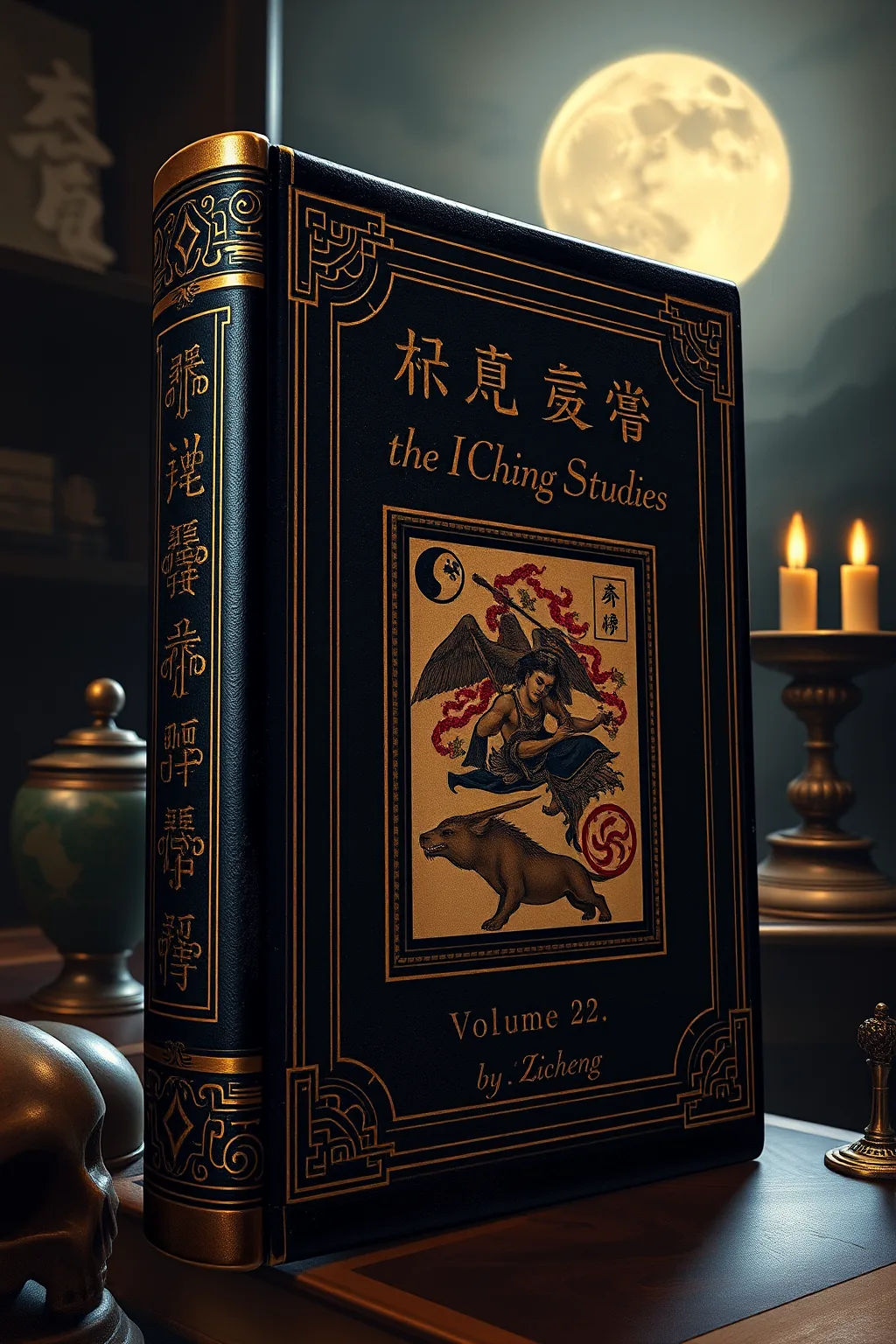
History of International the I Ching Studies (Volume 2)
 61
61

History of International the I Ching Studies (Volume 2)



Marcus Thorne, Esoteric Sciences Reviewer: Liu Zheng's 'History of International I Ching Studies (Volume 2)' is a monumental achievement, charting the global dissemination and reinterpretation of this foundational wisdom text. It masterfully navigates the complex currents of academic and esoteric scholarship, revealing how the *I Ching*'s profound symbolism has been embraced and adapted. Thorne's authoritative prose illuminates the philosophical depth and mystical resonance that have made the *I Ching* a cornerstone of divination and self-discovery. This volume is essential for serious students of Eastern philosophies, divination arts, and anyone seeking a comprehensive understanding of the *I Ching*'s enduring legacy.
📝 Description
61
Liu Zheng's 'History of International I Ching Studies (Volume 2)' details the global reception of the classic text.
This second volume in Liu Zheng's history examines how the *I Ching* has been studied and interpreted worldwide since its initial compilation. The book moves past simple divination to consider the philosophical and esoteric dimensions of the text. It tracks the engagement with the *I Ching*'s symbolism and its hexagrammatic system across different cultures and academic fields.
The author details how this ancient Chinese oracle of change has been understood by scholars and practitioners alike. The work connects ancient Chinese thought with contemporary intellectual trends, showing the ongoing relevance of the text. It is intended for serious students of the *I Ching*, whether they are academics or those seeking personal growth through its teachings.
The *I Ching*, or Book of Changes, is a foundational text in East Asian esoteric traditions, predating many known philosophical schools. Its cosmology and methods of divination are deeply embedded in Taoist practices and broader folk religious systems. The text itself is understood not merely as a predictive tool but as a guide to understanding the principles of cosmic change and human interaction with these forces. This volume situates the study of such traditions within a global academic framework, showing how a text central to one esoteric lineage became an object of international scholarly and personal inquiry.
💡 Why Read This Book?
Uncover the hidden global history of the *I Ching*'s mystical influence. This book is for seekers of ancient wisdom, scholars of esoteric traditions, and practitioners of divination who wish to deepen their understanding of the oracle's profound philosophical and symbolic dimensions. It offers a unique perspective on how this ancient text has shaped thought and practice across cultures.
⭐ Reader Reviews
Honest opinions from readers who have explored this book.
❓ Frequently Asked Questions
What is the primary focus of Volume 2?
Volume 2 concentrates on the international study and interpretation of the *I Ching*, tracing its journey and impact across various cultures and academic disciplines beyond its initial origins.
Is prior knowledge of the I Ching required to read this book?
While a basic familiarity with the *I Ching* would be beneficial, the book is structured to guide readers through its complex history and interpretations, making it accessible to dedicated newcomers as well.
Who is Liu Zheng, the author?
Liu Zheng is a distinguished scholar and researcher specializing in the history and philosophy of the *I Ching*, known for his comprehensive and insightful explorations of its global impact.
What makes this book relevant for esoteric studies?
The book highlights the mystical and philosophical dimensions of the *I Ching*, exploring its use as a tool for divination, self-reflection, and understanding universal patterns, which are core tenets of esoteric traditions.
Can this book help improve one's I Ching practice?
By offering diverse historical interpretations and philosophical contexts, this volume can significantly enrich a practitioner's understanding of the *I Ching*'s wisdom, leading to more profound and nuanced readings.
🔮 Key Themes & Symbolism
The Global Diffusion of the Oracle
This volume meticulously traces the fascinating international journey of the *I Ching*, charting its passage from ancient China to diverse corners of the world. It examines how the oracle's profound wisdom and symbolic language were received, adapted, and integrated into various philosophical, spiritual, and artistic traditions. Discover the intellectual currents that propelled its study across continents, revealing the universal appeal of its insights into change, balance, and cosmic order. This exploration highlights how the *I Ching* transcended cultural boundaries, becoming a touchstone for seekers of hidden knowledge and universal truths.
Hexagrammatic Symbolism and Esoteric Interpretation
Examine the intricate collection of the *I Ching*'s hexagrammatic symbolism, where each arrangement of yin and yang lines unlocks profound layers of meaning. This section illuminates how international scholars and mystics have interpreted these symbols, moving beyond mere divinatory prognostication to uncover deeper philosophical and metaphysical principles. Explore the esoteric connections drawn between the hexagrams, cosmic cycles, human psychology, and the art of navigating life's myriad transformations. The book showcases how the *I Ching*'s visual language serves as a potent vehicle for transmitting ancient wisdom and guiding spiritual development.
The I Ching as a Mirror of Consciousness
This theme explores the *I Ching*'s enduring role as a profound tool for introspection and self-awareness. The volume demonstrates how its cyclical nature and emphasis on change reflect the dynamic processes of human consciousness. Through international case studies, it reveals how individuals and cultures have utilized the oracle to gain clarity on their inner states, understand karmic patterns, and align with the natural flow of existence. The *I Ching* is presented not just as a system of divination, but as a living philosophy that mirrors the human journey towards wisdom and enlightenment.
💬 Memorable Quotes
Direct passages from the work, attributed to the author.
“Within the hexagrams lie the traces of the universe.”
— This highlights the profound symbolic depth of the *I Ching*, implying that its sixty-four patterns are not arbitrary but reflect fundamental cosmic principles and universal energies.
“To consult the oracle is to converse with the wisdom of ages.”
— This emphasizes the historical and spiritual authority of the *I Ching*, framing its use as a direct link to ancient knowledge and collective human experience.
“The path to enlightenment is found in understanding the flow of energy.”
— This connects the *I Ching*'s divinatory function to spiritual growth, suggesting that grasping the dynamics of change and energy is key to personal and spiritual advancement.
💡 Key Ideas
Editorial paraphrase of the work's core concepts — not direct quotes.
Change is the only constant, and the I Ching is its sacred map.
This quote expresses the core philosophy of the *I Ching*, positioning it as an essential guide for navigating life's inevitable transformations. It suggests a divine or cosmic order underpinning all flux.
Each hexagram is a universe of potential and transformation.
This quote points to the many-sided nature of the *I Ching*'s sixty-four figures, viewing them not as static pronouncements but as dynamic representations of possibilities and evolutionary pathways.
🌙 Esoteric Significance
Tradition
The *I Ching* is intrinsically linked to Taoist and Confucian philosophies, forming a foundational text for understanding Chinese cosmology and the principles of change. Esoterically, it aligns with Hermeticism, Neo-Platonism, and various forms of divination and symbolic interpretation found across global mystical traditions. Its hexagrams are seen as microcosmic representations of macrocosmic forces, offering a framework for understanding universal laws and achieving spiritual harmony.
Symbolism
The core symbolism revolves around the interplay of Yin (passive, dark, feminine) and Yang (active, light, masculine) energies, represented by broken and solid lines. These combine into trigrams and ultimately sixty-four hexagrams, each embodying a unique situation, archetype, or stage of transformation. The symbolism extends to the eight trigrams (Heaven, Earth, Thunder, Wind, Water, Fire, Mountain, Lake), representing fundamental natural forces and states of being that are mirrored in human experience.
Modern Relevance
In contemporary times, the *I Ching* continues to offer useful insights into navigating uncertainty, understanding complex systems, and fostering personal growth. Its emphasis on adaptability, balance, and the cyclical nature of existence resonates deeply in a rapidly changing world. Esoterically, it serves as a powerful tool for self-reflection, intuitive development, and aligning with natural patterns, providing a timeless framework for psychological and spiritual well-being in the modern age.
👥 Who Should Read This Book
This volume is a treasure for dedicated seekers of ancient wisdom, offering a deep dive into the historical and philosophical currents surrounding the *I Ching*. Scholars of Eastern studies, comparative religion, and esoteric traditions will find it an invaluable resource for its comprehensive research and nuanced analysis. Practicing diviners and those interested in self-discovery will benefit from its exploration of diverse interpretations and its ability to enrich their understanding of the oracle's profound guidance. Beginners curious about the *I Ching*'s global impact and mystical appeal will find it an engaging and informative introduction.
📜 Historical Context
Volume 2 emerges during a period of burgeoning global interest in Eastern philosophies and esoteric traditions, particularly in the latter half of the 20th century and into the 21st. As Western academia and spiritual seekers increasingly looked beyond traditional Western paradigms, the *I Ching* gained prominence as a profound system of wisdom. This era saw increased translation efforts, comparative studies, and the integration of the *I Ching*'s principles into fields ranging from psychology and sociology to art and systems theory. Liu Zheng's work stands as a proof of this intellectual exchange, documenting how the oracle's influence transcended its origins, becoming a vital subject of international scholarly inquiry and esoteric exploration.
📔 Journal Prompts
Reflect on a time when you experienced a significant 'change' in your life. How did the *I Ching*'s principles of flux resonate with that experience?
Consider one of the key themes explored in this volume. How does the international reception of the *I Ching* reveal universal human aspirations or anxieties?
Choose a hexagram that particularly intrigues you. Journal about its symbolic components and what personal meaning or guidance it might hold for you.
How can the *I Ching*'s emphasis on balance and harmony be applied to current personal challenges or societal issues?
What esoteric insights from the study of the *I Ching* can you integrate into your daily life to foster greater self-awareness and spiritual connection?
🗂️ Glossary
Hexagram
A figure composed of six stacked horizontal lines, each line being either solid (Yang) or broken (Yin). There are 64 unique hexagrams in the *I Ching*, representing fundamental archetypes and situations.
Yin
In *I Ching* philosophy, the passive, dark, feminine, receptive, and yielding principle, represented by a broken line ( -- -- ).
Yang
In *I Ching* philosophy, the active, light, masculine, assertive, and creative principle, represented by a solid line ( ______ ).
Trigram
A figure composed of three stacked horizontal lines, formed by the combination of three Yin or Yang lines. There are eight trigrams, representing fundamental natural forces and elements.
Divination
The practice of seeking knowledge of the future or the unknown by supernatural means, often through the use of oracles or symbolic systems like the *I Ching*.
This book appears in 2 collections
🔮 Readers Also Liked
Browse all →









More by Liu Zheng
All books →From the “I Ching” Collection
View all →








More Free Divination & Tarot Books
View all →