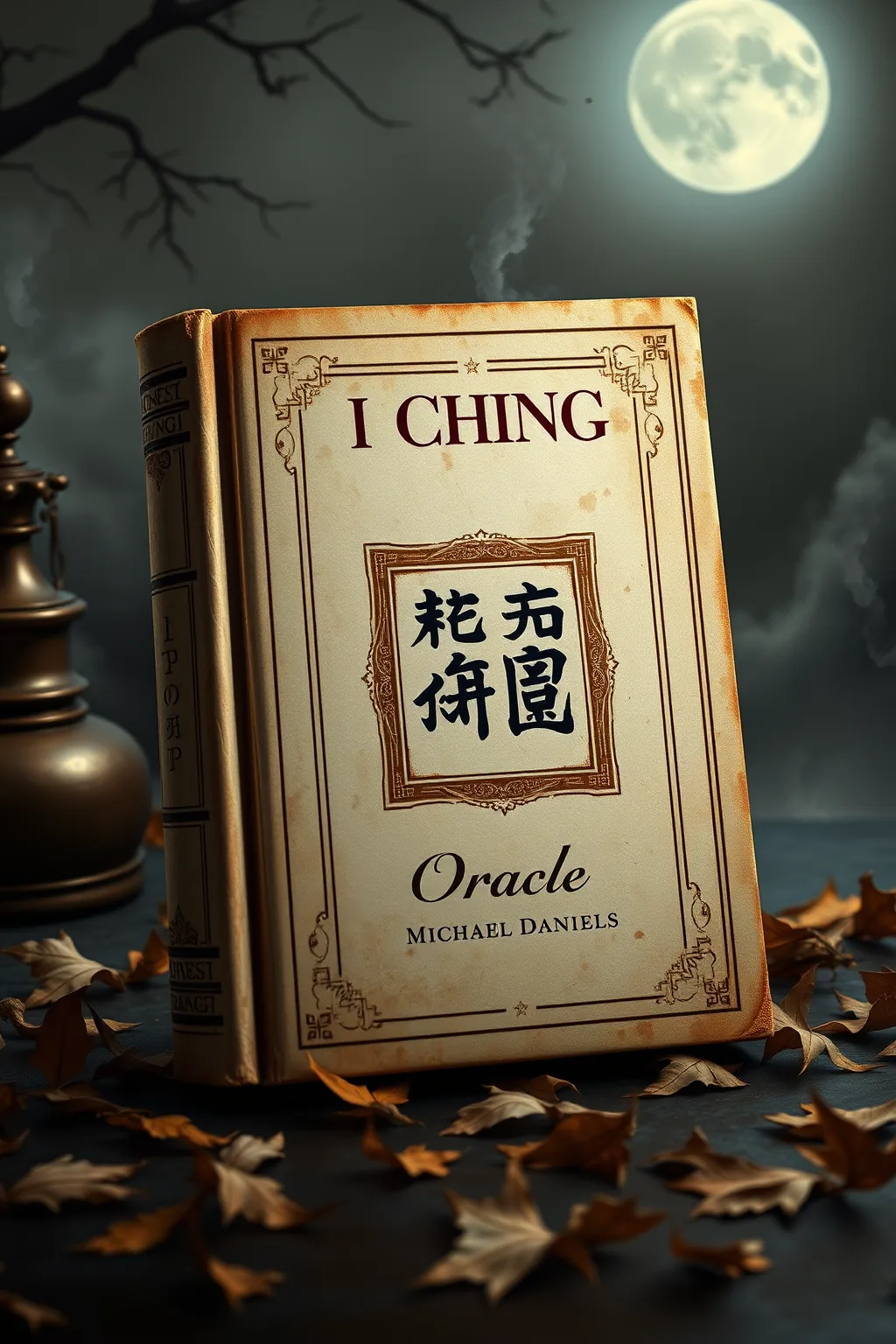
I Ching Oracle
 61
61

I Ching Oracle



Michael Daniels' "I Ching Oracle" is a luminous portal to one of humanity's most enduring divinatory systems. With a scholar's precision and a mystic's intuition, Daniels illuminates the intricate dance of the sixty-four hexagrams, revealing their profound philosophical underpinnings and practical applications. He transcends mere translation, offering a deep dive into the symbolic language and energetic currents that animate this ancient text. This work is an indispensable guide for anyone seeking to harness the I Ching's wisdom for personal growth, spiritual insight, or navigating life's complex junctures. A triumph of esoteric scholarship, it speaks directly to the soul.
📝 Description
61
Michael Daniels' "I Ching Oracle" deciphers the ancient Chinese Book of Changes.
This volume examines the I Ching, known as the Book of Changes, a foundational text in Chinese philosophy and a long-standing tool for divination. Daniels focuses on the system of 64 hexagrams, explaining how their patterns reflect the cycles of human life and the natural world. He details the symbolic meanings within each oracle, aiming to show readers paths toward understanding themselves and the cosmos. The book presents the I Ching not just as a predictive device but as a philosophical guide. It suggests the text can offer clarity and insight into the forces that influence our lives and the wider universe.
The "I Ching Oracle" is intended for those seriously interested in self-discovery, scholarly study, or esoteric practices. It aims to connect readers with the principles of this ancient text, which has influenced leaders and spiritual thinkers for centuries. The work allows for a direct engagement with a significant cultural and philosophical tradition.
The I Ching originates from ancient China, where it developed as a system for understanding cosmic order and human affairs. Its use in divination, particularly through coin or yarrow stalk methods to generate hexagrams, is central to its esoteric application. These hexagrams, composed of six lines (either solid or broken), represent dynamic states and transitions. The philosophy behind the I Ching suggests that by understanding these patterns, one can align personal actions with the natural flow of the universe, a concept shared with other esoteric traditions that seek harmony between the individual and the greater whole.
💡 Why Read This Book?
Unravel the mysteries of the universe and gain profound self-awareness. This book offers a unique lens through which to understand destiny, make crucial decisions, and harmonize with the natural order. Ideal for spiritual seekers, students of ancient wisdom, and those desiring a deeper connection to life's underlying currents. Discover timeless guidance for navigating challenges and embracing opportunities.
⭐ Reader Reviews
Honest opinions from readers who have explored this book.
❓ Frequently Asked Questions
What is the I Ching?
The I Ching, or Book of Changes, is an ancient Chinese divination text and philosophical classic. It comprises 64 hexagrams, each representing a fundamental situation or stage of life, offering guidance and insight.
How does the I Ching work as a divination tool?
By casting yarrow stalks or coins, specific hexagrams are generated, which are then interpreted using the accompanying text. This process reveals insights into current situations and potential future outcomes.
Is prior knowledge of Chinese philosophy required?
No, Michael Daniels' "I Ching Oracle" is crafted for accessibility. It provides clear explanations and contextual information, making it suitable for both beginners and those with some familiarity.
What are the benefits of consulting the I Ching?
Consulting the I Ching can offer clarity on complex decisions, provide perspective during times of uncertainty, foster self-understanding, and promote a sense of harmony with the cosmic flow.
Can the I Ching be used for more than just prediction?
Absolutely. The I Ching is a profound philosophical text offering wisdom on ethics, governance, and the nature of change. It serves as a guide for personal development and living a more balanced life.
🔮 Key Themes & Symbolism
The Philosophy of Change
Fundamentally, the I Ching is a evidence of the impermanence of all things. It teaches that change is the only constant, and understanding its patterns allows for harmonious adaptation. This theme explores the dynamic interplay of Yin and Yang, the fundamental forces that drive transformation, and how embracing flux leads to resilience and wisdom. It's a profound exploration of cosmic cycles and their reflection in human experience, urging readers to flow with, rather than resist, the inevitable shifts in life.
Symbolic Language of the Hexagrams
Each of the 64 hexagrams in the I Ching is a collection of symbolic imagery, formed by combinations of broken (Yin) and unbroken (Yang) lines. These symbols are not arbitrary; they represent archetypal situations, universal energies, and the dynamic relationships between heaven, earth, and humanity. Daniels meticulously deciphers this ancient iconography, revealing how the visual language of the hexagrams communicates complex philosophical concepts and offers useful insights into the subtle energies at play in any given moment.
Divination as a Path to Wisdom
Far from mere fortune-telling, the I Ching's divinatory practice is presented as a sacred dialogue with the cosmos. It's a method for gaining perspective, clarifying intentions, and understanding the karmic threads influencing our present. This theme emphasizes the I Ching as a mirror to the soul, reflecting our inner state and guiding us toward actions aligned with universal principles. It encourages a mindful approach to consultation, transforming it into a practice of self-awareness and spiritual growth.
💬 Memorable Quotes
Direct passages from the work, attributed to the author.
“In the dance of Yin and Yang, all creation finds its form.”
— This speaks to the fundamental duality that underpins existence, suggesting that understanding these opposing yet complementary forces is key to comprehending the universe.
“The wise do not resist the current, but learn to navigate.”
— This emphasizes the importance of adaptability and acceptance of life's changes, promoting a proactive rather than a passive approach to challenges.
“Through the hexagrams, the universe whispers its secrets.”
— This evokes the mystical aspect of the I Ching, portraying it as a channel through which cosmic knowledge and guidance can be received.
“To know the hexagram is to know a facet of the self.”
— This underscores the deeply introspective nature of I Ching study, suggesting that each symbol reflects a part of our own inner landscape and potential.
💡 Key Ideas
Editorial paraphrase of the work's core concepts — not direct quotes.
The ancient mirror shows the present, the future, and the path within.
This quote highlights the I Ching's dual nature as a tool for understanding external circumstances and internal states, emphasizing its timeless relevance.
🌙 Esoteric Significance
Tradition
The I Ching is a foundational text within Chinese esoteric traditions, particularly Taoism and later developments in Neidan (internal alchemy) and I Ching metaphysics. It is deeply connected to the principles of Yin and Yang, the Five Elements, and the concept of Qi (vital energy). Its esoteric significance lies in its use as a map of cosmic and human correspondences, a system for understanding the energetic flows that govern existence and influence destiny.
Symbolism
The core symbolism of the I Ching resides in its 64 hexagrams, each composed of six lines, either solid (Yang) or broken (Yin). These lines and their combinations represent archetypal forces, natural phenomena, and stages of human experience. The trigrams (three-line combinations) are particularly significant, symbolizing Heaven, Earth, Thunder, Wind, Water, Fire, Mountain, and Lake. The interaction and transformation of these symbols provide a profound symbolic language for understanding the interconnectedness of all things.
Modern Relevance
In the modern era, the I Ching continues to serve as a powerful tool for personal transformation and spiritual growth. Its emphasis on adaptability, mindfulness, and understanding the nature of change resonates deeply in a world characterized by rapid flux. Esoteric practitioners utilize it for self-reflection, decision-making, and aligning with universal principles. Its strong symbolism offers a framework for exploring consciousness, synchronicity, and the deeper patterns that shape our individual and collective realities.
👥 Who Should Read This Book
This comprehensive exploration of the I Ching is a treasure for a wide audience. **Beginners** will find Michael Daniels' clear prose and accessible explanations an ideal introduction to this complex system. **Scholars** of Eastern philosophy and comparative religion will appreciate the meticulous detail and historical context. **Spiritual seekers** and those on a path of self-discovery will find profound guidance and a unique tool for introspection. **Practitioners** of divination and esoteric arts will discover a rich resource for deepening their understanding and practice of this ancient oracle.
📜 Historical Context
The I Ching, or Book of Changes, traces its origins back to ancient China, with its earliest components dating as far back as the Western Zhou Dynasty (c. 1046–771 BCE). Initially used for divination, it evolved over centuries, absorbing philosophical interpretations from Confucianism and Taoism. By the Han Dynasty (206 BCE–220 CE), it had become a canonical text, deeply embedded in Chinese intellectual and spiritual life. Its influence extended beyond China, impacting Korean, Japanese, and Vietnamese cultures, and later captivating Western scholars and mystics. The I Ching represents a rare continuity of a complex philosophical and divinatory system, offering a unique window into the evolving thought of one of the world's oldest civilizations.
📔 Journal Prompts
Reflect on a recent significant change in your life. Which hexagrams resonate with this experience, and what guidance do they offer?
Consider the interplay of Yin and Yang in your daily routines. Where can you find balance or embrace necessary change?
If you were to consult the I Ching on a current dilemma, what question would you pose, and what initial insights do you anticipate?
Explore the symbolism of a particular trigram (e.g., Heaven, Earth, Water). How do its associated meanings manifest in your personal life?
How can the wisdom of the I Ching inform your decision-making process for future challenges or opportunities?
🗂️ Glossary
Hexagram
A symbol composed of six stacked lines, each being either solid (Yang) or broken (Yin). There are 64 unique hexagrams in the I Ching, representing fundamental archetypes and situations.
Trigram
A three-line symbol, formed by combinations of Yin and Yang lines. There are eight basic trigrams, each associated with specific elements, directions, and concepts.
Yin
The principle of receptivity, darkness, passivity, and femininity. In the I Ching, it is represented by a broken line (---).
Yang
The principle of activity, light, assertiveness, and masculinity. In the I Ching, it is represented by a solid line (—).
Ching
Meaning 'classic' or 'canon.' In 'I Ching,' it refers to the 'Book of Changes,' a foundational text of Chinese wisdom literature.
This book appears in 3 collections
🔮 Readers Also Liked
Browse all →








From the “Tarot” Collection
View all →







More Free Divination & Tarot Books
View all →