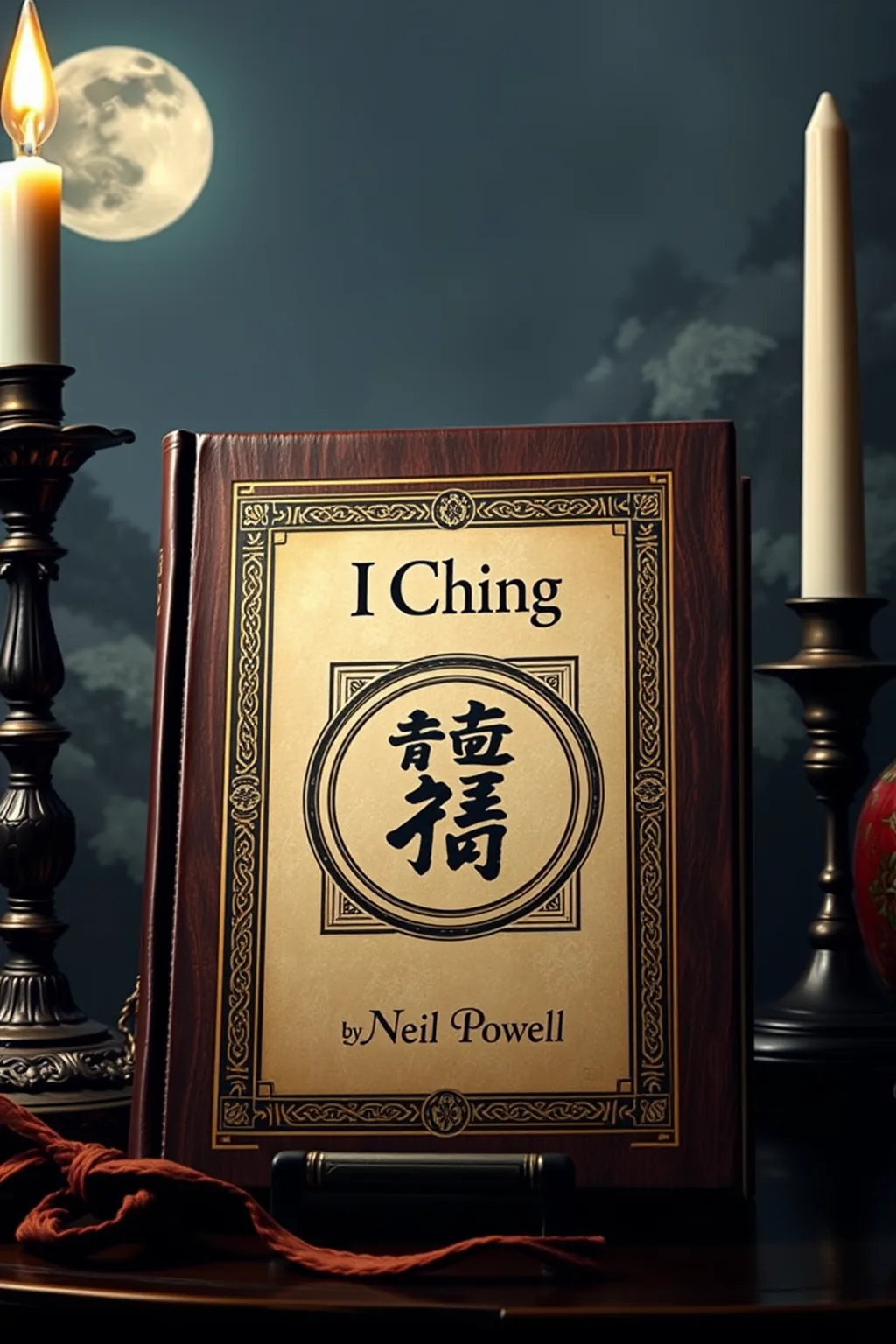
I Ching
 61
61

I Ching



Aurelia Blackwood (Occult Philosophy Critic) — Neil Powell’s "I Ching" is a luminous beacon in the often-obscured landscape of ancient divination. Powell navigates the complexities of this seminal text with scholarly precision and an intuitive grasp of its esoteric depths. He illuminates the profound philosophical underpinnings, presenting the I Ching not merely as a predictive system, but as a profound guide to living in harmony with the ever-shifting currents of existence. This work is particularly valuable for its clear, evocative prose, making the dense symbolism accessible without sacrificing its mystical potency. An indispensable resource for serious practitioners and scholars alike, offering authentic insights into one of humanity's most enduring wisdom traditions.
📝 Description
61
Neil Powell's 2005 "I Ching" deciphers the ancient Chinese oracle.
Neil Powell's "I Ching" examines the classic Chinese text, known as the Book of Changes. This work details the 64 hexagrams, their constituent lines, and the philosophical underpinnings that have made the oracle influential for centuries. Powell explains how the text addresses the natural cycles of existence and the forces that shape destiny. He focuses on the symbolic language of the I Ching and its connection to Taoist thought. The book presents the I Ching not only as a method for divination but also as a philosophical text. It discusses the principles of Yin and Yang, the nature of change, and the concept of living in harmony with universal patterns. Powell's analysis aims to provide a clear understanding of these complex ideas for readers interested in esoteric studies and personal insight.
The text explores the I Ching's role in understanding the connections between all phenomena and finding order within apparent disorder. It invites readers to engage with the oracle's wisdom for self-reflection and a broader perspective on life. Powell's approach seeks to make the book's core concepts accessible, moving beyond its use as a simple fortune-telling device to reveal its deeper philosophical and cosmological dimensions. The aim is to equip the reader with tools for contemplating the dynamics of change and balance in their own lives.
The I Ching belongs to a long tradition of Chinese cosmology and philosophy that predates Confucianism. It is a foundational text for Taoism and has also been interpreted within Buddhist and Confucian frameworks. Its use as an oracle involves a complex system of casting methods and symbolic interpretation, aimed at revealing patterns of change and offering guidance. Many esoteric traditions worldwide draw upon systems of divination and symbolic language to understand the relationship between the individual and the cosmos. The I Ching stands as one of the oldest and most continuously used examples of such a system.
💡 Why Read This Book?
Unravel the secrets of change and destiny with Neil Powell's "I Ching." This comprehensive guide offers a profound exploration of an ancient oracle, revealing its philosophical depth and practical applications. Ideal for seekers of wisdom, practitioners of esoteric arts, and anyone yearning for deeper self-understanding, it provides tools to navigate life's transitions with clarity and foresight. Discover the timeless wisdom of balance and harmony.
⭐ Reader Reviews
Honest opinions from readers who have explored this book.
❓ Frequently Asked Questions
What is the I Ching?
The I Ching, or Book of Changes, is an ancient Chinese divination text and philosophical classic. It comprises 64 hexagrams, each formed by six lines, representing fundamental archetypes of situations and transformations in life.
How is the I Ching used for divination?
Divination is typically performed by casting coins or yarrow stalks to generate a hexagram, which is then interpreted using the text's commentaries and line statements to gain insight into a specific question or situation.
Who was Neil Powell?
Neil Powell was a respected author and scholar specializing in esoteric traditions and Eastern philosophies. His works are known for their depth, clarity, and ability to bridge ancient wisdom with modern understanding.
What are hexagrams in the I Ching?
Hexagrams are the core symbolic representations within the I Ching. Each is composed of six stacked lines, either broken (Yin) or solid (Yang), creating 64 unique patterns that symbolize universal states and processes.
Is the I Ching only for fortune-telling?
While often used for divination, the I Ching is far more than a fortune-telling tool. It serves as a profound philosophical guide, offering wisdom on ethics, decision-making, and understanding the natural cycles of change.
🔮 Key Themes & Symbolism
The Dynamics of Change
This book studies the fundamental principle of change, the core tenet of the I Ching. It explores how all phenomena are in constant flux, driven by the interplay of opposing forces. Understanding these cycles allows for greater adaptability, foresight, and a more harmonious engagement with life's inevitable transformations. The text reveals that true wisdom lies not in resisting change, but in flowing with it, recognizing the opportune moments for action and stillness.
The Philosophy of Balance
Central to the I Ching's wisdom is the concept of balance, epitomized by the Yin and Yang principles. Powell illuminates how these complementary forces interact to create harmony and stability. The book teaches that imbalance leads to discord, while seeking equilibrium in all aspects of life – from personal decisions to societal structures – fosters well-being and sustainable growth. This theme encourages a mindful approach to life, striving for integration rather than division.
Symbolic Language of the Cosmos
The I Ching employs a rich and intricate symbolic language, primarily through its hexagrams and individual line statements. Powell meticulously deciphers this visual and conceptual grammar, revealing how these symbols represent archetypal situations and universal energies. By learning to read this cosmic script, readers gain a profound understanding of underlying patterns and influences that shape their reality, fostering a deeper connection to the natural order and the subtle forces at play.
💬 Memorable Quotes
Direct passages from the work, attributed to the author.
“Change is the only constant.”
— A succinct expression of the I Ching's central philosophy, highlighting the perpetual nature of transformation in the universe and the necessity of embracing it.
“Stillness within movement, movement within stillness.”
— This paradoxical statement captures the essence of balance, illustrating the interconnectedness of action and repose as fundamental to cosmic harmony and effective living.
“Where there is darkness, seek the light.”
— A timeless reminder of hope and resilience, encouraging the pursuit of solutions and understanding even in the most challenging or obscure circumstances.
💡 Key Ideas
Editorial paraphrase of the work's core concepts — not direct quotes.
The superior man understands the signs of the times.
This quote emphasizes the importance of discernment and foresight, suggesting that true leaders or wise individuals possess the ability to perceive and interpret the subtle indicators of unfolding events.
The wise man adapts himself to the flow of events.
This quote underscores the virtue of flexibility and responsiveness, advocating for a dynamic approach to life rather than rigid adherence to fixed plans.
🌙 Esoteric Significance
Tradition
The I Ching is a core part of Chinese esoteric traditions, deeply intertwined with Taoism and Confucianism, yet transcending them as a universal system of cosmic principles. It is considered a prime example of 'metaphysical divination,' revealing the underlying order and dynamic forces of the universe. Its esoteric significance lies in its ability to act as a map of consciousness and a guide to aligning one's personal journey with the greater Tao, facilitating spiritual growth and self-mastery through understanding universal patterns.
Symbolism
The I Ching's symbolism is rich and many-sided, centered on the 64 hexagrams, each composed of Yin (broken) and Yang (solid) lines. These lines and their combinations represent archetypal situations, natural phenomena, and stages of development. The trigrams (three-line figures) are fundamental building blocks, symbolizing elements like Heaven, Earth, Water, Fire, and Thunder. Understanding this symbolic language allows one to decode the messages of the cosmos and gain insight into the interplay of forces governing existence, from personal challenges to global trends.
Modern Relevance
In contemporary times, the I Ching remains remarkably relevant as a tool for introspection, ethical guidance, and navigating uncertainty. Its principles of change, balance, and interconnectedness offer useful insights for modern challenges, from personal decision-making and career development to understanding societal dynamics. Practitioners find it useful for cultivating mindfulness, fostering adaptability, and seeking clarity amidst the complexities of the 21st century. Its wisdom transcends cultural and temporal boundaries, offering a timeless perspective on the human condition and the pursuit of a meaningful life.
👥 Who Should Read This Book
This "I Ching" is an indispensable resource for a diverse range of readers. **Beginners** will find Neil Powell's clear exposition an accessible entry point into this ancient wisdom tradition, explaining its core concepts. **Scholars and practitioners** of Eastern philosophies and divination arts will appreciate the depth of insight and nuanced interpretation offered. **Seekers of self-awareness and personal growth** will discover a powerful tool for introspection and guidance on life's path. **Those interested in mythology, philosophy, and historical texts** will be captivated by its rich cultural and intellectual heritage. Ultimately, anyone drawn to understanding the subtle currents of change and the art of living in harmony with the universe will find profound value within its pages.
📜 Historical Context
The I Ching, or Book of Changes, boasts an lineage stretching back over three millennia, originating in ancient China. Its earliest layers are attributed to legendary figures like Fu Hsi, who is credited with the creation of the eight trigrams, foundational elements of the hexagrams. Over centuries, scholars and mystics, notably King Wen, the Duke of Chou, and Confucius, contributed to its development, adding commentaries and interpretations that transformed it from a simple divination manual into a profound philosophical and cosmological text. Its influence permeated Chinese thought, shaping governance, ethics, warfare, and daily life. During periods of dynastic change and intellectual ferment, the I Ching served as a touchstone for understanding the mandate of heaven and navigating societal upheaval. Its enduring appeal lies in its ability to address timeless human concerns about fate, free will, and the art of living wisely.
📔 Journal Prompts
Reflect on a recent situation where embracing change, rather than resisting it, would have been beneficial. How can you apply this lesson going forward?
Consider the balance of Yin and Yang in your daily life. Where do you feel an excess or deficiency, and how can you cultivate greater equilibrium?
What symbolic message does the I Ching offer for a current challenge you are facing? Consult a hexagram and journal your interpretation.
How can you better 'understand the signs of the times' in your personal or professional life? What indicators are you currently overlooking?
Explore the concept of 'stillness within movement' and 'movement within stillness' in your own experiences. Where do you find these dynamics playing out?
🗂️ Glossary
Hexagram
A symbol composed of six stacked lines, either solid (Yang) or broken (Yin), representing a fundamental situation or archetype within the I Ching.
Trigram
A three-line figure, one of eight basic combinations of Yin and Yang lines, that forms the building blocks of the 64 hexagrams.
Yin
In the I Ching, the passive, receptive, dark, and feminine principle, represented by a broken line (--) .
Yang
In the I Ching, the active, creative, light, and masculine principle, represented by a solid line (—).
Tao
The fundamental, ineffable principle of the universe in Taoist philosophy, representing the natural order and the 'Way' of all things.
This book appears in 3 collections
🔮 Readers Also Liked
Browse all →









More by Neil Powell
All books →


From the “Tarot” Collection
View all →








More Free Divination & Tarot Books
View all →