I Ching
 61
61

I Ching



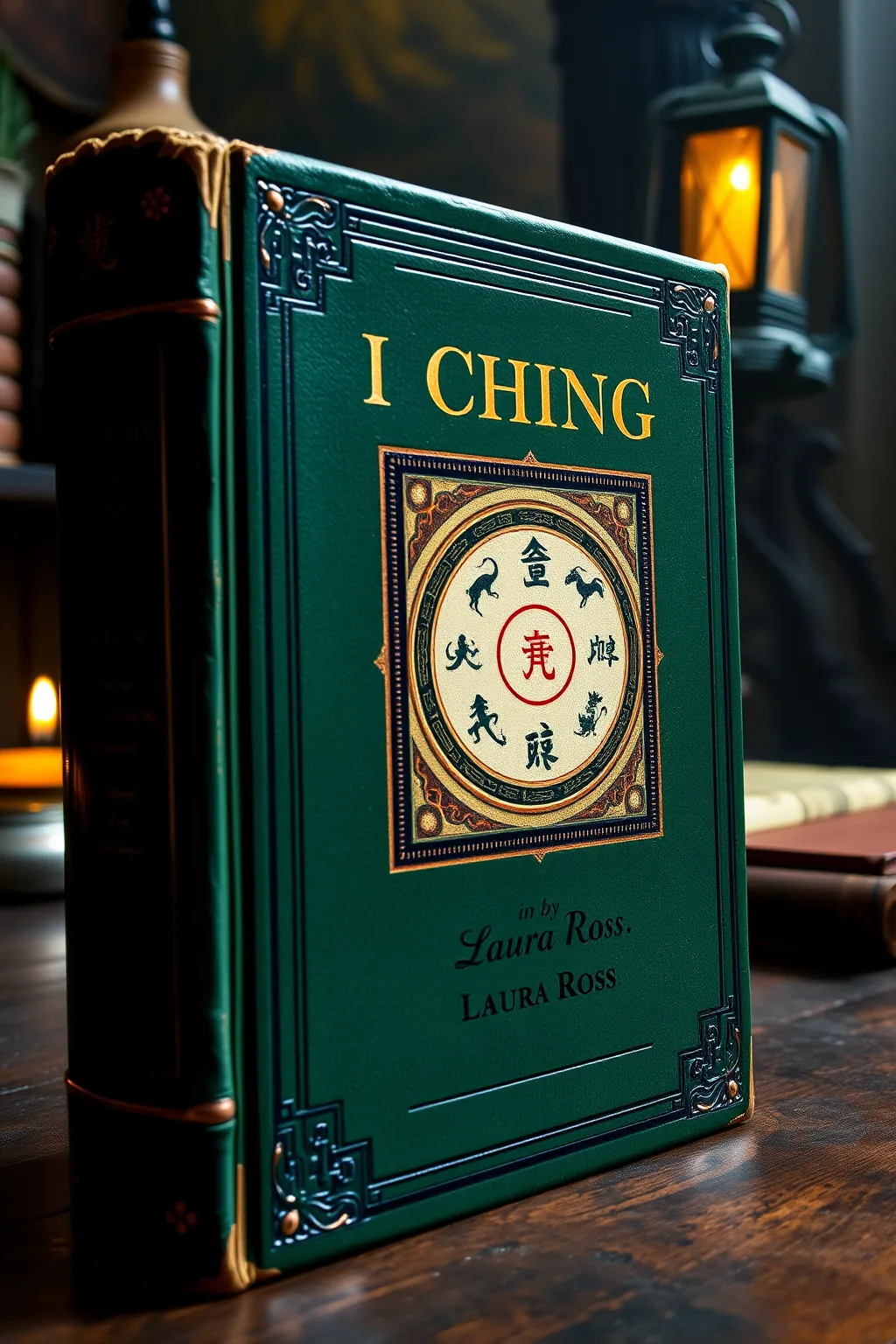
Laura Ross’s rendition of the I Ching is a beacon for serious students of esoteric lore. Her insightful commentary pierces through superficial interpretations, revealing the profound metaphysical depths embedded within each hexagram. Ross adeptly navigates the complex symbolism, offering clarity without sacrificing the mystical resonance that makes the I Ching so potent. This edition is a triumph, providing practitioners and scholars alike with an authoritative guide to one of humanity’s most enduring wisdom traditions. It is an essential text for anyone seeking to master the art of intuitive insight and harmonious living.
📝 Description
61
Laura Ross's 2012 I Ching translation unpacks the ancient Chinese oracle's symbolism.
Laura Ross's translation of the I Ching, published in 2012, approaches the ancient Chinese text not just as a divination tool but as a philosophical guide. Ross details the symbolism within the 64 hexagrams and their changing lines. She connects these elements to millennia of Chinese thought and esoteric interpretation.
The book aims to illuminate the text's core ideas about change, balance, and the natural order. Ross focuses on themes like impermanence, adaptability, and the relationship between human action and universal patterns. This edition is intended for those interested in a deeper understanding of the I Ching's philosophical and practical applications in understanding life's dynamics.
The I Ching, or Book of Changes, is a foundational text in Chinese philosophy and esoteric traditions. Its origins are traced back to the Zhou Dynasty, and it has been a central work for Daoism, Confucianism, and various folk traditions. The text uses a system of hexagrams, formed by six stacked lines (solid for yang, broken for yin), to represent states of being and processes of change. Each hexagram and its shifting lines are interpreted to offer guidance and insight into specific situations, reflecting a worldview where all phenomena are in constant flux and interconnected.
💡 Why Read This Book?
Embark on a transformative journey with Laura Ross's I Ching. This book offers a profound connection to ancient wisdom, revealing the secrets of cosmic balance and personal destiny. Ideal for seekers of truth, scholars of metaphysics, and practitioners of divination, it provides unparalleled insight into the forces shaping our lives, guiding you toward greater self-awareness and harmony. Unlock the oracle's timeless guidance to navigate life's ever-changing currents.
⭐ Reader Reviews
Honest opinions from readers who have explored this book.
❓ Frequently Asked Questions
What is the I Ching?
The I Ching, or Book of Changes, is an ancient Chinese divination text and philosophical classic. It is comprised of 64 hexagrams, each representing a unique situation or phase in life, offering guidance and insight through symbolic interpretation.
How does one use the I Ching for divination?
Traditionally, yarrow stalks or coins are used to generate hexagrams, which are then interpreted using the text. Laura Ross's edition provides clear methodologies and rich interpretations to aid practitioners.
Is this book suitable for beginners?
Absolutely. Laura Ross's approachable style and detailed explanations make the I Ching accessible to newcomers, while still offering depth for experienced practitioners and scholars.
What is the philosophical significance of the I Ching?
The I Ching explores fundamental philosophical concepts like change, balance, cause and effect, and the interconnectedness of all things, offering a worldview centered on harmony and adaptation.
What does 'hexagram' mean in the context of the I Ching?
A hexagram is a symbol composed of six horizontal lines, each representing either yin (broken) or yang (solid). These 64 unique combinations form the core of the I Ching's divinatory system.
🔮 Key Themes & Symbolism
The Philosophy of Change
At its heart, the I Ching is a evidence of the immutable nature of change. It teaches that life is a constant flux, a dynamic interplay of opposing forces that propel existence forward. Understanding this principle allows one to adapt, to find strength in flexibility, and to navigate life's challenges with equanimity. This theme encourages a philosophical shift from resistance to acceptance, fostering resilience and wisdom through the recognition of impermanence as the fundamental law of the cosmos.
Cosmic Harmony and Balance
The I Ching elucidates the profound interconnectedness of all things, emphasizing the importance of maintaining balance within oneself and in relation to the universe. Through the interplay of yin and yang, it reveals the archetypal forces that govern creation and dissolution. Achieving harmony is not about static equilibrium, but a dynamic dance of opposing energies. This theme guides the reader towards aligning their actions and intentions with the natural rhythms of the cosmos, fostering well-being and auspicious outcomes.
The Oracle of Self-Discovery
Beyond its function as a divinatory tool, the I Ching serves as a profound mirror for the soul, reflecting the inner range of the seeker. Each hexagram offers an archetypal scenario, prompting introspection and revealing hidden potentials and challenges. By engaging with its wisdom, individuals can gain clarity on their present circumstances, understand their motivations, and discern the most beneficial path forward. This theme underscores the I Ching's power as a catalyst for personal growth and spiritual evolution.
💬 Memorable Quotes
Direct passages from the work, attributed to the author.
“To know oneself is to know the Tao.”
— This profound statement links self-awareness directly to understanding the universal principles of existence, implying that inner exploration is the key to comprehending the fundamental nature of reality.
“The supreme good is like water.”
— This metaphor likens the highest virtue to water's adaptable, yielding, yet powerful nature. It suggests that true strength lies in flexibility, humility, and the ability to nourish and flow with circumstances.
💡 Key Ideas
Editorial paraphrase of the work's core concepts — not direct quotes.
The superior man acts but does not rely on what has been done.
This quote emphasizes proactivity and forward momentum, suggesting that true progress comes from present action rather than dwelling on past achievements or relying solely on established methods.
When something is done, it is time to move on.
Highlighting the essence of impermanence, this quote advises against stagnation. It encourages embracing the cyclical nature of life and releasing what has served its purpose to make way for new beginnings.
To be humble and to be patient is to be close to the Tao.
This quote posits that virtues of humility and patience are direct pathways to aligning with the universal order. It suggests that these qualities foster a receptive state conducive to wisdom and spiritual insight.
🌙 Esoteric Significance
Tradition
The I Ching is a foundational text within the Taoist and Confucian philosophical traditions, yet its esoteric dimensions extend far beyond. It is deeply embedded in Chinese metaphysics, cosmology, and classical divination systems, including Feng Shui and Traditional Chinese Medicine. Its symbolic language and cyclical patterns resonate with Hermeticism and other Western esoteric streams that explore universal laws of correspondence and transformation. It offers a framework for understanding the subtle energies that govern both the macrocosm and the microcosm, making it a bridge between Eastern and Western esoteric thought.
Symbolism
The core symbolism of the I Ching lies in its 64 hexagrams, each formed from combinations of six yin (broken) and yang (solid) lines. These lines represent fundamental cosmic forces and states of being. The trigrams (three-line combinations) like Heaven (☰), Earth (☷), Fire (☲), and Water (☵) are elemental archetypes. The dynamic interplay and transformation between hexagrams symbolize the ceaseless process of change, causality, and interconnectedness. Each hexagram's imagery, associated judgment, and line statements offer layered meanings, inviting contemplation on specific situations and underlying universal principles.
Modern Relevance
In the modern era, the I Ching's relevance is profound. It offers a timeless antidote to the chaos and uncertainty of contemporary life, providing a framework for understanding change and finding stability within it. Its emphasis on balance, mindfulness, and ethical action resonates deeply with contemporary seekers of personal growth and spiritual wisdom. For practitioners, it remains a powerful tool for divination and self-reflection. For scholars, it offers a window into ancient philosophical thought. Its cyclical perspective and emphasis on interconnectedness also align with contemporary ecological and systems-thinking paradigms, making its wisdom more pertinent than ever.
👥 Who Should Read This Book
Laura Ross's I Ching is a treasure for a diverse audience. **Beginners** will find accessible explanations and clear guidance to start their journey into this ancient oracle. **Scholars of Eastern philosophy and metaphysics** will appreciate the depth of interpretation and historical context. **Spiritual seekers** looking for profound wisdom and a deeper connection to universal principles will discover a guiding light. **Practitioners of divination, tarot, and other esoteric arts** will find it an invaluable resource for expanding their understanding of symbolic language and cyclical patterns. Anyone yearning for insight into life's changes and a path towards greater harmony will benefit immensely.
📜 Historical Context
The I Ching, or Book of Changes, has roots stretching back over three millennia, making it one of the oldest surviving Chinese classical texts. Its origins are intertwined with ancient divination practices, likely developed during the Shang Dynasty (c. 1600–1046 BCE) and refined through the Zhou Dynasty (c. 1046–256 BCE). It was initially used for oracular purposes, with lines and hexagrams interpreted to predict outcomes and guide decisions. Over centuries, its significance expanded dramatically, evolving into a profound philosophical and cosmological text. During the Warring States period and the Han Dynasty, scholars like Confucius and his followers are believed to have added commentaries, imbuing it with ethical and political dimensions. Its influence permeated Chinese culture, impacting philosophy, art, medicine, and statecraft, and it became one of the "Five Classics" of Confucianism. Its journey through history reflects a continuous adaptation and reinterpretation, solidifying its position as a central to East Asian thought and spiritual practice.
📔 Journal Prompts
Reflect on a recent period of significant change in your life. How did the I Ching's principles of flux and adaptation apply?
Consider the interplay of yin and yang in your personal relationships. Where do you see balance and where might there be an imbalance?
Choose a hexagram that appeals to your current life situation. What guidance does its symbolism offer you?
How can you apply the wisdom of 'impermanence' to cultivate greater acceptance and reduce resistance in your daily life?
Explore the concept of 'acting but not relying on what has been done.' How can you integrate this into your future endeavors?
🗂️ Glossary
Hexagram
A symbol composed of six horizontal lines, representing a specific situation or phase in the I Ching's divinatory system. Each hexagram is formed by combining two trigrams.
Yin
The feminine, passive, dark, receptive, and yielding principle in Taoist philosophy, represented by a broken line (--) in the I Ching.
Yang
The masculine, active, light, creative, and assertive principle in Taoist philosophy, represented by a solid line (—) in the I Ching.
Trigram
A symbol composed of three horizontal lines, representing fundamental elemental forces or archetypes such as Heaven, Earth, Fire, and Water. Two trigrams form a hexagram.
Tao
The fundamental principle of the universe in Taoism; the 'Way.' It represents the natural order, the source of all things, and the ultimate reality, often understood as ineffable and beyond human comprehension.
This book appears in 3 collections
🔮 Readers Also Liked
Browse all →









From the “Tarot” Collection
View all →





More Free Divination & Tarot Books
View all →