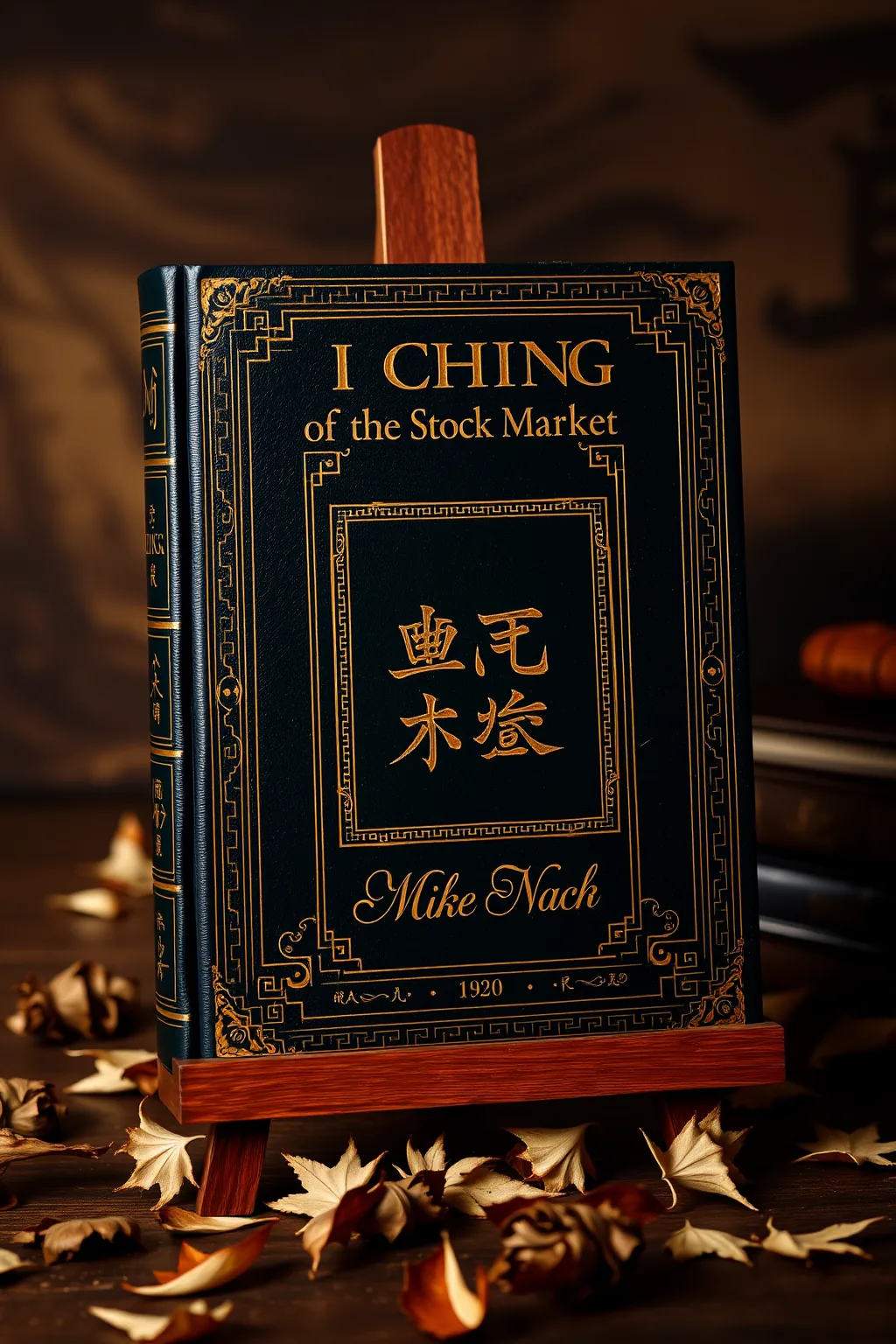
I Ching of the Stock Market
 61
61

I Ching of the Stock Market



Lorelei Sage, Contemplative Literature Editor — Mike Nach's "I Ching of the Stock Market" is a revelation for those who sense a deeper order beneath the surface of financial fluctuations. Nach adeptly bridges the ancient wisdom of the I Ching with the modern complexities of market speculation, offering not just predictive tools but a profound philosophical lens. His exposition is rich with symbolic interpretation, revealing how hexagrams act as cosmic mirrors to market sentiment and price action. This book is a treasure for practitioners of divination, investors seeking intuitive guidance, and scholars of esoteric systems. It transcends mere technical analysis, inviting readers to engage with markets on a soul-level.
📝 Description
61
Mike Nach's 1996 book connects the I Ching to stock market analysis.
Mike Nach's "I Ching of the Stock Market," first published in 1996, applies the ancient Chinese divination text to financial trading. The book details how the 64 hexagrams can be used to interpret market movements and investor psychology. Nach provides methods for casting hexagrams and relating their symbolic meanings to specific market conditions.
The author argues that stock price fluctuations mirror larger universal patterns, accessible through the I Ching's wisdom. This approach moves beyond standard technical and fundamental analysis. It encourages a more intuitive and philosophically grounded perspective on investing, aiming to align the trader with broader cosmic cycles rather than just predicting short-term gains. The book is for those who seek symbolic interpretation in financial decision-making.
This work sits within a tradition of applying ancient divination systems to modern practical concerns, particularly finance. It follows figures who saw correspondences between cosmological orders and human activities. Like earlier attempts to find order in chaos through symbolic systems, Nach uses the I Ching to map the perceived randomness of the stock market onto a structured philosophical framework. This is akin to applying astrological or numerological principles to interpret events, seeking hidden connections and underlying rhythms.
💡 Why Read This Book?
This book offers a unique fusion of ancient divination and modern finance. It's for seekers who believe markets are influenced by more than just data, for practitioners of esoteric arts looking to apply their knowledge, and for investors who desire a deeper, more intuitive understanding of market cycles. Discover hidden patterns and unlock a mystical perspective on financial fortune.
⭐ Reader Reviews
Honest opinions from readers who have explored this book.
❓ Frequently Asked Questions
Can the I Ching truly predict stock market movements?
The "I Ching of the Stock Market" posits that the I Ching offers insights into potential market tendencies and underlying energies, rather than definitive predictions. It guides intuition and strategic decision-making.
Is prior knowledge of the I Ching required?
While familiarity can enhance the experience, Mike Nach provides clear explanations and interpretations, making the book accessible to newcomers interested in applying its wisdom to financial markets.
What kind of investor would benefit most from this book?
This book is ideal for investors who are open to esoteric principles, seek intuitive guidance beyond traditional analysis, and are interested in understanding market psychology through a symbolic lens.
How does this approach differ from standard financial analysis?
It moves beyond quantitative data to explore the qualitative, energetic, and symbolic forces that may influence market sentiment and price direction, drawing parallels with ancient wisdom.
What is the philosophical underpinning of this method?
The book operates on the principle of synchronicity and the belief that universal patterns reflected in the I Ching also manifest in collective human endeavors like financial markets.
🔮 Key Themes & Symbolism
The Symbiotic Dance of Heaven and Earth
This theme explores the fundamental I Ching concept of Yin and Yang, applied to the macrocosmic forces influencing financial markets. It explores how opposing yet complementary energies—such as optimism and pessimism, expansion and contraction, supply and demand—interact and create the dynamic ebb and flow of stock prices. The book illustrates how understanding these archetypal forces can provide a framework for anticipating shifts in market sentiment and identifying turning points.
Hexagrams as Cosmic Blueprints
Here, the focus is on the profound symbolic language of the I Ching's 64 hexagrams. Nach reveals how each hexagram acts as a unique blueprint, encapsulating specific archetypal situations and inherent potentials. These ancient symbols are presented not as static prophecies, but as dynamic indicators of prevailing energies, offering nuanced insights into the underlying conditions and potential outcomes of market trends. The reader learns to interpret these visual metaphors as maps of the collective unconscious at play in finance.
Intuition as the Alchemical Key
This central theme emphasizes the crucial role of developing intuition in conjunction with I Ching wisdom. The book argues that while the hexagrams provide a symbolic language, true mastery lies in the ability to intuitively grasp their meaning and apply it to real-time market events. Nach guides the reader in cultivating this inner knowing, transforming the act of trading from a purely analytical exercise into a harmonized interplay of intellect and inspired insight.
💬 Memorable Quotes
Direct passages from the work, attributed to the author.
“Hexagrams are whispers from the universal mind, speaking to the trader's soul.”
— This highlights the intuitive and spiritual aspect of using the I Ching for financial guidance, implying a direct connection to higher consciousness.
“In the flux of speculation, find the stillness of the unchanging principle.”
— This encourages a mindful approach to trading, urging the reader to seek inner equilibrium and timeless truths amidst market volatility.
“The true investor sees not just numbers, but the unfolding of destiny.”
— This elevates the act of investing beyond mere financial gain, framing it as participation in a grander, predestined cosmic narrative.
“Synchronicity reveals the market's interconnectedness with the soul's journey.”
— This emphasizes the concept of meaningful coincidences, suggesting that market events can be seen as reflections of personal spiritual growth and cosmic alignment.
💡 Key Ideas
Editorial paraphrase of the work's core concepts — not direct quotes.
The market's pulse is a cosmic rhythm, waiting to be understood.
This quote suggests that financial markets are not merely random occurrences but are governed by deeper, universal patterns that can be deciphered through ancient wisdom.
🌙 Esoteric Significance
Tradition
This work draws heavily from the ancient Chinese tradition of the I Ching (Book of Changes), a foundational text of Taoism. It interprets the I Ching's divinatory system, its philosophical underpinnings of change and balance, and its symbolic language as a means to understand the dynamic forces at play within financial markets, connecting it to broader metaphysical principles of cosmic order and cyclical patterns.
Symbolism
The core symbolism revolves around the 64 hexagrams, each representing a distinct archetypal situation or energetic configuration. These symbols, derived from combinations of solid (Yang) and broken (Yin) lines, are interpreted as metaphors for market psychology, economic cycles, and investor behavior, revealing hidden patterns and potential outcomes.
Modern Relevance
In a world increasingly driven by data and algorithms, the "I Ching of the Stock Market" offers a vital counterpoint by emphasizing intuition, symbolism, and the interconnectedness of macrocosmic forces with human endeavors. It provides a framework for a more holistic and conscious approach to financial decision-making, resonating with contemporary seekers looking for meaning and deeper understanding beyond superficial analysis.
👥 Who Should Read This Book
This book is a beacon for the discerning investor, the contemplative scholar, and the dedicated practitioner of esoteric arts. Beginners curious about applying ancient wisdom to modern challenges will find a clear, informative guide. Experienced practitioners of divination will discover a novel application for their skills. Scholars of comparative philosophy and mysticism will appreciate the unique synthesis of Chinese metaphysics and financial markets. Ultimately, anyone seeking a deeper, more intuitive, and philosophically rich understanding of the forces that shape our economic world will find profound value within these pages.
📜 Historical Context
Published during an era of burgeoning interest in alternative philosophies and the integration of Eastern wisdom into Western life, Mike Nach's "I Ching of the Stock Market" emerged as a unique contribution to both financial literature and esoteric studies. The late 20th and early 21st centuries saw a growing skepticism towards purely materialistic explanations, paving the way for works that explored the intersection of consciousness, spirituality, and practical life. This book tapped into a zeitgeist where individuals sought deeper meaning and guidance beyond conventional paradigms. It stands as a proof of the enduring relevance of ancient systems like the I Ching in providing useful insights into the human experience, even in seemingly mundane domains like commerce and speculation.
📔 Journal Prompts
Reflect on a recent market event: which I Ching hexagram best describes the prevailing energy, and why?
How can the concept of Yin and Yang be applied to your personal investment strategy?
Consider a hexagram that appeals to your current financial goals. What actions does its symbolism suggest?
In moments of market uncertainty, what inner stillness can you cultivate, inspired by the I Ching's principles?
Explore the synchronicities you've observed between your personal life and market movements, as suggested by the 'I Ching of the Stock Market'.
🗂️ Glossary
Hexagram
A symbol composed of six stacked horizontal lines, each either solid (Yang) or broken (Yin), representing a specific archetypal situation or energetic state within the I Ching.
I Ching
An ancient Chinese divination text and philosophical classic, meaning 'Book of Changes,' which describes the world as a dynamic process of constant transformation governed by balanced forces.
Yang
In Taoist philosophy, the active, light, masculine, and assertive principle, often represented by a solid line in an I Ching hexagram. In markets, it can symbolize expansion, optimism, or upward momentum.
Yin
In Taoist philosophy, the passive, dark, feminine, and receptive principle, often represented by a broken line in an I Ching hexagram. In markets, it can symbolize contraction, pessimism, or downward momentum.
Synchronicity
The meaningful coincidence of two or more events where something other than the probability of their occurring implies a causal relationship, as described by Carl Jung.
This book appears in 5 collections
🔮 Readers Also Liked
Browse all →









From the “Remote Viewing” Collection
View all →





More Free Divination & Tarot Books
View all →