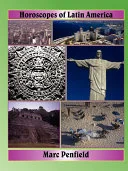
Horoscopes of Latin America
 77
77

Horoscopes of Latin America
Marc Penfield's "Horoscopes of Latin America" attempts a monumental task: to map the astrological character of an entire continent and its associated islands. The sheer scope is admirable, presenting detailed astrological profiles for forty distinct political entities. Penfield's dedication to mundane astrology is evident, particularly in his thoroughness regarding the historical independence dates that form the basis for many of his chart calculations. A notable strength lies in the comparative aspect; by grouping nations within distinct regions like the Caribbean or South America, he highlights both unique national horoscopes and shared regional astrological influences. However, the book occasionally feels like an exhaustive catalog rather than a deeply interpretive text. While the factual data underpinning the horoscopes is presented, the astrological synthesis could sometimes be more nuanced. For instance, his analysis of the "liberation" periods for countries like Brazil or Mexico, while factually correct regarding their independence, could benefit from a deeper exploration of the astrological symbolism inherent in their monarchical transitions. Ultimately, "Horoscopes of Latin America" serves as an invaluable, albeit dense, reference for those deeply committed to the study of mundane astrology.
📝 Description
77
Marc Penfield's 2008 book surveys the horoscopes of nearly forty Latin American nations.
Horoscopes of Latin America by Marc Penfield offers a detailed astrological examination of a large geographical and cultural area. The book divides its analysis into four main regions: Mexico, the Caribbean, Central America, and South America. Within these sections, Penfield examines the horoscopic profiles of approximately forty countries and colonies. This broad scope seeks to establish a consistent astrological viewpoint across diverse nations, many of which share a history of independence from Iberian empires.
The volume is designed for serious astrology students, especially those interested in geopolitical astrology and the astrological character of nations. It will also interest researchers of Latin American history and culture who approach their subjects from an esoteric perspective. Astrologers who focus on mundane astrology or wish to broaden their understanding beyond individual natal charts will find a wealth of material. The book serves as a resource for individuals who use astrology as a means to understand collective energies and historical trends.
This work fits within the tradition of mundane astrology, which applies astrological principles to the collective lives of nations and societies. It builds upon earlier efforts to chart national destinies using key historical dates, such as independence or the founding of governments. By assigning specific horoscopes to countries, Penfield engages with the idea that celestial patterns influence collective events and national character, a concept explored in various esoteric traditions throughout history.
💡 Why Read This Book?
• Gain a unique astrological framework for understanding the collective consciousness of nations, particularly evident in the analysis of countries like Brazil and its 1822 independence horoscope. • Explore the astrological implications of shared colonial histories, as Penfield examines how nations like those in Central America, breaking from Spain, exhibit distinct yet related astrological signatures. • Discover specific astrological interpretations for forty countries, offering a comparative lens to mundane astrology that goes beyond generalized regional readings, providing concrete chart data for each entity.
⭐ Reader Reviews
Honest opinions from readers who have explored this book.
❓ Frequently Asked Questions
What specific historical dates does Marc Penfield use for national horoscopes in "Horoscopes of Latin America"?
Penfield primarily utilizes independence dates for national horoscopes, recognizing that these mark a nation's emergence as a sovereign entity. For example, the book would likely reference Brazil's 1822 independence date to establish its foundational astrological chart.
How does the book differentiate between the horoscopes of Mexico and other Central American countries?
While many Central American nations share a history of independence from Spain, Penfield differentiates horoscopes by using their specific independence dates and analyzing unique planetary placements and aspects for each country, acknowledging distinct national trajectories.
Does "Horoscopes of Latin America" discuss astrological influences on the Caribbean islands?
Yes, the book dedicates a specific section to the Caribbean, analyzing its island nations' horoscopes. This section likely accounts for the diverse colonial histories and unique geographical positions of these islands, offering a distinct astrological perspective.
What is the significance of Penfield's division of Latin America into four sections?
The division into Mexico, the Caribbean, Central America, and South America allows Penfield to explore both overarching regional astrological themes and country-specific nuances. This structure facilitates comparative analysis of shared histories and distinct national destinies.
Is "Horoscopes of Latin America" suitable for beginner astrologers?
While comprehensive, the book's dense, encyclopedic nature and focus on mundane astrology might be more suited for intermediate to advanced students of astrology who are already familiar with chart interpretation and astrological concepts.
What is mundane astrology and how is it applied in this book?
Mundane astrology interprets collective human affairs, such as politics and world events. In this book, it's applied by casting horoscopes for nations based on key historical dates to understand their national character and destiny.
🔮 Key Themes & Symbolism
National Horoscopes
The core concept involves casting astrological charts for nations, often based on their independence dates, to represent their collective psyche and destiny. Penfield applies this to approximately forty countries across Mexico, Central America, the Caribbean, and South America, examining how planetary positions at these central moments might explain national characteristics, historical patterns, and cultural tendencies. This approach treats nations as entities with their own astrological signatures.
Comparative Mundane Astrology
This theme focuses on the astrological parallels and divergences among nations, particularly those sharing colonial histories or geographical proximity. Penfield contrasts horoscopes of countries that gained independence from Spain versus Portugal, or those that adopted monarchical systems like Mexico and Brazil. The work facilitates a comparative study, highlighting how similar historical forces might manifest differently in individual national horoscopes.
Geopolitical Astrological Influences
The book explores how astrological principles can illuminate geopolitical events and national identities within Latin America. It studies the astrological interpretations of independence movements, political structures, and regional dynamics. By analyzing charts for countries across the continent, Penfield seeks to provide an esoteric framework for understanding the collective energies and historical trajectories that shape this vibrant part of the world.
Iberian Colonial Legacy
A significant underlying theme is the astrological impact of Iberian colonization and subsequent independence. Penfield examines how the timing of these historical shifts, often occurring in a concentrated period for many nations, influences their astrological makeup. The distinction between Spanish and Portuguese colonial legacies, and their respective paths to nationhood, is analyzed through the lens of astrological configurations.
💬 Memorable Quotes
Direct passages from the work, attributed to the author.
“Mexico and Brazil adopted monarchies after independence.”
— This observation highlights a unique historical divergence within Latin America's independence movements. Astrologically, it suggests distinct foundational charts compared to republican nations, potentially influencing their long-term development and national character as interpreted by Penfield.
“The Caribbean section presents a distinct astrological profile.”
— This points to the unique colonial histories and geographical isolation of Caribbean nations, differentiating their astrological signatures from mainland Central and South America. It signifies a deliberate approach to regional astrological variance.
“Most countries declared independence over a brief period.”
— This temporal clustering of independence dates implies a shared astrological 'moment' or influence impacting the region. Penfield likely analyzes these concurrent astrological configurations to understand commonalities and differences in national destinies.
“The work covers 40 countries and colonies.”
— This statement underscores the encyclopedic scope of Penfield's research. It signifies a commitment to providing a comprehensive astrological mapping of the entire region, treating each entity as a subject for detailed analysis.
“The book is divided into four continental sections.”
— This structural choice by Penfield emphasizes a geographical and cultural approach to mundane astrology. It allows for regional comparisons while also detailing individual national horoscopes within those broader frameworks.
🌙 Esoteric Significance
Tradition
This work firmly sits within the tradition of mundane astrology, a branch of Western esotericism concerned with the astrological interpretation of world events, nations, and political entities. It draws implicitly on the historical practice of casting horoscopes for cities and kingdoms, a practice that has roots in Hellenistic astrology and was continued through medieval and Renaissance periods. Penfield's contribution is to apply this methodology systematically to the complex political range of Latin America, treating each nation as an individual entity with a unique astrological signature.
Symbolism
Key symbols in this work would include the astrological chart itself, representing the "birth" of a nation, typically tied to its independence date. Planetary placements and aspects within these charts act as potent symbols, signifying inherent national characteristics, potential conflicts, and evolutionary paths. For instance, the placement of Mars might symbolize national temperament or military tendencies, while Jupiter could indicate fortune or expansion. The division into geographical regions (Mexico, Caribbean, etc.) also serves as symbolic mapping, clustering nations by shared historical or geographical astrological influences.
Modern Relevance
Contemporary practitioners of geopolitical astrology and researchers interested in the astrological underpinnings of national identity continue to find value in Penfield's meticulous cataloging. His work provides a foundational dataset for comparative studies in mundane astrology. Thinkers exploring the astrological dimensions of post-colonial societies or the astrological impact of historical turning points, such as independence movements, can draw upon the specific charts and analyses presented. It serves as a resource for those who view astrology as a tool for understanding collective human patterns and historical cycles.
👥 Who Should Read This Book
• Students of mundane astrology seeking detailed astrological charts and interpretations for approximately forty Latin American nations, particularly those interested in the astrological impact of independence movements. • Researchers of comparative geopolitical history interested in an esoteric perspective on national development, political structures, and regional influences across Mexico, Central America, the Caribbean, and South America. • Astrologers specializing in natal astrology who wish to expand their understanding to collective entities, using the book as a reference for how national horoscopes are constructed and interpreted based on historical events like the 1822 independence of Brazil.
📜 Historical Context
Published in 2008, Marc Penfield's "Horoscopes of Latin America" emerged during a period of resurgent interest in mundane astrology, moving beyond individual natal charts to explore collective phenomena. The work tackles nations whose histories are deeply intertwined with the Iberian colonial project and subsequent independence struggles, many of which occurred in the early 19th century. This era saw Spain and Portugal cede control over vast territories, leading to diverse political formations, including monarchies in Mexico and Brazil, contrasting with the republican ideals prevalent elsewhere. Penfield's approach can be seen as engaging with a tradition of national charting that dates back centuries, seeking to apply it to a region often viewed through a single lens. While not directly engaging with contemporary scholars like Nicholas Campion, who also writes extensively on mundane astrology, Penfield's encyclopedic cataloging of national horoscopes implicitly contributes to the growing body of work that seeks to understand collective destiny through astrological principles.
📔 Journal Prompts
Mexico's monarchical independence: How does this unique historical astrological event influence its national chart?
The Caribbean's distinct astrological signature: Reflect on the factors contributing to its divergence from mainland horoscopes.
Analyze the astrological implications of shared Spanish colonial independence dates across Central American nations.
Compare the astrological symbolism of Jupiter's placement in the horoscopes of two South American nations.
Explore the potential astrological interpretations of the 'brief period' of independence declarations across the continent.
🗂️ Glossary
Mundane Astrology
A branch of astrology that focuses on the interpretation of collective human affairs, such as the horoscopes of nations, cities, and global events, rather than individual charts.
National Horoscope
An astrological chart cast for a specific country, typically based on its date of independence or establishment of government, used to understand its collective characteristics and destiny.
Independence Date
The specific date on which a country officially declared or achieved sovereignty, often used as the primary basis for casting its national horoscope in mundane astrology.
Colonial Legacy
The lasting impact of colonial rule on a nation's political, social, economic, and cultural structures, which can be explored through an astrological lens in terms of national chart influences.
Geopolitical Astrology
The application of astrological principles to the study of international relations, national policies, and global affairs, often involving the analysis of national horoscopes.
Monarchy
A form of government with a monarch at the head, such as the historical examples of Mexico and Brazil mentioned in the book, which implies distinct astrological considerations for their national charts.
Sovereignty
The supreme power or authority of a state to govern itself or another state; the achievement of sovereignty is a key event for astrological charting of nations.
This book appears in 1 collection
🔮 Readers Also Liked
Browse all →









From the “Mundane Astrology” Collection
View all →









More Free Astrology & Cosmology Books
View all →