Heroides
 79
79

Heroides
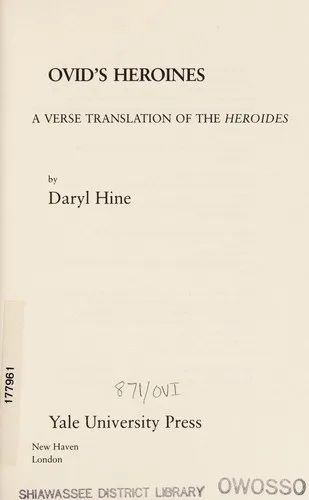
Ovid’s *Heroides* remains a powerful exploration of voice and vulnerability, and this 1921 edition by Palmer and Kennedy offers a serviceable translation. The strength of the collection lies in its radical empathy, giving form to the unspoken grievances of mythological women. Consider Penelope's lengthy epistle to Ulysses; she doesn't just lament his absence but dissects his strategic delays and the very nature of his 'heroism' with a sharp, almost modern, wit. However, the translation occasionally falters, sometimes sacrificing Ovid's characteristic fluidity for a more literal, stilted rendering that can obscure the emotional immediacy. The editorial framing, while academically sound for its time, lacks the interpretive depth available to contemporary readers. Despite these limitations, the *Heroides* continues to offer a compelling perspective on the personal cost of epic deeds.
Verdict: A valuable, if occasionally stiff, presentation of ancient emotional correspondence.
📝 Description
79
Arthur Palmer and Kennedy's 1921 edition of Ovid's *Heroides* presents letters from mythic women to absent lovers.
Ovid's *Heroides* is a collection of fictional letters written from the perspective of famous women from myth and history to their absent lovers. These epistles, translated and edited by Arthur Palmer and Kennedy for a 1921 publication, give voice to figures often overshadowed by their male counterparts. Each letter is a monologue where women like Penelope, Medea, and Dido express their feelings about abandonment, longing, and the personal costs of heroic actions.
The work structures these letters as individual pieces, allowing distinct female voices to emerge. It addresses themes central to human relationships, such as love, betrayal, and the consequences of war and ambition on personal lives. This edition aims to make these ancient Roman emotional perspectives accessible to contemporary readers, inviting reflection on enduring human experiences.
While Ovid's *Heroides* is primarily a work of classical literature, its focus on intense personal emotion, the inner lives of women, and the dramatic potential of correspondence can be seen as a precursor to later traditions that explore subjective experience. The detailed psychological portraits and the exploration of longing and absence resonate with elements found in later mystical and devotional writings, which often use epistolary forms to express a deep, personal connection or yearning. The collection’s structure, presenting individual voices in isolation, also echoes the focus on solitary contemplation found in certain esoteric practices.
💡 Why Read This Book?
• Gain insight into the concept of *fama* (reputation) as perceived by women in antiquity, as seen in Penelope's letters concerning Ulysses' prolonged absence and the stories circulating about him. • Understand the dramatic tension between public glory and private suffering, exemplified by Medea's disillusionment with Jason and the consequences of his quest for the Golden Fleece. • Experience the epistolary form as an early mode of psychological exploration, particularly through Sappho's lament to Phaon, revealing a raw, personal vulnerability not often attributed to classical figures.
⭐ Reader Reviews
Honest opinions from readers who have explored this book.
❓ Frequently Asked Questions
When was Ovid's *Heroides* originally written?
Ovid composed the *Heroides* during the late 1st century BCE and early 1st century CE, likely between 1 BCE and 8 CE, a period of significant literary production in Augustan Rome.
Who are some of the women featured in Ovid's *Heroides*?
The collection features prominent mythological and legendary figures such as Penelope (wife of Ulysses), Dido (queen of Carthage), Medea (sorceress), Ariadne (abandoned by Theseus), and Sappho (the poet).
What is the primary literary form of the *Heroides*?
The *Heroides* is primarily a collection of fictional letters, written in elegiac couplets. Each letter is a monologue from a woman to her absent lover or husband.
What is the significance of the 1921 edition by Palmer and Kennedy?
This 1921 edition represents an early 20th-century scholarly engagement with Ovid, providing a translation and commentary intended to make the ancient text accessible during a period of renewed classical studies.
Does Ovid's *Heroides* offer a feminist perspective?
While not explicitly feminist by modern standards, the *Heroides* offers a proto-feminist exploration by giving voice and interiority to women often marginalized in patriarchal narratives, focusing on their emotional experiences and grievances.
What does 'Heroides' mean?
'Heroides' is derived from the Greek 'hērōs', meaning 'hero'. It translates to 'heroines' or 'epistles of heroines', signifying the letters written by famous women of myth and legend.
🔮 Key Themes & Symbolism
Female Subjectivity in Antiquity
The *Heroides* is groundbreaking for its sustained focus on the inner lives and emotional perspectives of women within classical mythology. Figures like Penelope, usually defined by their husbands' absence, are given agency through their written words, articulating their desires, frustrations, and sharp critiques of male actions. This grants a unique insight into a form of subjectivity often suppressed or overlooked in the predominantly male-authored literary tradition of Rome. The letters explore their feelings of abandonment, their strategic maneuvering in relationships, and their profound sense of personal injustice stemming from heroic narratives. This exploration provides a crucial counterpoint to the epic tales that often sideline female experience.
The Personal Cost of Heroism
A central theme is the devastating impact of 'heroic' deeds and epic quests on the personal lives of the women involved. Medea’s letter to Jason, for example, moves beyond her sorcery to reveal her profound sense of betrayal and the personal sacrifices she made for his ambition. Similarly, Ariadne’s plea to Theseus highlights her abandonment after aiding his escape from the Minotaur. Ovid uses these epistles to question the glory of the male hero by exposing the suffering and emotional wreckage left in his wake. The work implicitly critiques a societal structure that valorizes male achievement at the expense of female well-being and emotional stability.
The Epistolary Form as Dramatic Medium
Ovid masterfully employs the letter format not merely for communication but as a powerful dramatic device. Each epistle is a carefully crafted monologue, a performance of emotion intended to elicit a specific response from the absent recipient—often guilt, pity, or renewed affection. The *Heroides* demonstrates the potential of the epistolary form to explore psychological depth and complex interpersonal dynamics. The women write as if their words hold power to reshape events or rectify wrongs, revealing their agency within the confines of their circumstances. This use of the letter as a tool for self-expression and persuasion was innovative for its time.
Mythological Reinterpretation
The *Heroides* offers a significant reinterpretation of well-known myths by shifting the narrative perspective. Instead of recounting the grand adventures of heroes like Ulysses or Jason from an external viewpoint, Ovid presents these events through the eyes of the women left behind. This approach challenges traditional heroic narratives by highlighting their often-unacknowledged consequences for women. By focusing on the aftermath and the personal ramifications, Ovid subtly questions the heroic ideal and invites readers to consider the complexities and moral ambiguities inherent in these legendary tales, offering a more nuanced understanding of ancient Greek and Roman mythology.
💬 Memorable Quotes
Direct passages from the work, attributed to the author.
““The cause of my suffering, my letters show, is my own fault… I have deserved this fate.””
— This sentiment, echoing in various forms, particularly from figures like Ariadne, reflects a complex self-awareness. It acknowledges personal agency while simultaneously condemning the actions of the beloved, highlighting the painful intersection of choice and consequence in relationships.
““Let my name be forgotten if only my wrongs may be avenged.””
— This dramatic plea underscores the depth of a heroine's anguish. It suggests that personal memory and legacy become secondary to the overwhelming need for justice or retribution against the one who caused their profound pain.
““You are safe, and I am lost; you are well, and I am suffering.””
— This stark contrast highlights the unequal distribution of fortune and suffering between the hero and the heroine. It emphasizes the hero's ability to escape unscathed while the heroine is left to bear the full weight of their shared ordeal or separation.
““Why is the name of 'wife' given to me, if I am not to be your wife?””
— This question, posed by a deserted wife, directly challenges the societal definitions and promises that underpin her status. It reveals the precariousness of a woman's position when a man's actions negate the very foundation of her identity and relationship.
💡 Key Ideas
Editorial paraphrase of the work's core concepts — not direct quotes.
“I am deserted, and my just complaints accuse your cruelty.”
This line captures the core grievance of many heroines: abandonment coupled with a sense of righteous indignation. It frames their suffering not as passive victimhood but as a direct result of their lover's perceived injustice and lack of fidelity.
🌙 Esoteric Significance
Tradition
While Ovid's *Heroides* is primarily a work of classical literature, its focus on emotional resonance and the interior lives of mythological figures lends itself to esoteric interpretation, particularly within psychological and archetypal traditions. It doesn't fit neatly into hermetic, kabbalistic, or theosophical lineages but rather serves as source material for understanding the anima or feminine principle in Jungian psychology. The letters can be seen as accessing primal emotional patterns and archetypal figures (the abandoned lover, the wronged wife) that resonate with Gnostic explorations of soul fragmentation and longing for wholeness.
Symbolism
The primary symbols are the letters themselves, representing communication, longing, and the attempt to bridge distance—both physical and emotional. The absent lover (Ulysses, Jason, Paris) symbolizes the unattainable or the 'other' towards which the feminine principle yearns. Places mentioned, like Troy or Colchis, become symbolic landscapes of betrayal or the site of heroic, yet destructive, quests. The act of writing itself symbolizes an attempt to reclaim agency and assert one's reality against the silence or indifference of the world.
Modern Relevance
Contemporary thinkers in depth psychology, particularly those influenced by Jung, draw upon the *Heroides* to explore archetypal figures and the dynamics of the psyche. Feminist literary critics continue to analyze the text for its proto-feminist explorations of female voice and agency. Furthermore, contemporary poets and artists engaged with classical mythology often revisit Ovid's heroines, using their narratives as springboards for modern explorations of relationships, trauma, and resilience, finding enduring power in these ancient expressions of human emotion.
👥 Who Should Read This Book
• Students of classical literature and Roman poetry seeking foundational texts that explore emotional depth and narrative voice within myth. • Scholars of gender studies and feminist theory interested in early representations of female subjectivity and critiques of patriarchal structures in antiquity. • Readers drawn to psychological archetypes and the exploration of longing, abandonment, and betrayal, who appreciate nuanced character studies presented through the epistolary form.
📜 Historical Context
Ovid's *Heroides*, originally composed around the turn of the Common Era, emerged during the sophisticated literary milieu of Augustan Rome. This period, while outwardly promoting moral order, was a fertile ground for complex explorations of human emotion and mythology. Ovid himself was a master of elegiac poetry, a genre often concerned with love, loss, and personal reflection, which provided a natural vehicle for the *Heroides*. The collection’s influence was immense, shaping Western notions of love and lament through the Middle Ages and Renaissance, inspiring countless poets and writers. By the time of this 1921 translation by Palmer and Kennedy, Ovid was firmly established as a classical master, but the early 20th century also saw critical reappraisals. Scholars like Gilbert Highet would later analyze Ovid's engagement with themes of psychology and social commentary, placing him within a lineage that included contemporaries like Horace and Virgil, while also noting his departure towards more personal and subjective expression, distinct from the grand state-sponsored epics.
📔 Journal Prompts
Penelope's strategic delay and Ulysses' protracted absence: explore the interplay of patience and action.
Medea's disillusionment with Jason: reflect on the personal cost of 'heroic' ambition.
The symbolic weight of the written letter in bridging emotional chasms.
Sappho's lament for Phaon: analyze the expression of unrequited desire.
The concept of *fama* and its impact on the heroines' narratives.
🗂️ Glossary
Elegy
A form of poetry that laments or meditates on a subject, often characterized by a mournful or reflective tone. Ovid frequently employed elegiac couplets in his works, including the *Heroides*.
Epistolary Novel/Poem
A literary genre where the main narrative is conveyed through a series of documents, typically letters. The *Heroides* is a key early example in poetry.
Fama
Latin for 'rumor,' 'report,' or 'fame.' In Roman literature, *fama* often refers to public reputation and the spread of information, which could be both positive and negative.
Mythological Figures
Characters drawn from ancient myths and legends, such as Penelope, Dido, and Medea, whose stories Ovid retells from a female perspective.
Subjectivity
The quality of existing in someone's mind rather than the external world; personal experience, feelings, and beliefs. The *Heroides* emphasizes the subjective experiences of its heroines.
Augustan Age
The period of Roman history during the reign of Emperor Augustus (27 BCE – 14 CE), considered a golden age for Latin literature, with poets like Virgil, Horace, and Ovid flourishing.
Elegiac Couplet
A pair of successive lines of verse, the first in iambic pentameter and the second in iambic trimeter. This meter was commonly used for laments and love poetry in Latin.
🔮 Readers Also Liked
Browse all →









More by Ovid, Arthur Palmer, Kennedy
All books →
More Free Occult Philosophy Books
View all →