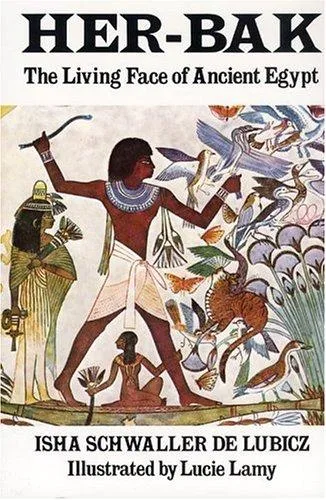
Her-Bak, "Chick Pea"
 73
73

Her-Bak, "Chick Pea"
Isha Schwaller de Lubicz's Her-Bak, "Chick Pea" is an ambitious attempt to reframe our understanding of ancient Egypt, positing a profound spiritual and philosophical depth often absent in mainstream scholarship. The book’s strength lies in its relentless pursuit of symbolic meaning, treating the ancient Egyptian landscape and its monuments as a living text. One particular passage, discussing the symbolic resonance of the chick pea itself as a metaphor for germination and divine potential, offers a unique lens through which to view Egyptian thought. However, the work’s interpretive framework can occasionally feel overly speculative, relying on a dense, interconnected system of symbolism that demands considerable prior knowledge or a willingness to accept its premises without empirical proof. The detailed symbolic readings, while compelling, sometimes overshadow the historical narrative. Ultimately, Her-Bak offers a rich, albeit challenging, alternative perspective for those willing to engage with its dense symbolic universe.
📝 Description
73
Published in 1954, Her-Bak argues ancient Egypt was a civilization of sophisticated spiritual cosmology.
Isha Schwaller de Lubicz's Her-Bak, "Chick Pea" presents a study of ancient Egypt focused on its symbolic language and spiritual foundations. The author moved beyond standard historical and archaeological views to propose that Egyptian civilization was a highly developed spiritual and philosophical culture. This perspective suggests a wisdom that still resonates. The book is for serious students of esoteric traditions, comparative religion, ancient symbolism, and Hermetic philosophy. Readers who look for a non-material understanding of ancient Egypt will find its detailed analyses valuable. It speaks to those who question mainstream Egyptology and are open to spiritual interpretations of past civilizations.
Her-Bak discusses the concept of the "living symbol" in Egyptian religion and art, suggesting these symbols held active power rather than just representing things. It examines the Egyptian view of the cosmos as a divine manifestation, the pharaoh's role as a spiritual link, and the complex metaphysical systems that shaped daily life and religious practices. The text specifically considers the "Chick Pea" symbol as important, though often overlooked, representing a seed of potential.
Published in 1954, Her-Bak appeared during a time of renewed interest in esoteric thought, influenced by figures like Helena Blavatsky and Rudolf Steiner. It offered a spiritual and symbolic interpretation of ancient Egypt, contrasting with the materialistic archaeology common then. This approach aligns with thinkers like René Guénon who also sought spiritual frameworks in history. The book challenged prevailing academic views by proposing a deeply integrated spiritual cosmology for ancient Egypt, positioning it within a lineage of alternative historical and philosophical inquiry.
💡 Why Read This Book?
• Gain an alternative perspective on ancient Egyptian civilization, understanding its spiritual cosmology beyond typical historical accounts, by examining the work's interpretation of "living symbols." • Explore the esoteric significance of the "Chick Pea" symbol, learning how it represents germination and divine consciousness within an ancient spiritual framework. • Grasp the symbolic language of Egyptian art and architecture as presented by Isha Schwaller de Lubicz, offering a unique hermeneutic approach to historical interpretation.
⭐ Reader Reviews
Honest opinions from readers who have explored this book.
❓ Frequently Asked Questions
What is the significance of "Chick Pea" in Her-Bak?
The "Chick Pea" in Her-Bak symbolizes the seed of divine consciousness, representing germination, potential, and the unfolding of spiritual life within the Egyptian symbolic system.
Who was Isha Schwaller de Lubicz?
Isha Schwaller de Lubicz was a prominent esoteric author and scholar, known for her significant contributions to the study of ancient Egypt, particularly her symbolic and spiritual interpretations.
When was Her-Bak first published?
Her-Bak, "Chick Pea" was first published in 1954, a period marked by a surge in esoteric and spiritual interpretations of ancient cultures.
Does Her-Bak require prior knowledge of Egyptology?
While prior knowledge can be helpful, Her-Bak is written to introduce its symbolic framework. However, readers should be open to esoteric interpretations and dense symbolic analysis.
What is the main argument of Her-Bak?
The book argues that ancient Egypt possessed a highly developed spiritual and philosophical system, expressed through a rich symbolic language embedded in its art, architecture, and religion, which influenced its entire civilization.
How does Her-Bak differ from standard Egyptology?
Unlike standard Egyptology, which often focuses on historical and archaeological evidence, Her-Bak emphasizes the symbolic and spiritual dimensions, interpreting Egyptian culture as a manifestation of profound metaphysical principles.
🔮 Key Themes & Symbolism
The Living Symbol
Her-Bak posits that ancient Egyptian symbols were not static representations but dynamic, living forces carrying inherent meaning and power. The text explores how these symbols, from hieroglyphs to architectural features, were integral to the spiritual and cosmic understanding of the Egyptians. It suggests that to truly understand Egypt, one must engage with these symbols as active agents in shaping consciousness and reality, rather than mere historical artifacts.
Spiritual Cosmology
The book presents a sophisticated spiritual cosmology for ancient Egypt, arguing that the civilization was founded on profound metaphysical principles. It details how the Egyptians perceived the universe as a divine manifestation and how their religious practices, political structures, and daily life were deeply intertwined with this understanding. This contrasts with purely materialistic or historical interpretations, emphasizing a holistic, divinely ordered worldview.
The Chick Pea Symbol
Central to the work is the exploration of the "Chick Pea" (Her-Bak) as a potent symbol. It is interpreted as representing the germinating seed of divine consciousness, the potential for spiritual rebirth, and the cyclical nature of existence within the Egyptian esoteric tradition. This symbol serves as a key to unlocking deeper layers of meaning within the broader Egyptian symbolic language.
Metaphysical Interpretation of Monuments
Her-Bak reinterprets Egyptian monuments not just as architectural achievements or historical records, but as physical embodiments of metaphysical truths. The alignment of temples, the form of statues, and the inscriptions are analyzed for their symbolic and energetic functions within a divinely ordered cosmos. This approach seeks to reveal the sacred geometry and spiritual intent behind these ancient structures.
💬 Memorable Quotes
Direct passages from the work, attributed to the author.
“The chick pea is the seed of divine consciousness.”
— This statement expresses the book's central thesis regarding the 'Chick Pea' symbol, highlighting its role as a metaphor for spiritual potential and awakening within the Egyptian esoteric framework.
“Every stone in Egypt sings a sacred song.”
— This evocative phrase suggests that ancient Egyptian monuments and structures are imbued with spiritual meaning and cosmic harmony, acting as conduits for divine knowledge.
“Symbolism is the language of the soul.”
— This interpretation emphasizes the profound connection between symbolic expression and the inner spiritual life, suggesting that symbols in ancient Egypt were direct communications from the soul.
“The Pharaoh was the living link between heaven and earth.”
— This highlights the sacred role of the Egyptian ruler, not just as a political leader but as a spiritual intermediary tasked with maintaining cosmic balance and divine order on Earth.
“Ancient Egypt was a school for the soul.”
— This concept frames the entire civilization as an environment designed for spiritual development and enlightenment, where life itself was a pedagogical process guided by divine principles.
🌙 Esoteric Significance
Tradition
Her-Bak is firmly rooted in the Hermetic and Gnostic traditions, interpreting ancient Egypt through a lens of universal spiritual laws and symbolic correspondences. It presents Egyptian civilization not merely as a historical entity but as a manifestation of a perennial wisdom, a sacred science concerned with the divine order of the cosmos and humanity's place within it. This approach seeks to uncover the esoteric underpinnings of a civilization often viewed solely through its archaeological remnants.
Symbolism
The work places immense emphasis on "living symbols." Key symbols explored include the "Chick Pea" itself, representing the germinating seed of divine consciousness, and the concept of cosmic balance, inherent in the Egyptian understanding of Ma'at. Monuments are interpreted not just architecturally but as symbolic representations of metaphysical principles, with their alignments and forms conveying sacred geometry and spiritual truths.
Modern Relevance
Contemporary practitioners of Hermeticism, comparative religion scholars, and students of esoteric symbolism continue to draw upon Her-Bak. Its detailed symbolic analysis informs modern approaches to understanding ancient mythologies and sacred art. Thinkers and groups interested in sacred geometry, the spiritual history of civilizations, and the integration of ancient wisdom into modern consciousness find its interpretive framework invaluable.
👥 Who Should Read This Book
• Students of esoteric Egyptology seeking a spiritual interpretation of ancient Egyptian culture beyond conventional historical accounts. • Practitioners of Hermeticism and comparative religion interested in exploring universal wisdom traditions and their symbolic languages. • Readers fascinated by ancient symbolism and mythology who wish to understand how these elements can inform a deeper spiritual worldview.
📜 Historical Context
Her-Bak, "Chick Pea," published in 1954, emerged during a post-war era of burgeoning interest in Eastern and esoteric philosophies, influenced by earlier movements like Theosophy and Anthroposophy. Isha Schwaller de Lubicz, building upon the work of her husband, Alexandre, offered a radical departure from the prevailing academic Egyptology, which often focused on historical materialism and archaeological findings. Her approach aligned with a more spiritual and symbolic interpretation of ancient civilizations, a current also explored by figures like René Guénon, who similarly sought to uncover the metaphysical underpinnings of world traditions. While not directly engaging with contemporaries in published debates, Schwaller de Lubicz's work implicitly challenged the rationalist and often secular perspectives of mainstream scholars. The reception within esoteric circles was significant, providing a rich symbolic framework for understanding ancient Egypt that resonated with those seeking a spiritual dimension to history.
📔 Journal Prompts
The symbolic meaning of the "Chick Pea" as a seed of consciousness.
How ancient Egyptian monuments function as "living symbols."
The role of the Pharaoh as a spiritual intermediary.
Reflections on Ma'at as cosmic balance in ancient Egyptian thought.
Interpreting the "sacred song" sung by Egyptian stones.
🗂️ Glossary
Her-Bak
The name given to the "Chick Pea" symbol within the context of this work, representing the seed of divine consciousness and spiritual germination.
Living Symbol
A concept suggesting that ancient Egyptian symbols were not mere representations but active, dynamic forces carrying inherent meaning and spiritual power.
Spiritual Cosmology
The book's interpretation of ancient Egypt's worldview, emphasizing a universe governed by divine principles and sacred laws, where all aspects of life were interconnected.
Ma'at
The ancient Egyptian concept of truth, balance, order, law, morality, and justice, personified as a goddess, essential for cosmic and social harmony.
Sacred Geometry
The belief that geometric shapes and proportions hold symbolic and spiritual significance, applied here to the understanding of Egyptian architecture and art.
Pharaoh as Intermediary
The understanding of the Egyptian ruler's role not just as a political leader but as a divine link connecting humanity to the gods and maintaining cosmic order.
Metaphysical Principles
Fundamental laws and truths governing reality beyond the physical, which the book posits as the foundation of ancient Egyptian civilization and its symbolic expressions.
🔮 Readers Also Liked
Browse all →









More by Isha Schwaller de Lubicz
All books →
More Free Occult Philosophy Books
View all →