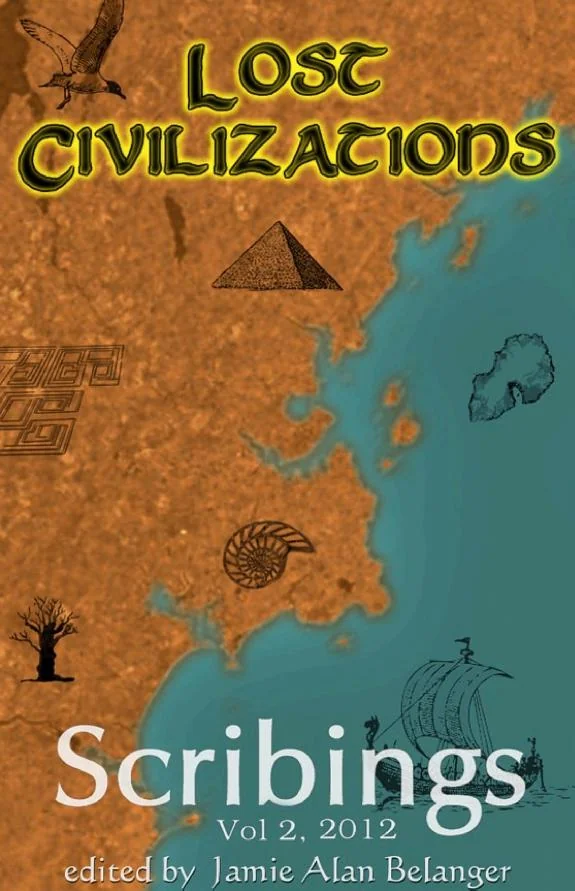
Scribings, Vol 2: Lost Civilizations
 78
78

Scribings, Vol 2: Lost Civilizations
The Greater Portland Scribists deliver a varied collection in Scribings, Vol 2: Lost Civilizations, showcasing a range of narrative voices and thematic explorations. The strength of this volume lies in its imaginative scope, transporting readers to diverse historical settings. One particularly striking story follows a Viking boy confronting an executioner's axe, a potent image of inherited responsibility or perhaps a moment of unexpected agency. However, the collection's unevenness is also apparent; some narratives feel more fully realized than others, occasionally leaving the reader wanting deeper engagement with the established worlds. The story of a vanishing civilization, viewed through a young girl's eyes, offers a poignant, if brief, exploration of loss. While not every tale achieves the same impact, the collection as a whole provides an intriguing, if sometimes fleeting, exploration of forgotten histories and their echoes. It serves as a compelling, albeit brief, expedition into speculative pasts.
📝 Description
78
Published in 2012, Scribings, Vol 2 collects eight tales of vanished societies and the uncanny.
This 2012 collection by Jamie Alan Belanger, Cynthia Ravinski, and Richard Veysey presents eight short stories. The narratives center on lost civilizations and forgotten places, taking readers from ancient Egypt to Norse settlements. These speculative historical fiction pieces often include a touch of the supernatural.
Readers who enjoy fiction that blends historical settings with imaginative elements will find this volume appealing. It engages with themes of forgotten pasts, the outcomes of human actions, and the very nature of civilization. The stories are concise, aiming to provoke thought about the human condition across different times and cultures.
The collection emerged during a period of interest in historical fiction and speculative stories. The authors, associated with the Greater Portland Scribists, seem to have been interested in exploring questions about history and the metaphysical. The focus on lost civilizations taps into a long standing human curiosity about origins, societal collapse, and past mysteries.
The stories in Scribings, Vol 2 tap into a persistent interest in lost or hidden histories, a theme common in esoteric traditions. These traditions often explore ancient civilizations not just as historical entities but as repositories of forgotten knowledge or spiritual insights. The collection’s engagement with speculative elements and the uncanny suggests an exploration of realities beyond the mundane, aligning with esoteric pursuits that seek deeper truths or hidden connections within the past and human experience.
💡 Why Read This Book?
• Gain unique perspectives on historical moments, such as the specific scenario of a Viking boy presented with an executioner's ax, offering insights into duty and choice beyond typical historical accounts. • Contemplate the impermanence of civilizations through narratives like the one detailing a society's disappearance through a young girl's eyes, fostering a unique appreciation for societal fragility. • Explore the theme of creation and dreams through the character of a bookbinder achieving his aspirations, providing a concrete example of personal ambition amidst broader historical or speculative contexts.
⭐ Reader Reviews
Honest opinions from readers who have explored this book.
❓ Frequently Asked Questions
What specific historical periods or locations are featured in Scribings, Vol 2: Lost Civilizations?
The collection touches upon ancient Egypt, referencing an Egyptian pyramid in an unusual location, and also includes narratives set in Viking-era environments, alongside explorations of entirely fictional or speculative lost civilizations.
Who are the primary authors contributing to this volume?
The book features contributions from Jamie Alan Belanger, Cynthia Ravinski, and Richard Veysey, with its initial publication date recorded as June 29, 2012.
What kinds of themes does Scribings, Vol 2 explore?
Central themes include lost civilizations, the consequences of actions, learning from mistakes, personal ambition, and the passage of time. The stories often involve speculative historical settings and unique individual experiences within them.
Is this book part of a series?
Yes, this is the second volume in the 'Scribings' series, focusing specifically on the theme of 'Lost Civilizations'.
What is the overall tone of the stories in this collection?
The tone varies across the eight stories but generally leans towards speculative fiction with elements of historical curiosity, personal drama, and sometimes a touch of the uncanny or philosophical reflection on human endeavors.
Does the book offer insights into specific historical events?
While the stories are speculative, they use historical settings like ancient Egypt and Viking culture as backdrops. They focus more on fictionalized human experiences within these contexts rather than strict historical accounts of events.
🔮 Key Themes & Symbolism
Elements of Vanished Worlds
The collection consistently returns to the concept of 'lost civilizations,' prompting contemplation on societal impermanence and the traces left behind. Whether through an Egyptian pyramid in an unexpected locale or a civilization that vanishes entirely, the narratives explore how past societies continue to influence the present, often through myth, archaeology, or the lingering consequences of their existence. The stories suggest that no civilization is truly forgotten, only hidden, waiting to be rediscovered or to resurface in unexpected ways.
The Weight of Choice
Several stories grapple with the repercussions of decisions, particularly those with significant historical or personal stakes. The Viking boy facing an executioner's axe exemplifies this, where a single choice can define a life or legacy. This theme extends to societal choices, implying that the rise and fall of civilizations are often tied to critical junctures. The collection posits that understanding the past involves recognizing the important moments where different choices could have led to vastly altered outcomes.
Ambition and Creation
Against the backdrop of lost worlds and historical sweep, the human drive to create and achieve personal dreams shines through. The narrative featuring a bookbinder achieving his aspirations highlights the power of individual will and craft. This theme contrasts the grand, often ephemeral, nature of civilizations with the enduring power of individual artistry and ambition, suggesting that while empires fall, human creativity and the pursuit of mastery can leave their own lasting legacies.
The Uncanny in the Familiar
The collection frequently places fantastical or peculiar elements within recognizable historical settings. An Egyptian pyramid in a peculiar location is a prime example, blending the known with the strange. This approach invites readers to question the solidity of their perceived reality and history, suggesting that the veil between the ordinary and the extraordinary is thinner than often assumed. It taps into a sense of wonder about the hidden potentials and mysteries embedded within our understanding of the past.
💬 Memorable Quotes
Direct passages from the work, attributed to the author.
“A Viking boy is handed the executioner's ax.”
— This stark image expresses the collection's engagement with important moments and inherited burdens. It suggests a narrative focus on individual agency and responsibility within dramatic, high-stakes historical or mythological contexts.
“It's sometimes too late to learn from mistakes.”
— This aphorism speaks to the theme of consequence and the irreversible nature of certain actions, both for individuals and entire civilizations within the stories.
“A civilization vanishes through the eyes of a young girl.”
— This highlights the collection's use of perspective to explore grand themes of loss and impermanence, grounding epic events in intimate, personal experience.
“A bookbinder achieves his dreams.”
— This represents the theme of personal ambition and the creative drive, offering a counterpoint to the dissolution of civilizations with the enduring power of individual craft and aspiration.
“An Egyptian pyramid in a peculiar location.”
— This phrase points to the collection's penchant for juxtaposing the familiar with the strange, hinting at hidden histories or speculative geographical anomalies.
🌙 Esoteric Significance
Tradition
While not explicitly tied to a single established esoteric lineage like Hermeticism or Gnosticism, Scribings, Vol 2 engages with themes common in esoteric thought: the cyclical nature of time, hidden histories, and the potential for forgotten knowledge or civilizations. It operates within a broader modern esoteric sensibility that values speculative exploration of the past and the unseen forces that might shape human destiny. The collection can be seen as contributing to a contemporary occult or metaphysical literary landscape that seeks to uncover veiled truths about existence.
Symbolism
The 'lost civilizations' themselves serve as potent symbols of impermanence, the collective unconscious, and the forgotten potential of humanity. An 'Egyptian pyramid in a peculiar location' suggests sacred geometry disrupted or misplaced, hinting at cosmic disharmony or hidden sacred sites. The 'executioner's ax' can symbolize fate, judgment, inherited karma, or the harsh realities of power and consequence, often explored in esoteric discussions of destiny and free will.
Modern Relevance
Contemporary thinkers and practitioners interested in ancient civilizations, archaeoastronomy, or speculative history might find resonance in the collection's themes. Writers exploring alternative historical narratives or the concept of lost high-technology societies could draw inspiration. Furthermore, individuals engaging with modern occultism's fascination with hidden knowledge and forgotten epochs will find the book's speculative approach relevant to their broader inquiries into the nature of reality and history.
👥 Who Should Read This Book
• Readers interested in speculative fiction that uses historical settings like ancient Egypt and Viking culture as springboards for imaginative storytelling. • Individuals drawn to themes of forgotten histories, societal collapse, and the enduring impact of past events on the present. • Those who appreciate short story collections that explore personal journeys and the consequences of choices within unique, often uncanny, narrative landscapes.
📜 Historical Context
Published in 2012, Scribings, Vol 2: Lost Civilizations emerged from the collective efforts of the Greater Portland Scribists, a group dedicated to exploring imaginative narratives. The early 21st century saw a proliferation of speculative fiction that engaged with historical settings, often blending factual elements with fictionalized events and characters. This period also witnessed a resurgence of interest in esoteric and metaphysical themes within popular literature and independent publishing. The collection's focus on 'lost civilizations' aligns with enduring human curiosity about ancient mysteries, societal collapse, and alternative histories, a fascination explored by authors ranging from Graham Hancock, who investigates ancient technologies, to historical fiction writers like Bernard Cornwell, who vividly reconstructs past eras. The work likely aimed to tap into this broad cultural interest, offering unique perspectives beyond conventional historical accounts, potentially facing reception from readers seeking both adventure and intellectual stimulation.
📔 Journal Prompts
The Viking boy confronting the executioner's axe: What inherited burdens or unexpected choices define your own path?
Reflect on a civilization's disappearance as seen through a child's eyes: What details of loss are most potent?
Consider the bookbinder achieving his dreams: What creative acts shape your reality against larger forces?
An Egyptian pyramid in a peculiar location: Where do you find the sacred misplaced or subverted in your world?
The concept of learning too late from mistakes: What past oversights offer the most valuable lessons now?
🗂️ Glossary
Lost Civilizations
Societies or cultures from the past whose existence is either forgotten, only hinted at through myth and legend, or whose remnants suggest a more advanced or different way of life than currently understood.
Greater Portland Scribists
The author collective responsible for the 'Scribings' series, likely a group of writers based in or associated with the Portland area, focused on collaborative or thematic storytelling.
Executioner's Ax
A tool associated with capital punishment, symbolizing finality, judgment, and the harsh exercise of power or fate within a narrative context.
Bookbinder
A craftsperson who binds pages together to create books. In the context of the stories, this can represent creation, preservation of knowledge, and the pursuit of mastery.
Peculiar Location
An unusual, strange, or unexpected place. When applied to something like an Egyptian pyramid, it suggests a disruption of the expected geographical or historical context.
Vanishing Civilization
A society that disappears or ceases to exist, often mysteriously or abruptly, leaving behind few traces or records.
Consequence
The result or effect of an action or condition, often implying a negative outcome or the idea that actions have inevitable repercussions.
This book appears in 1 collection
🔮 Readers Also Liked
Browse all →









From the “Lost Civilizations” Collection
View all →




More Free Occult Philosophy Books
View all →