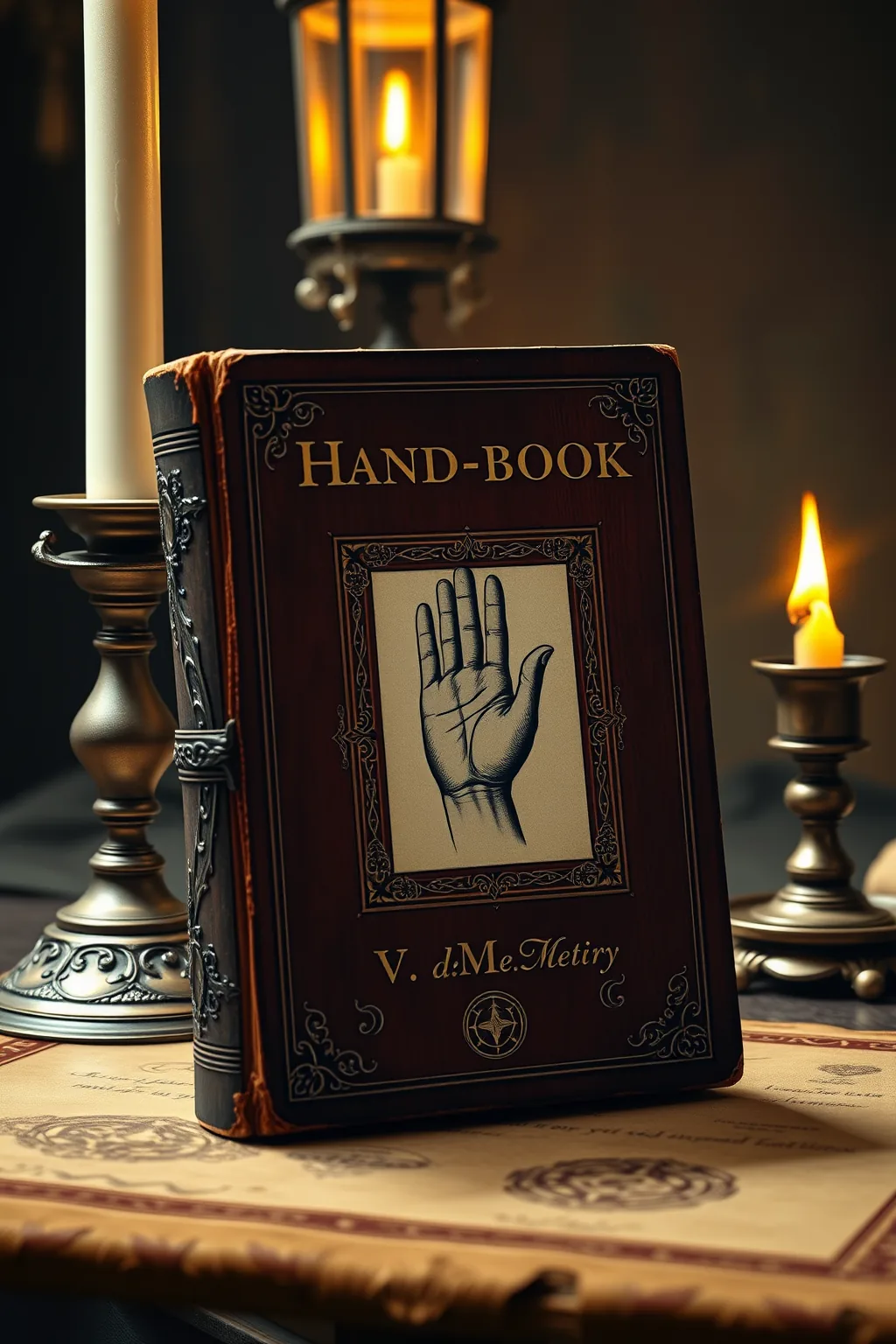
Hand-book of modern palmistry
 61
61

Hand-book of modern palmistry



Sophia Crane (Associate Editor) — V. de Metz's "Hand-book of Modern Palmistry" stands as a beacon of clarity and depth in the realm of palmistry. De Metz masterfully demystifies the complex art, offering esoteric insights that resonate with practitioners and curious minds alike. The book excels in its systematic approach, detailing the significance of every hand feature with an authoritative yet accessible tone. It transcends superficial prediction, delving into the psychological and spiritual underpinnings of palmistry, making it an invaluable resource for serious students of divination. This is a must-read for anyone seeking to understand the profound wisdom encoded within the lines of their palms.
📝 Description
61
V. de Metz's "Hand-book of Modern Palmistry" published in 1903 explained chiromancy for a new era.
This 1903 handbook by V. de Metz aims to demystify the practice of palmistry, or chiromancy. De Metz treats the hand as a text, detailing how its lines, mounts, and finger segments offer insights into a person's character and potential future. The book moves beyond simple prediction, seeking to connect the physical features of the hand to broader philosophical ideas about human nature and the universe.
It guides readers through interpreting these physical signs, presenting them as a form of symbolic language. The author encourages a thoughtful approach to self-understanding, suggesting that by examining the hand, one can gain a better grasp of their inner life and their place in the wider cosmos. The text is suited for those interested in metaphysical subjects and personal growth through symbolic interpretation.
Published in 1903, V. de Metz's "Hand-book of Modern Palmistry" arrived during a period of renewed interest in occult and esoteric subjects, following the rise of Spiritualism and Theosophy. Chiromancy, an ancient practice, was being re-examined and adapted for contemporary audiences. De Metz positions palmistry not merely as a fortune-telling tool but as a system of symbolic interpretation that connects the physical body, specifically the hand, to larger metaphysical principles. This approach aligns with other esoteric traditions of the time that sought to find correspondences between the microcosm of the human being and the macrocosm of the universe.
💡 Why Read This Book?
Unravel the ancient secrets etched into your very palms. "Hand-book of Modern Palmistry" offers a clear, insightful guide to understanding your unique destiny, character, and potential. Ideal for spiritual seekers, aspiring palmists, and those curious about the profound connections between the physical hand and the inner self. Discover a timeless wisdom that empowers self-awareness and personal growth.
⭐ Reader Reviews
Honest opinions from readers who have explored this book.
❓ Frequently Asked Questions
Is palmistry a reliable method of prediction?
Palmistry is best understood as a tool for self-awareness and understanding potential paths, rather than a rigid prediction. It reveals tendencies and influences, empowering individuals to shape their destiny.
What are the primary components of palmistry?
Palmistry analyzes various elements including the lines (life, head, heart, etc.), mounts (Venus, Jupiter, etc.), finger shapes, and the overall hand structure, each carrying specific symbolic meanings.
Can anyone learn palmistry?
Yes, with dedication and the right guidance, anyone can learn the art of palmistry. This handbook provides a structured approach to understanding its fundamental principles.
How does palmistry connect to other esoteric arts?
Palmistry shares common roots and symbolic language with astrology, numerology, and tarot, all seeking to interpret cosmic influences and human experience through symbolic systems.
What is the philosophical significance of palmistry?
Philosophically, palmistry suggests a correspondence between the inner self and the outer form, implying that our physical characteristics can reflect our spiritual and psychological makeup.
🔮 Key Themes & Symbolism
The Hand as a Cosmic Map
This theme explores the profound concept of the hand as a microcosm reflecting the macrocosm. It posits that the lines, mounts, and fingers are not arbitrary markings but rather divine inscriptions, a celestial chart detailing the individual's life path, innate potentials, and karmic influences. The book explores the ancient belief that the patterns on our palms are preordained yet mutable, offering a mix of destiny and free will. It emphasizes the meditative practice of reading one's own hand as a form of self-dialogue with the universe.
Symbolism and Archetypal Meanings
The core of this theme lies in deciphering the collection of symbols embedded within palmistry. Each line, mount, and finger possesses archetypal significance, drawing parallels to planetary energies, mythological figures, and universal human experiences. The book meticulously unpacks these meanings, illustrating how the 'line of the heart' speaks to emotional landscapes, the 'mount of Jupiter' to ambition and leadership, and the 'line of the head' to intellectual faculties. Understanding this symbolic language unlocks a deeper comprehension of human psychology and spiritual development.
The Art of Chiromancy and Self-Discovery
This theme focuses on palmistry as a practical discipline and a path to profound self-discovery. It moves beyond simple fortune-telling to present chiromancy as a sophisticated system for understanding one's strengths, weaknesses, challenges, and opportunities. The handbook provides the tools and knowledge necessary to interpret these subtle signs, fostering personal growth, informed decision-making, and a more conscious engagement with life's journey. It encourages a holistic approach, integrating the insights gained from the hand into a broader spiritual practice.
💬 Memorable Quotes
Direct passages from the work, attributed to the author.
“Every line tells a story, every mount a character.”
— This highlights the narrative potential of palmistry, suggesting that the intricate details of the hand form a complex biography of the person's life, personality, and destiny.
“Know thy hand, know thyself.”
— This emphasizes the power of palmistry as a tool for self-knowledge, implying that by understanding the markings on one's hand, one can gain clear insights into their own nature and potential.
“The stars above are reflected in the lines below.”
— This evokes the ancient hermetic principle of 'as above, so below,' linking the celestial movements and cosmic energies to the markings found on the human hand.
💡 Key Ideas
Editorial paraphrase of the work's core concepts — not direct quotes.
The hand is a mirror to the soul.
This quote expresses the fundamental principle of palmistry – that the physical form, specifically the hand, reflects the inner spiritual and psychological state of an individual.
The future is not written in stone, but etched in potential.
This quote offers a nuanced view of destiny in palmistry, suggesting that while the hand indicates predispositions and possibilities, individuals retain agency to influence their future.
🌙 Esoteric Significance
Tradition
Palmistry, or chiromancy, is an ancient esoteric tradition rooted in Hermeticism and Neoplatonism, believing in the interconnectedness of the universe and the human being. It aligns with the principle of 'as above, so below,' suggesting that celestial influences and cosmic energies are mirrored in the physical form. This tradition views the hand as a living document, a divinely inscribed map of the soul's journey and its potential manifestations.
Symbolism
The symbolism in palmistry is vast and many-sided. Lines represent the flow of energy and life force (Life Line, Heart Line), intellectual processes (Head Line), and destiny or fate (Fate Line). Mounts, the fleshy pads on the palm, are associated with planetary deities and their characteristics: Jupiter for ambition, Saturn for wisdom, Venus for love and passion. Finger shapes and lengths also carry specific symbolic meanings related to personality traits and aptitudes, forming a complex language of interpretation.
Modern Relevance
In contemporary times, palmistry retains its relevance as a powerful tool for self-awareness, personal development, and psychological insight. It offers individuals a unique lens through which to understand their innate strengths, challenges, and potential life paths. In an age often characterized by uncertainty and a search for meaning, the practice provides a sense of connection to ancient wisdom and a framework for navigating life's complexities with greater understanding and intentionality.
👥 Who Should Read This Book
This indispensable handbook is curated for a diverse audience of seekers and scholars. For the **beginner**, it serves as a clear and comprehensive introduction, clarifying the foundational principles of palmistry. **Students of divination** and metaphysics will find a collection of symbolic interpretation and historical context, deepening their understanding of this ancient art. **Spiritual seekers** will discover a profound pathway to self-discovery, unlocking insights into their inner landscape and life's purpose. **Practitioners** of other esoteric arts, such as astrology or tarot, will find valuable cross-referencing and complementary knowledge that enriches their practice.
📜 Historical Context
Written during a period when esoteric knowledge was undergoing a resurgence and reinterpretation, V. de Metz's "Hand-book of Modern Palmistry" emerged from a rich tradition of divination that spanned centuries. The late 19th and early 20th centuries witnessed a keen interest in spiritualism, the occult, and ancient wisdom, as scholars and practitioners sought to bridge the gap between material science and metaphysical understanding. This era saw the popularization of various divinatory arts, including palmistry, which were studied and practiced by a diverse audience, from seasoned occultists to curious laypeople. De Metz's work likely contributed to this trend by offering a systematic and accessible guide, making the complex art of chiromancy more palatable for a modern audience grappling with rapid societal changes and seeking deeper meaning.
📔 Journal Prompts
Reflect on the dominant line on your palm. What does it reveal about your core life energy or primary focus?
Examine the mounts on your palm. Which ones are most pronounced and how do they manifest in your daily life?
Consider the shape of your hand and fingers. What archetypal qualities do they suggest about your personality and approach to life?
How does the information gleaned from your palm readings align with or challenge your current self-perception?
Meditate on the concept of 'potential' as depicted in your palmistry. What actions can you take to actualize this potential?
🗂️ Glossary
Chiromancy
The practice of foretelling fortunes or character by the lines and marks on the palm of the hand. It is often used interchangeably with palmistry.
Mounts
The fleshy, raised areas on the palm, typically located at the base of the fingers and below the thumb, each associated with a specific planet and its corresponding traits.
Phalanges
The segments of the fingers, separated by the creases between the knuckles. Each phalanx can hold symbolic meaning related to specific aspects of life.
Trifurcation
A line that splits into three distinct branches, often indicating multiple significant influences or outcomes related to the path the line represents.
Quadrangle
The area of the palm between the lines of the head and heart, considered a significant space for interpreting personality and choices.
This book appears in 1 collection
🔮 Readers Also Liked
Browse all →








From the “Palmistry” Collection
View all →








More Free Divination & Tarot Books
View all →