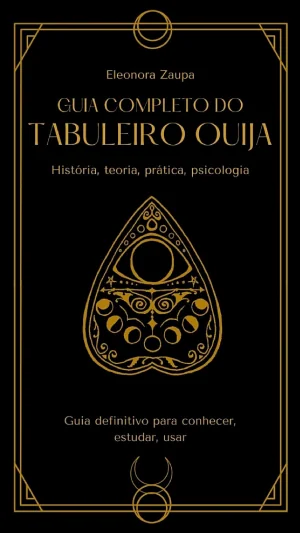
Guia Completo do Tabuleiro Ouija
 76
76

Guia Completo do Tabuleiro Ouija
Eleonora Zaupa's "Guia Completo do Tabuleiro Ouija" provides a much-needed scholarly perspective on a device too often relegated to horror movie tropes. The work excels in its detailed historical tracing, particularly its thorough examination of the board's early days as a recreational parlor game, an aspect frequently overlooked. Zaupa effectively disentangles the board's initial commercial success from its later occult associations. However, the book's extensive theoretical discussions, while informative, occasionally become dense, potentially obscuring the practical guidance for novice users. A passage detailing the psychological influence of group dynamics during a session offers a particularly insightful look at potential ideomotor responses. Despite its academic rigor, the book could benefit from more explicit guidance on establishing protective protocols for practitioners. It stands as a valuable, if occasionally challenging, resource for understanding the Ouija board's multifaceted nature.
📝 Description
76
Eleonora Zaupa's Guia Completo do Tabuleiro Ouija (2023) examines the Ouija board beyond sensationalism.
This book traces the Ouija board's history, from its 19th-century origins as a parlor game to its later use in spiritual communication. It details how the board is used, the ideas behind its perceived effectiveness, and the psychological factors that might influence user experiences. Zaupa addresses the board's emergence during the Spiritualist movement in the United States and its initial marketing by Parker Brothers. The work notes how popular culture and negative accounts later shifted its perception towards darker associations.
The book explains concepts like ideomotor action, where subconscious thoughts guide the planchette. It also places the Ouija board within the wider history of divination tools and attempts to communicate with unseen forces. Zaupa considers the psychological effects on users, such as dissociation and suggestion, as potential explanations for Ouija sessions, contrasting them with supernatural interpretations.
The Ouija board, as presented in this guide, occupies a unique space within modern esoteric traditions. It emerged from the Spiritualist movement of the late 19th century, a period rife with attempts to communicate with the deceased. While some view it as a genuine channel for spirits, others see it as a tool for accessing the subconscious mind. This work examines both perspectives, situating the board within a lineage of divinatory practices that seek hidden knowledge and connection to non-physical realities.
💡 Why Read This Book?
• Learn about the Ouija board's surprising origins as a parlor game in the late 19th century, moving beyond its contemporary reputation for dark spiritualism. • Understand the concept of ideomotor action, a key psychological explanation for the planchette's movement, as detailed in Zaupa's analysis. • Gain insight into the board's place within the broader history of American Spiritualism, a significant cultural movement of the 1800s.
⭐ Reader Reviews
Honest opinions from readers who have explored this book.
❓ Frequently Asked Questions
When was the Ouija board first published?
The Ouija board was first commercially published and marketed in 1890 by Parker Brothers, although its conceptual origins lie in earlier spiritualist practices and divinatory tools.
What is the ideomotor effect in relation to the Ouija board?
The ideomotor effect refers to the unconscious, involuntary muscle movements that can cause the planchette to move, driven by the users' subconscious thoughts and expectations, as explored in the book.
Did the Ouija board always have a dark reputation?
No, initially it was widely embraced as a recreational parlor game and a tool for lighthearted divination, a stark contrast to its later association with unsettling spiritual encounters.
Who was instrumental in the Ouija board's early commercial success?
While its invention is complex, figures like Elijah Bond and Charles Kennard were involved in patenting and early production, with Parker Brothers later achieving widespread distribution.
How does this book differ from other Ouija guides?
This guide offers a more academic and historically grounded approach, examining the psychological and sociological factors alongside traditional esoteric interpretations, rather than focusing solely on ritualistic use.
What historical period is most relevant to the Ouija board's emergence?
The late 19th century, particularly the era of American Spiritualism (mid-to-late 1800s), is the most critical period for understanding the Ouija board's genesis and initial popularity.
🔮 Key Themes & Symbolism
The Board as a Psychological Mirror
The work meticulously examines how the Ouija board can act as a conduit for the subconscious. It looks at the ideomotor effect, positing that users' own thoughts, expectations, and psychological states may manifest as messages from the planchette. This perspective reframes the board not merely as a communication device with external entities, but as a powerful tool for self-exploration and understanding one's inner landscape, particularly during the late 19th-century spiritualist fervor.
Evolution from Game to Oracle
Tracing the Ouija board's journey from its inception as a novelty parlor game around the 1890s to its later adoption as a serious divinatory instrument is a core theme. The book highlights how societal perceptions and individual intentions transformed the board's perceived function, moving it from lighthearted entertainment to a tool for seeking profound answers, often within the context of burgeoning spiritualist movements.
Historical Spiritualist Context
The guide anchors the Ouija board firmly within the historical context of American Spiritualism, a movement that captivated the nation in the mid-to-late 19th century. It explores how the board became integrated into this broader cultural phenomenon, offering a unique method for individuals and families to engage with beliefs about the afterlife and communication with spirits during a time of widespread interest in the paranormal.
The Duality of Perception
A significant aspect explored is the dichotomy in how the Ouija board is perceived: as a harmless recreational device or a dangerous portal to malevolent forces. The book analyzes the cultural shifts and anecdotal evidence that contributed to its increasingly somber reputation, contrasting the initial innocence of its commercial introduction with later, more cautionary tales.
💬 Memorable Quotes
Direct passages from the work, attributed to the author.
“The table medical has had a huge success, science has studied the hidden processes beyond the str”
— This fragmented sentence suggests a transition in the book's narrative, indicating that while the Ouija board achieved commercial success, scientific inquiry began to investigate the psychological mechanisms underlying its operation, moving past purely supernatural explanations.
“Quasi tutte le famiglie americane ne possedevano uno”
— This statement highlights the widespread adoption and popularity of the Ouija board in American households during its peak, portraying it as a common household item for recreation and divination.
“Ma poi c'è un rumore diverso, sombrio e misterioso.”
— This signifies a turning point in the perception and use of the Ouija board, suggesting a shift from its initial benign purpose towards associations with darker, more unsettling, and mysterious experiences.
“Usalo non era mais un gioco divertente o un contatto sicuro con Além.”
— This phrase indicates a loss of innocence for the Ouija board, implying that its use evolved beyond simple amusement or safe communication with the afterlife, becoming potentially fraught with unknown risks.
💡 Key Ideas
Editorial paraphrase of the work's core concepts — not direct quotes.
Mentre la tabella medica ha avuto un enorme successo, la scienza ha studiato i processi nascosti oltre lo str
This paraphrased concept underscores the parallel development of the Ouija board's popularity and the scientific community's growing interest in understanding the psychological underpinnings of its effects, moving beyond anecdotal evidence.
🌙 Esoteric Significance
Tradition
The Ouija board, as explored in this guide, finds its roots not in a single codified esoteric lineage but rather as a syncretic tool emerging from the fertile ground of 19th-century American Spiritualism. This movement itself drew eclectically from various spiritual traditions, including elements of mesmerism, Swedenborgianism, and folk magic. The work positions the Ouija board as a modern manifestation of divinatory practices present across many cultures, adapted for a rapidly industrializing and increasingly secularizing society seeking connection to the unseen.
Symbolism
The board's design is rich with symbolic potential. The letters of the alphabet, numbers 0-9, the words 'YES,' 'NO,' and 'GOOD BYE' form the primary symbolic lexicon, representing the building blocks of communication and the definitive end of a session. The planchette, often shaped like a teardrop or pointer, symbolizes guidance or the agency of the unseen forces. The very act of its construction and use can be seen as a ritualistic act, a symbolic creation of a bridge between the material and immaterial realms.
Modern Relevance
Contemporary practitioners of modern occultism and paranormal investigation frequently engage with the Ouija board, often seeking to replicate or understand historical practices. Thinkers exploring transpersonal psychology and consciousness studies may reference the board's phenomena, particularly the ideomotor effect, as a lens through which to examine subconscious communication. It remains a touchstone for discussions on belief, perception, and the human drive to connect with perceived higher powers or hidden knowledge.
👥 Who Should Read This Book
• Individuals researching the history of American Spiritualism and its cultural impact will find detailed accounts of the board's integration into this significant social movement. • Practitioners of divination and esoteric arts seeking a comprehensive understanding of various tools will gain insight into the Ouija board's mechanics and historical context. • Those interested in the psychology of altered states and parapsychology will appreciate the exploration of ideomotor action and subconscious influence related to the board's use.
📜 Historical Context
The "Guia Completo do Tabuleiro Ouija" emerges from the fertile ground of late 19th-century American Spiritualism, a movement that swept through society following the reported phenomena associated with the Fox sisters. This era, roughly from the 1850s through the early 1900s, was characterized by intense public fascination with the afterlife, séances, and communication with the departed. The Ouija board, patented in 1890 by Elijah Bond and Charles Kennard, perfectly captured this zeitgeist, initially marketed by Parker Brothers as a parlor game. It offered a tangible, accessible method for families to participate in what was perceived as spiritual communion. The work situates the board's rise against competing spiritualist methods and burgeoning psychological theories. While figures like William James explored altered states of consciousness, the Ouija board provided a more direct, albeit controversial, avenue for exploring the unknown, eventually leading to a bifurcated reputation between playful diversion and occult tool.
📔 Journal Prompts
The board's initial marketing as a recreational parlor game:
The shift from 'fun game' to 'somber and mysterious' communication:
Psychological explanations for the planchette's movement:
The Ouija board's role within 19th-century Spiritualism:
Personal reflections on the duality of the Ouija board's reputation:
🗂️ Glossary
Planchette
A small, heart-shaped or pointer device used on the Ouija board, designed to glide over the surface and indicate letters, numbers, or words.
Ideomotor Action
The psychological phenomenon where users' unconscious muscular movements cause the planchette to move, driven by subconscious thoughts and expectations.
Spiritualism
A religious movement prominent in the 19th century, centered on the belief that the living could communicate with the spirits of the dead.
Divination
The practice of seeking knowledge of the future or the unknown by supernatural means.
Parler Game
A game played in a social setting, typically among friends or family in a living room, often involving conversation or lighthearted activities.
Esoteric
Intended for or likely to be understood by only a small number of people with a specialized knowledge or interest.
Transpersonal Psychology
A branch of psychology that studies transpersonal phenomena, such as the connection between human consciousness and the cosmos, and the potential for human development beyond the ego.
This book appears in 1 collection
🔮 Readers Also Liked
Browse all →









From the “Ancient Mysteries” Collection
View all →





More Free Occult Philosophy Books
View all →