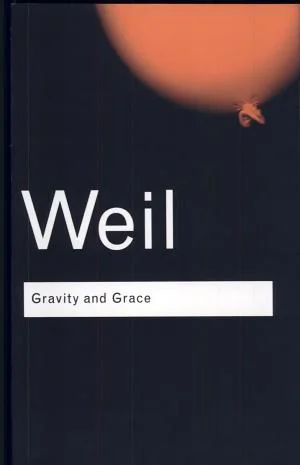
Gravity and Grace
 77
77

Gravity and Grace
Simone Weil’s Gravity and Grace is less a book and more a spiritual excavation. Thibon’s compilation offers stark, aphoristic pronouncements that cut through conventional piety. One strength is Weil’s unflinching gaze upon affliction; she does not shy away from the brutal reality of suffering as a potential conduit to the divine, a concept particularly potent in her reflections on the necessity of 'decreation.' A limitation, however, lies in the fragmented nature of the collection; the lack of sustained argument can make her dense ideas feel overwhelming without significant reader effort. The passage on the necessity of 'wait[ing] for God's love' without demanding it encapsulates her austere, challenging approach. It is a vital, if difficult, spiritual text.
📝 Description
77
Compiled posthumously by Gustave Thibon, "Gravity and Grace" reveals Simone Weil's private spiritual thoughts.
This collection gathers Simone Weil's spiritual and philosophical notes, which she entrusted to Gustave Thibon before her death in 1943. First published in English in 1952, the book offers a direct look at her intense inner life. Weil’s radical ideas on affliction, the nature of attention, and God’s presence are distilled here. The writings address those grappling with fundamental questions and who admire figures living their principles strictly. It will appeal to readers interested in how profound personal suffering connects with spiritual understanding, particularly within Christian mysticism or existentialism explored unconventionally. The book does not shy away from difficult subjects, confronting human frailty and the divine.
Emerging after World War II, this compilation appeared as Europe faced widespread destruction and spiritual questioning. Weil, a French philosopher and mystic, died in exile. Her friend Thibon preserved her notebooks, making this work possible. Its English release in 1952 introduced Weil's distinct perspective to a post-war intellectual climate. Her ideas on suffering and justice resonated with contemporaries, including Albert Camus.
Simone Weil's "Gravity and Grace" is rooted in a tradition of Christian contemplation that emphasizes the soul's purification through suffering and self-emptying. Her concept of 'decreation' aligns with mystical paths that seek to diminish the ego, or the 'self,' to allow for divine inhabitation. This approach views hardship not as punishment but as a necessary condition for spiritual growth, a theme found in the Desert Fathers and later mystics like John of the Cross. Weil’s focus on 'attention' as a form of prayer echoes contemplative practices aiming for a direct, unmediated experience of the divine, moving beyond ritual or dogma towards an internal, existential engagement.
💡 Why Read This Book?
• Understand the concept of 'decreation' as a spiritual practice, a core tenet of Weil's philosophy, distinct from simple self-denial. You will learn how she viewed the necessity of emptying the self to receive divine grace, a concept explored in her reflections on affliction. • Grasp the unique role of affliction in Weil's thought, as she presents suffering not as something to be avoided but as a potential gateway to spiritual transformation. This perspective challenges conventional views on hardship, as detailed in her aphorisms. • Explore Weil's concept of 'attention' as a form of prayer, a practice she considered central to spiritual life and encountering the divine presence in the mundane. This focus offers a practical, albeit demanding, path to spiritual engagement.
⭐ Reader Reviews
Honest opinions from readers who have explored this book.
❓ Frequently Asked Questions
When was Simone Weil's Gravity and Grace first published in English?
The first English edition of Gravity and Grace was published in 1952 by Routledge & Kegan Paul, decades after Simone Weil's death in 1943.
Who compiled and published Simone Weil's notebooks?
Gustave Thibon, a French philosopher and farmer, compiled and published Simone Weil's notebooks after she entrusted them to him before her death.
What is Simone Weil's concept of 'decreation'?
'Decreation' in Weil's philosophy refers to the spiritual process of emptying oneself of the ego and desires to create space for God's grace to enter.
What role does affliction play in Weil's spiritual thought?
Weil viewed affliction not as merely suffering to be endured, but as a powerful, albeit painful, means of spiritual purification and a potential conduit for encountering the divine.
Is Gravity and Grace a complete philosophical treatise by Simone Weil?
No, Gravity and Grace is a collection of posthumously compiled fragments and aphorisms from Simone Weil's notebooks, not a systematically structured philosophical work.
Where did Simone Weil live and work during the 1930s and 1940s?
During the 1930s and early 1940s, Simone Weil worked as a factory laborer and participated in the Spanish Civil War, experiencing firsthand the hardships she later wrote about.
🔮 Key Themes & Symbolism
The Necessity of Affliction
Weil posits affliction not as a mere hardship but as a divine tool for spiritual growth. This theme explores how suffering, when accepted with 'attention,' can strip away ego and open the soul to grace. She argues that direct contact with necessity, often found in severe physical or social conditions, is crucial for understanding true spiritual reality, a concept explored through her own experiences as a factory worker and her reflections on the Passion of Christ.
Decreation and the Void
This theme centers on Weil's radical notion of 'decreation'—the spiritual act of unmaking the self. It involves a profound surrender, a willing abdication of personal will and identity, to create a void where God's presence can manifest. This is not nihilism but a disciplined spiritual practice aimed at achieving a state of pure receptivity, allowing divine love to fill the emptiness left by the self.
Attention as Prayer
Weil redefines prayer not as petition but as sustained, focused attention. This 'waiting for God' involves a complete concentration of the soul on the object of contemplation, whether it be a mathematical problem, the suffering of others, or the divine itself. True attention, for Weil, is a passive yet active state of spiritual receptivity, a powerful means of encountering reality and grace in its purest form.
The Paradox of Love and Necessity
Gravity and Grace grapples with the seemingly contradictory nature of divine love in a world governed by necessity and suffering. Weil explores how God's love is paradoxically expressed through the very structures of necessity that cause pain. This theme looks at the idea that true love requires acknowledging and embracing these difficult realities, finding the divine not in escape from necessity, but within its unyielding framework.
💬 Memorable Quotes
Direct passages from the work, attributed to the author.
“It is necessary to accept affliction.”
— This aphorism expresses Weil's radical view of suffering. It suggests that rather than resisting or lamenting hardship, a spiritual discipline involves a conscious acceptance, seeing affliction as a pathway to deeper truth and divine connection.
“We must believe that it is possible to be a saint without God.”
— This provocative statement challenges conventional religious understanding. It implies that the striving for goodness and virtue, even in the absence of explicit faith or divine recognition, possesses an inherent spiritual value.
“The greatest sin is to be content.”
— Weil suggests that complacency is the ultimate spiritual failing. True spiritual progress requires a constant dissatisfaction with one's current state, a perpetual striving and awareness of what is lacking, pushing one towards greater effort and transformation.
“Imagination is the only thing that can save us.”
— In Weil's context, this refers not to fantasy but to the faculty of spiritual perception and empathy. It is the ability to truly imagine the reality of others' suffering or the nature of divine truth that allows for genuine connection and transcendence.
💡 Key Ideas
Editorial paraphrase of the work's core concepts — not direct quotes.
For the greater the void, the greater the glory of God.
This quote directly relates to Weil's concept of 'decreation.' It posits that the more the self is emptied and reduced, the more potential there is for the divine to manifest and be recognized, highlighting the paradoxical nature of spiritual fulfillment.
🌙 Esoteric Significance
Tradition
Weil's work, while deeply rooted in Christian mysticism, often departs from orthodox interpretations, bordering on Gnostic themes of spiritual detachment and the world as a place of affliction. Her emphasis on 'decreation' and the void can be seen as an extreme form of apophatic theology, aligning with mystical traditions that seek God through negation and emptiness rather than positive affirmation. She engages with concepts of divine love and necessity in a way that speaks to perennial mystical quests for ultimate reality.
Symbolism
A key symbol is the 'void' or 'emptiness,' representing the space created by 'decreation' necessary for divine grace. The 'cross' symbolizes not just suffering but the necessary structure of necessity through which divine love operates. 'Light' often signifies divine presence or truth, but paradoxically, it is often perceived through an overwhelming darkness or absence, reflecting the apophatic nature of her theology.
Modern Relevance
Contemporary thinkers and practitioners in fields ranging from existential psychology to contemplative spirituality draw on Weil's insights. Her ideas on attention are particularly relevant in an age of distraction, influencing mindfulness practices and philosophical discussions on consciousness. Movements focused on social justice and the critique of consumerism also find resonance in her radical critique of modern life and her championing of the marginalized.
👥 Who Should Read This Book
• Students of comparative mysticism seeking to understand radical Christian contemplative practices that diverge from mainstream dogma. • Philosophers and theologians interested in existentialist thought and its engagement with faith, suffering, and the nature of the divine. • Individuals grappling with personal suffering or seeking a profound spiritual framework for understanding affliction and finding meaning in hardship.
📜 Historical Context
Published posthumously in 1952 by Routledge & Kegan Paul, *Gravity and Grace* emerged from the intellectual range of post-war Europe, a period marked by existential questioning and a profound need for spiritual grounding. Simone Weil, a French Catholic mystic and philosopher, died in exile in 1943, leaving behind notebooks filled with intense reflections. Her friend Gustave Thibon curated these writings, presenting a stark spiritual philosophy that contrasted sharply with more optimistic post-war humanism. Weil's radical engagement with manual labor and her profound empathy for the oppressed placed her work in dialogue with existentialist thinkers like Albert Camus, who acknowledged her influence, though her intensely personal and paradoxical approach defied easy categorization within any single philosophical school. Her critiques of modern society and her exploration of suffering offered a challenging counterpoint to prevailing ideologies.
📔 Journal Prompts
The concept of 'decreation' and its implications for personal identity.
Reflections on the role of affliction in spiritual development.
The practice of 'attention' as a form of prayer in daily life.
Interpreting the paradox of divine love within necessity.
Weil's critique of contentment and its relevance today.
🗂️ Glossary
Decreation
Simone Weil's term for the spiritual process of unmaking the self, emptying one's will and ego to create space for God's grace to enter and operate.
Affliction
In Weil's philosophy, affliction is not merely suffering but a state of profound, often physical or social, degradation that can serve as a crucible for spiritual transformation.
Attention
For Weil, attention is a form of prayer, a sustained and focused concentration of the soul on reality, truth, or the divine, requiring complete passivity and receptivity.
Necessity
The unyielding structure of the physical and social world, which Weil saw as the framework through which divine love operates, even when it manifests as suffering.
Void
The emptiness created by decreation, which is essential for the manifestation of God's glory and presence within the soul.
Malheur
French for 'misfortune' or 'unhappiness,' often used by Weil to denote a profound state of suffering and alienation that can lead to spiritual insight.
Lourd
French for 'heavy' or 'weighty,' used by Weil to describe the oppressive burden of physical labor and the weight of existence.
🔮 Readers Also Liked
Browse all →








More Free Occult Philosophy Books
View all →