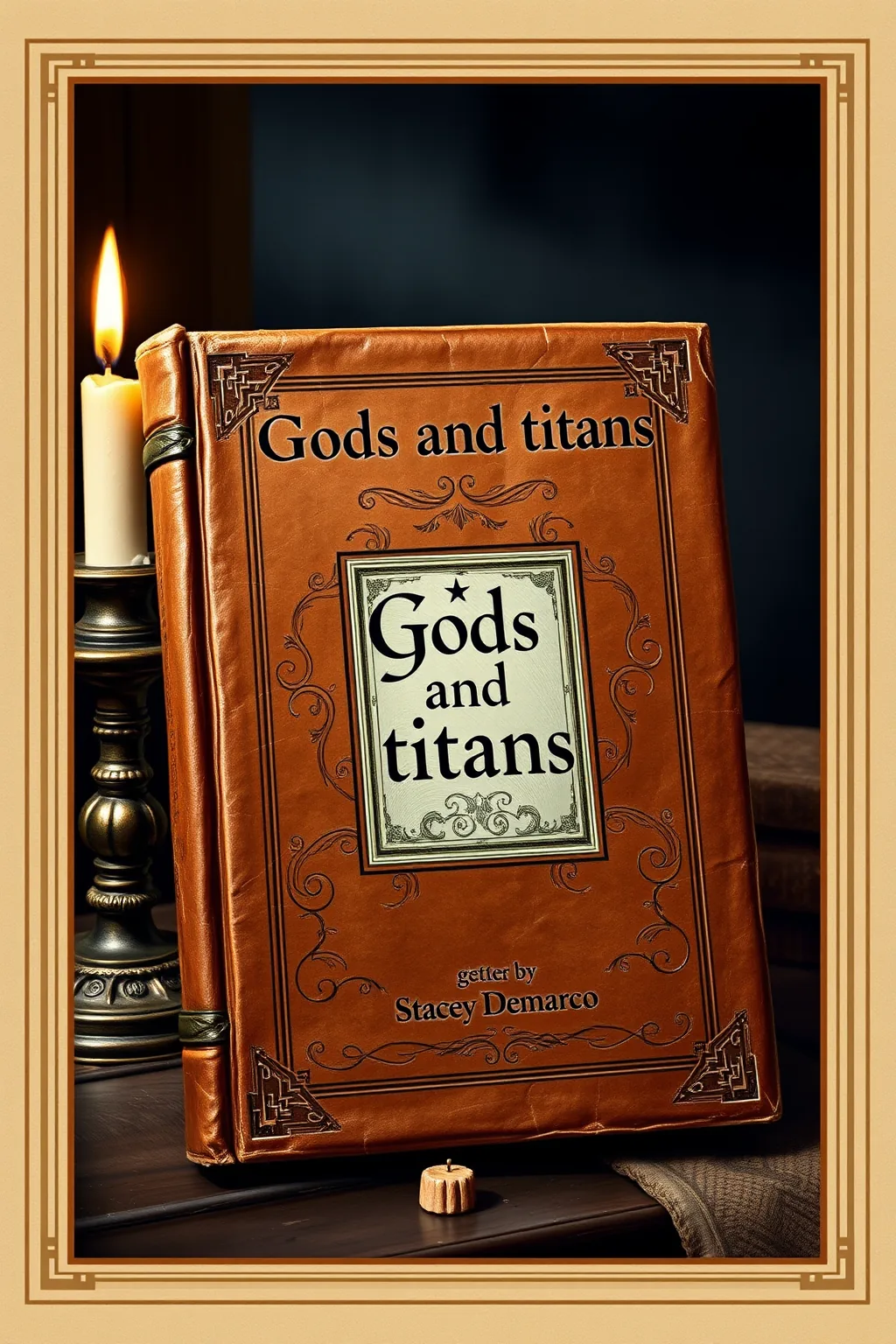
Gods and titans
 75
75

Gods and titans
Stacey Demarco's "Gods and Titans" tackles a vast subject with an accessible yet scholarly approach. The strength of the work lies in its clear articulation of how these ancient figures and their stories function as potent archetypes, offering a framework for understanding psychological and spiritual dynamics. Demarco effectively bridges the gap between historical myth and modern relevance, demonstrating their continued impact. A minor limitation, however, is that the sheer breadth of the topic means some pantheons receive more cursory treatment than others. The exploration of the Titans' overthrow of the older gods, for instance, while crucial, could have benefited from further deconstruction of the generational conflict as an archetypal pattern of societal and personal change. Nevertheless, "Gods and Titans" serves as a solid introduction to the enduring power of mythic narratives.
📝 Description
75
Stacey Demarco's 2013 book examines gods and titans as symbolic systems shaping Western thought.
Stacey Demarco's "Gods and Titans" analyzes the foundational figures and narratives in ancient mythologies, highlighting their symbolic weight and lasting impact. The book treats pantheons not just as historical records but as active symbolic structures that have influenced Western ideas and spirituality. It provides a clear overview of major deities and their stories, tracing their origins and development across different cultures.
The work is for anyone wanting a deeper grasp of the mythological roots of Western culture and spirituality. Students of comparative mythology, esotericism, and archetypal psychology will find it particularly relevant. Readers interested in how old stories continue to shape modern minds, art, and beliefs will discover useful insights. It serves as a guide for those looking to connect with the primal energies embodied by divine and heroic figures.
Published in 2013, "Gods and Titans" arrives during a renewed interest in ancient mythologies and their psychological interpretations, a trend influenced by figures like Carl Jung. Demarco's work builds upon a long history of mythological study, from classical scholars to modern mythographers like Joseph Campbell. It speaks to a contemporary revival of interest in pagan traditions, archetypal studies, and the spiritual dimensions of ancient stories, often moving beyond purely academic or theological viewpoints.
💡 Why Read This Book?
• Gain a structured understanding of key mythological figures like Zeus and the Titans, and how their narratives, originating in ancient Greece, continue to inform archetypal psychology. • Explore the concept of the divine family and cosmic order as presented in Demarco's work, offering insights into how these ancient structures reflect fundamental human needs for meaning. • Understand the symbolic representation of creative and destructive forces within deities, providing a lens to examine the dualities present in personal and collective human experience.
⭐ Reader Reviews
Honest opinions from readers who have explored this book.
❓ Frequently Asked Questions
What is the primary focus of Stacey Demarco's 'Gods and Titans'?
The book focuses on the archetypal significance and enduring influence of figures and narratives from ancient mythologies, presenting them as potent symbolic systems that have shaped Western thought and spirituality.
When was 'Gods and Titans' by Stacey Demarco first published?
Stacey Demarco's 'Gods and Titans' was first published in 2013, placing it within a contemporary context of renewed interest in ancient mythologies.
Who would benefit most from reading 'Gods and Titans'?
Individuals interested in comparative mythology, esotericism, archetypal psychology, and the ongoing impact of ancient stories on modern culture will find this book particularly valuable.
Does the book discuss specific mythologies in detail?
Yes, the work examines key deities and their associated myths, tracing their origins and evolution across various cultural lenses, with a notable focus on foundational Greek myths.
What is the role of archetypes in 'Gods and Titans'?
The book posits archetypes as universal patterns of human experience embodied by mythological figures, using these to explain the psychological and spiritual dynamics of the myths presented.
What makes this book relevant today?
It demonstrates how ancient narratives and figures continue to inform modern consciousness, art, and belief systems, offering readers a connection to primal forces represented by these divine and heroic figures.
🔮 Key Themes & Symbolism
Archetypal Foundations
Demarco's work posits that figures like Zeus, Hera, and the primordial Titans are not merely characters from ancient tales but embody universal human experiences and psychological patterns. These archetypes, such as the powerful father, the nurturing mother, or the rebellious offspring, provide a framework for understanding the deeper currents of human motivation and societal structure. The book explores how these primal forms, deeply ingrained in the collective unconscious, continue to shape our perceptions and behaviors, offering a lens through which to analyze contemporary human dynamics.
Cosmic Order and Duality
A central theme is the establishment and maintenance of cosmic order as depicted in mythology, often through the struggles between generations of gods, like the Titans and Olympians. This struggle highlights the inherent duality within the divine and the universe itself, with deities representing both creative and destructive forces. The book examines how these mythological narratives reflect humanity's ongoing quest to find meaning and stability within a world often characterized by chaos and change, and how this duality is mirrored in human nature.
The Heroic Journey's Echo
While not exclusively focused on heroes, the book implicitly or explicitly touches upon the heroic archetype's presence within mythological narratives. The journey of gods and titans often involves trials, transformations, and the assertion of power, mirroring the developmental stages of the individual. Demarco's exploration suggests that these ancient stories serve as foundational templates for personal growth and self-discovery, illustrating the enduring human impulse to overcome challenges and achieve a higher state of being or understanding.
Myth as Living Symbolism
The work emphasizes that the power of these myths lies not in their literal interpretation but in their symbolic resonance. Gods and titans function as potent symbols that communicate profound truths about existence, power, and the human condition. Demarco encourages readers to engage with these symbols as living forces that can offer guidance and insight into personal and collective spiritual paths, rather than viewing them as static historical accounts.
💬 Memorable Quotes
Direct passages from the work, attributed to the author.
“The Titans represent primal forces, the untamed chaos preceding ordered existence.”
— This highlights the symbolic role of the Titans as embodying the raw, unformed energies that existed before the structured rule of the Olympians, representing a foundational stage of cosmic development.
“Mythological figures often embody both the creator and destroyer aspects of existence.”
— This concept points to the inherent duality found in deities, reflecting the universal principle that creation and destruction are interconnected forces shaping reality.
“Understanding the gods and titans offers a key to unlocking archetypal patterns within ourselves.”
— This interpretation suggests that the study of these mythological beings provides direct access to understanding the fundamental psychological blueprints that influence human behavior and experience.
💡 Key Ideas
Editorial paraphrase of the work's core concepts — not direct quotes.
Zeus's reign signifies the establishment of a new cosmic law and order.
This paraphrase suggests that Zeus's victory over the Titans marked a central shift, establishing a new paradigm of divine governance and societal structure within the mythological framework.
The generational conflicts in myth mirror human struggles with authority and change.
This paraphrase connects the ancient narratives of divine power struggles to contemporary human experiences of challenging established norms and adapting to evolving circumstances.
🌙 Esoteric Significance
Tradition
This work draws heavily from the Western Esoteric tradition, particularly its engagement with classical mythology as a source of spiritual and psychological wisdom. It aligns with Hermetic and Neoplatonic interpretations that see deities and mythical narratives as symbolic representations of cosmic principles and inner states of consciousness. Demarco's approach departs from strict historical or religious dogma, framing these figures within an archetypal psychology that speaks to Theosophical and Jungian ideas, making them relevant for modern spiritual seekers.
Symbolism
Key symbols include the primordial chaos represented by the Titans, signifying untamed potential and the raw forces of creation before order is imposed. The thunderbolt of Zeus symbolizes divine authority, cosmic law, and the power to enact change. The concept of the divine family, like the Olympian pantheon, represents structured hierarchies and the interplay of elemental and psychological forces that govern existence, reflecting both cosmic order and human relationships.
Modern Relevance
Contemporary practitioners of Jungian psychology, archetypal astrology, and various pagan and neo-pagan spiritual paths often draw upon the framework presented in works like "Gods and Titans." The book's emphasis on archetypes as living forces that influence modern life makes it a resource for those exploring personal mythology, shadow work, and the integration of ancient wisdom into daily spiritual practice. Thinkers and practitioners focused on the psychological underpinnings of belief systems find its approach valuable.
👥 Who Should Read This Book
• Students of comparative mythology and comparative religion seeking to understand the foundational narratives of Western culture and their psychological resonance. • Individuals interested in archetypal psychology and how figures like the Titans and Olympians embody universal human patterns and internal dynamics. • Spiritual seekers exploring esoteric traditions who wish to connect with the symbolic power of ancient deities as a means of personal growth and understanding.
📜 Historical Context
Published in 2013, Stacey Demarco's "Gods and Titans" emerged during a period of significant popular and academic interest in mythology, psychology, and esoteric traditions. This era saw a proliferation of works that reinterpreted ancient myths through the lens of Carl Jung's archetypal psychology and Joseph Campbell's monomyth. Demarco's contribution engages with this lineage, offering a synthesis that bridges academic scholarship with accessible spiritual and psychological application. The work arrived in contrast to purely historical or theological analyses, emphasizing the living, symbolic power of these figures. While not subject to specific censorship or major academic debates upon release, it aligns with a broader intellectual current that sought to find perennial wisdom in ancient narratives, often drawing parallels with contemporary spiritual practices and New Age thought, distinguishing itself from more dogmatic religious or strictly classical studies.
📔 Journal Prompts
The primal forces embodied by the Titans: how do these manifest in your own life?
Reflect on the concept of cosmic order as established by Zeus and its relevance to personal structure.
What does the duality of creative and destructive forces within deities reveal about your own inner landscape?
Consider the symbolic journey of gods and titans as a metaphor for personal transformation.
How do the relationships within the Olympian pantheon mirror or contrast with human family dynamics?
🗂️ Glossary
Archetype
In mythology and psychology, a universal, archaic pattern and image that derives from the collective unconscious and is part of the shared human experience, often embodied by mythological figures.
Titans
In Greek mythology, the elder gods who were the children of Uranus (Sky) and Gaia (Earth), preceding the Olympian gods and representing primal forces.
Olympians
The twelve major deities of the Greek pantheon, who resided on Mount Olympus and overthrew the Titans to establish their rule.
Cosmic Order
The concept of a structured, harmonious universe governed by divine laws or principles, as often depicted in mythological cosmogonies.
Duality
The state of having two parts, often representing opposing forces such as creation/destruction, light/dark, or good/evil, frequently embodied by mythological figures.
Mythic Narrative
A story or account that conveys cultural meaning, often involving supernatural beings or events, used to explain the world and human existence.
Collective Unconscious
A concept introduced by Carl Jung, referring to a shared reservoir of experiences and instincts common to all humankind, from which archetypes emerge.
🔮 Readers Also Liked
Browse all →









More by Stacey Demarco
All books →


More Free Occult Philosophy Books
View all →