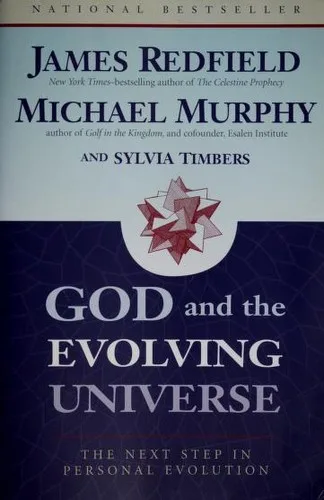
God and the evolving universe
 80
80

God and the evolving universe
The ambition of "God and the Evolving Universe" is undeniable, attempting to harmonize the vast narratives of cosmic evolution with the concept of a divine presence. Redfield, Murphy, and Timbers offer a perspective that moves beyond static, anthropomorphic deities, proposing instead a fluid, co-creative relationship between the universe and the sacred. One particularly striking aspect is the exploration of how consciousness itself might be a driving force in evolutionary development, a concept that moves beyond simple teleology. However, the book occasionally struggles with its own breadth, sometimes feeling more like a collection of speculative essays than a tightly integrated argument. While the 2016 publication date situates it within contemporary dialogues, some of the scientific explanations could benefit from more recent cosmological or biological findings. Despite these points, the work provides a compelling vision for those seeking spiritual meaning within a scientifically informed framework.
📝 Description
80
"God and the Evolving Universe" (2016) links cosmic development to a divine reality.
Published in 2016, James Redfield, Michael Murphy, and Sylvia Timbers' "God and the Evolving Universe" examines the connection between spiritual beliefs and scientific understanding. The authors propose that the universe's ongoing evolution, as understood through cosmology and biology, is not separate from but is fundamentally tied to an ultimate or divine reality. Their work aims to bridge the gap between faith and empirical evidence, suggesting that consciousness plays a dynamic, active role in the universe's unfolding.
This book is for readers who seek to reconcile spiritual feelings with a contemporary scientific outlook. It addresses those interested in how physics, biology, and cosmology inform theological and philosophical questions about existence and the divine. Individuals looking for a way to integrate personal spiritual experiences with the broad narratives of cosmic and biological change will find this volume useful.
This 2016 work follows a tradition of integrating spiritual thought with scientific discovery, echoing earlier efforts like Teilhard de Chardin's work. It taps into the New Age interest in consciousness and its role in reality. Redfield's popular spiritual writing and Murphy's background in transpersonal psychology inform its approach, aiming to synthesize these ideas for a modern audience grappling with quantum physics and evolutionary theology.
💡 Why Read This Book?
• Gain a framework for understanding the universe's ongoing evolution not as a random process, but as a divinely guided or inherently sacred unfolding, challenging traditional theological views. • Explore the concept of a participatory universe, where consciousness is presented as an active co-creator, influencing the very fabric of reality as explored in the book's discussions. • Discover how scientific discoveries, such as those in cosmology and evolutionary biology, can be seen as revealing the dynamic nature of the divine, rather than contradicting it, as presented in the work's synthesis.
⭐ Reader Reviews
Honest opinions from readers who have explored this book.
❓ Frequently Asked Questions
What is the main argument of 'God and the Evolving Universe' regarding divinity and science?
The book argues that the universe's ongoing evolution, as understood through science, is not separate from but is intimately connected to a dynamic, evolving divine presence. It suggests a participatory relationship between consciousness and cosmic development.
Who are the authors of 'God and the Evolving Universe'?
The authors are James Redfield, Michael Murphy, and Sylvia Timbers. The book was first published in 2016.
Does the book present a traditional view of God?
No, it moves away from traditional, static concepts of God. Instead, it proposes a more fluid, emergent divinity that is co-evolving with the universe itself, influenced by and influencing cosmic processes.
What scientific fields are discussed in relation to spiritual concepts?
The work engages with concepts from cosmology, evolutionary biology, and physics, exploring how these scientific understandings can inform and be integrated with spiritual and metaphysical perspectives on existence.
What is the concept of a 'participatory universe' as presented in the book?
It's the idea that consciousness is not just a passive observer of the universe but an active participant in its ongoing creation and evolution. This suggests a fundamental interconnectedness between mind and matter.
When was 'God and the Evolving Universe' originally published?
The book was first published in 2016.
🔮 Key Themes & Symbolism
Participatory Cosmic Evolution
The central thesis posits that the universe's expansion and evolutionary processes are not deterministic or accidental but are guided by, and in dialogue with, a conscious divine principle. This principle is itself evolving. The work suggests that human consciousness, as an emergent aspect of this universe, plays an active role in this unfolding, influencing outcomes through intention and awareness. This contrasts with views of a detached creator, instead proposing an immanent and co-creative deity integral to the fabric of existence from its inception to its future states.
Emergent Divinity
Rather than viewing God as a static, pre-existing entity, the authors explore the notion of an 'emergent divinity.' This concept suggests that the divine nature itself is developing and becoming more complex alongside the universe. As the cosmos evolves through stages of complexity, from fundamental particles to galaxies and life, so too does the expression and nature of the sacred. This perspective allows for a God that is not fully known or defined but is continuously revealing itself through the ongoing processes of creation.
Integration of Science and Spirituality
The book aims to bridge the perceived chasm between empirical scientific findings and spiritual or metaphysical beliefs. It uses insights from cosmology, quantum physics, and evolutionary biology not to disprove spiritual concepts, but to reinterpret them in a modern context. By examining the universe's origins, its fundamental laws, and the emergence of life and consciousness through scientific lenses, the authors find echoes and confirmations of spiritual truths, suggesting a unified reality where matter and spirit are intertwined aspects of a single, evolving whole.
Consciousness as a Cosmic Force
A significant theme is the elevated role of consciousness. It is presented not merely as a byproduct of biological evolution but as a fundamental force within the universe, potentially as primary as matter or energy. The work explores how consciousness, at all levels, contributes to the universe's ongoing formation and evolution. This perspective invites readers to consider their own awareness not as isolated but as part of a vast, interconnected cosmic consciousness that actively shapes reality.
💬 Memorable Quotes
Direct passages from the work, attributed to the author.
“The universe is not a machine, but a living, evolving process.”
— This statement captures the book's departure from a purely mechanistic view of cosmology. It suggests an organic, dynamic quality to existence, implying purpose and inherent development rather than mere physical causality.
“Divinity is not a fixed point, but a horizon we are moving towards.”
— This highlights the concept of emergent divinity, framing God not as a static being but as a developing reality or principle that the universe itself is moving towards or expressing more fully over time.
“Our consciousness is a window through which the universe experiences itself.”
— This emphasizes the participatory nature of consciousness, suggesting that individual awareness is not separate from the cosmic whole but is an essential means by which the universe becomes self-aware.
“Evolution and divine creation are two sides of the same unfolding reality.”
— This interpretation directly addresses the book's core aim: to reconcile scientific evolutionary theory with spiritual understandings of creation, presenting them as complementary aspects of a singular, ongoing process.
“The future is not predetermined; it is being co-created.”
— This reflects the active role assigned to consciousness and the divine in shaping what is to come. It suggests a fluid reality where outcomes are influenced by present actions and awareness, rather than being set in stone.
🌙 Esoteric Significance
Tradition
This work aligns with contemporary esoteric thought that seeks to integrate scientific understanding with metaphysical principles, diverging from more traditional, dogma-bound religious frameworks. It echoes themes found in process theology and certain branches of Theosophy that emphasize an evolving God and a dynamic cosmos. However, it departs from strict adherence to any single historical lineage, instead drawing eclectically from modern physics, evolutionary biology, and transpersonal psychology to construct its unique vision of a participatory, evolving divinity.
Symbolism
While not heavily reliant on traditional esoteric symbols, the book implicitly uses concepts like 'evolution' and 'participation' as symbolic vehicles. 'Evolution' symbolizes ongoing creation, a universe in flux, and the gradual unfolding of potential. 'Participation' symbolizes interconnectedness and the active role of consciousness, suggesting that reality is not passively observed but is co-created through interaction and awareness, a motif found in Gnostic ideas of emanation and divine play.
Modern Relevance
The ideas presented in "God and the Evolving Universe" resonate with contemporary movements in consciousness research, integral theory, and panpsychism. Thinkers exploring the hard problem of consciousness and the role of subjective experience in the universe find common ground with its concept of consciousness as a fundamental cosmic force. Its approach to reconciling science and spirituality also appeals to individuals seeking non-dogmatic, expansive belief systems in an increasingly secularized yet spiritually curious world.
👥 Who Should Read This Book
• Readers interested in reconciling scientific cosmology and evolutionary biology with spiritual or theological concepts, seeking a unified worldview. • Individuals exploring transpersonal psychology and the nature of consciousness, particularly those who view awareness as an active force in the universe. • Those seeking alternative perspectives on divinity that move beyond static, anthropomorphic deities, favoring a dynamic, co-evolving divine principle.
📜 Historical Context
Published in 2016, "God and the Evolving Universe" arrived during a period of increased public engagement with the intersection of science and spirituality. It followed decades of popular interest in consciousness studies, heavily influenced by institutions like the Esalen Institute, co-founded by Michael Murphy. The work can be seen as a continuation of the lineage of thinkers like Pierre Teilhard de Chardin, whose 1959 "The Phenomenon of Man" also sought to synthesize evolutionary theory with a spiritual worldview. While the New Age movement had already explored such themes extensively, this book aimed for a more grounded, integrated approach, drawing on contemporary scientific discourse. Its release occurred alongside ongoing academic and public debates on evolutionary psychology, cosmology, and the nature of consciousness, positioning it as a contribution to these discussions, seeking to offer a coherent narrative for those grappling with modern scientific paradigms and traditional religious or spiritual questions.
📔 Journal Prompts
Reflect on the concept of 'participatory universe' and how your own consciousness might influence reality.
Consider the 'emergent divinity' idea: How might the divine be evolving alongside the cosmos?
Analyze the 'integration of science and spirituality' presented: Where do you see the greatest harmony or tension?
Explore the implications of consciousness as a cosmic force: What responsibilities does this imply for humanity?
Think about the evolutionary journey of the universe and your place within it, as described in the book.
🗂️ Glossary
Participatory Universe
A cosmological model suggesting that consciousness is not merely an observer but an active participant in the creation and evolution of reality, influencing and being influenced by universal processes.
Emergent Divinity
The concept that the divine nature is not static or pre-defined but is developing and becoming more complex in parallel with the evolution of the universe itself.
Cosmic Evolution
The scientific understanding of the universe's development from its earliest stages to its present state, encompassing the formation of stars, galaxies, planets, and life.
Transpersonal Psychology
A branch of psychology that studies transpersonal states and experiences, such as mystical experiences, spiritual development, and the nature of consciousness beyond the individual ego.
Panpsychism
The philosophical view that consciousness or mind is a fundamental and ubiquitous feature of reality, present in all matter, not just in complex biological organisms.
Immanent Divinity
The belief that the divine is present within the universe and its processes, rather than being transcendent and entirely separate from creation.
Metaphysical Principles
Fundamental concepts or truths about reality that are considered to be beyond the scope of empirical science, dealing with the nature of existence, being, and the universe.
🔮 Readers Also Liked
Browse all →![Ten Great Mysteries [10 stories, 5 poems]](/img/thumb/ten-great-mysteries-10-stories-5-poems-edgar-allan-poe-433440.webp)








More by James Redfield, Michael Murphy, Sylvia Timbers
All books →
More Free Occult Philosophy Books
View all →