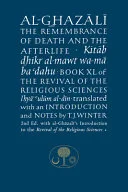
The Remembrance of Death and the Afterlife
 73
73

The Remembrance of Death and the Afterlife
Al-Ghazali's meditations on death and the hereafter, translated here for the first time in full English, offer a stark, unvarnished perspective on mortality’s spiritual utility. This is not an armchair contemplation; Al-Ghazali grounds his extensive theological framework in the practical necessity of self-purification. The section detailing the 'Vision of the Angel' is particularly striking, presenting a visceral account of spiritual encounter that underscores the Sufi emphasis on direct experience. While the prose can be dense, reflecting its 11th-century origins and theological rigor, its unflinching focus on the consequences of one's deeds for the afterlife provides a potent counterpoint to modern secular complacency. The limitation lies in the sheer volume and density of the source material, which can make sustained engagement challenging for the uninitiated. Nevertheless, for those seeking a rigorous exploration of death's role in spiritual discipline, this translation is a significant contribution.
📝 Description
73
This 11th-century Persian text offers the first complete English translation of Al-Ghazali's thoughts on death and the afterlife.
This volume presents the first complete English translation of a significant section from Abu Hamid Al-Ghazali's *Ihya' Ulum al-Din* (The Revival of the Religious Sciences). Composed in the 11th century, this part of the *Ihya'* focuses on the spiritual importance of contemplating death and the stages of the afterlife. Al-Ghazali moves beyond theological discussion to emphasize the practical use of these contemplations for purifying the soul, a central practice in Sufism.
Scholars of Islamic spirituality, students of Sufism, and readers interested in comparative esotericism will find this translation useful. It appeals to those seeking to understand the historical development of mystical thought on eschatology and the soul's progression. The work is also relevant for individuals engaged in contemplative practices concerning mortality and existence beyond the physical world.
Al-Ghazali, known as the 'Proof of Islam,' was an important intellectual figure of the Ash'ari school and a Sufi mystic in 11th-century Persia. His *Ihya'* aimed to revive the spiritual core of Islam, synthesizing law, theology, and mysticism. It faced some criticism for its mystical elements but became widely popular and influential, forming a core text for many Sufi orders.
Abu Hamid Al-Ghazali's work is situated within the rich tradition of Islamic mysticism, Sufism. His *Ihya' Ulum al-Din* sought to reassert the spiritual dimension of Islam against what he saw as increasing formalism. This particular section on death and the afterlife reflects a core Sufi concern with transforming the self through direct spiritual experience and contemplation, rather than solely through external observance. It connects theological concepts of eschatology with practical methods for inner purification, a hallmark of Sufi path.
💡 Why Read This Book?
• You will learn the specific Sufi concept of *muhasaba* (self-examination) as a direct pathway to purifying the soul, as expounded by Al-Ghazali within the *Ihya' Ulum al-Din*. • You will encounter the detailed stages of the afterlife as described by Al-Ghazali, offering a structured esoteric map of the soul's post-mortem journey. • You will understand the 11th-century intellectual landscape where Al-Ghazali synthesized Islamic law and mysticism, clarifying his unique position within Ash'ari theology.
⭐ Reader Reviews
Honest opinions from readers who have explored this book.
❓ Frequently Asked Questions
What is the primary focus of Abu Hamid Al-Ghazali's 'The Remembrance of Death and the Afterlife'?
The book focuses on the spiritual importance of contemplating death and the subsequent stages of the afterlife, integrating this reflection into the Sufi path of self-purification and moral development.
What is the significance of the *Ihya' Ulum al-Din*?
The *Ihya' Ulum al-Din* (The Revival of the Religious Sciences) is considered Al-Ghazali's magnum opus, a comprehensive synthesis of Islamic jurisprudence, theology, and mysticism, aiming to restore the spiritual vitality of Islam.
Who was Abu Hamid Al-Ghazali?
Abu Hamid Al-Ghazali (c. 1058–1111) was a Persian Ash'ari theologian, jurist, philosopher, and Sufi mystic, renowned as one of the most influential scholars in Islamic history.
What is the Sufi concept of *tazkiyat al-nafs* discussed in the book?
*Tazkiyat al-nafs* refers to the purification of the soul, a central aim in Sufism, achieved through practices like contemplation, self-examination, and adherence to spiritual discipline, as advocated by Al-Ghazali.
Does the book discuss specific visions of angels or the divine?
Yes, the text describes the stages of the future life, including the 'Vision of the Angel,' offering an esoteric perspective on spiritual encounters in the afterlife.
When was the *Ihya' Ulum al-Din* originally written?
The *Ihya' Ulum al-Din* was written by Al-Ghazali in the late 11th century, around the period of 1095-1100 CE, during his time in Damascus and later in his hometown of Tus.
🔮 Key Themes & Symbolism
Contemplation of Mortality
The work posits that the remembrance of death is not a morbid exercise but a vital spiritual discipline. By consistently reflecting on the impermanence of life and the certainty of death, the individual is motivated towards greater self-awareness and the cultivation of virtues. This contemplation serves as a crucial tool for breaking attachment to worldly desires and fostering an orientation towards the eternal, aligning with Sufi principles of detachment and focus on the Divine.
The Soul's Journey
Al-Ghazali meticulously outlines the stages of existence beyond physical death. This includes descriptions of the intermediate state in the grave, the resurrection, and the ultimate reckoning. Each stage is presented not merely as a theological doctrine but as an experiential reality for the soul, emphasizing the direct consequences of one's earthly actions on their eternal fate. The narrative serves as an esoteric guide for the spiritual aspirant.
Self-Purification (Tazkiyat al-Nafs)
Central to the text is the concept of *tazkiyat al-nafs*, the purification of the soul. Al-Ghazali links the contemplation of death directly to this process, arguing that understanding the ephemeral nature of life and the gravity of the hereafter compels one to rectify moral failings and cultivate spiritual qualities. Practices such as *muhasaba* (self-examination) are presented as essential methods for achieving this inner cleansing.
The Vision of the Divine
The work culminates in discussions of the ultimate spiritual reward: the vision of the Divine. This is presented as the pinnacle of the afterlife experience, the direct apprehension of God's essence, which is the ultimate goal of the Sufi path. Al-Ghazali describes this beatific vision as the fulfillment of the soul's yearning and the ultimate cessation of all suffering, a state of profound spiritual union.
💬 Memorable Quotes
Direct passages from the work, attributed to the author.
“The world is a bridge, so pass over it but do not build upon it.”
— This aphorism captures Al-Ghazali's view of earthly existence as transient. It emphasizes that life's purpose is not accumulation or attachment to material possessions, but rather a passage towards the eternal, urging readers to focus on spiritual preparedness.
“To forget death is to invite heedlessness, and heedlessness is the seed of misguidance.”
— This statement highlights the spiritual danger of ignoring mortality. For Al-Ghazali, the constant awareness of death acts as a potent antidote to spiritual complacency and a motivator for righteous living and seeking divine knowledge.
“The heart is like a mirror; it must be polished to reflect the Divine light.”
— This metaphor illustrates the Sufi emphasis on inner purification. The heart, as the seat of spiritual perception, needs to be cleansed of worldly distractions and negative qualities to become capable of receiving divine illumination and true understanding.
“The grave is either a garden of paradise or a pit of hellfire.”
— This stark declaration emphasizes the immediate and profound consequences of one's deeds in the afterlife, beginning with the state of the grave. It serves as a powerful reminder of the importance of righteous living and spiritual readiness.
“The true remembrance of death is not to weep, but to live wisely.”
— Al-Ghazali distinguishes between mere emotional displays about death and its practical application. Genuine remembrance involves structuring one's life in accordance with spiritual truths, making choices that lead to eternal well-being rather than superficial grief.
🌙 Esoteric Significance
Tradition
This work is a central to Sunni Sufism, a major lineage within Islamic esotericism. Al-Ghazali's approach bridges orthodox Islamic theology (Ash'ari school) with the inward-looking, experiential path of the mystics. While not strictly adhering to lineages like Neoplatonic Hermeticism or Gnosticism, his emphasis on the soul's journey, purification, and direct apprehension of the Divine shares universal esoteric themes of transcendence and inner transformation.
Symbolism
The 'grave' functions as a potent symbol for the transitionary state between physical death and resurrection, representing the immediate consequence of earthly life. The 'mirror' is a recurring Sufi symbol for the heart, which must be polished through spiritual discipline to reflect Divine truths. The 'bridge' symbolizes the transient nature of the material world, a pathway to the eternal, urging detachment and focus on the spiritual.
Modern Relevance
Contemporary scholars of comparative religion and spirituality frequently engage with Al-Ghazali's synthesis. Modern Sufi orders continue to draw directly from the *Ihya'*. Thinkers interested in contemplative practices, ethics, and the intersection of faith and psychology find his rigorous exploration of the soul's journey and purification highly relevant to contemporary spiritual seeking.
👥 Who Should Read This Book
• Students of Islamic mysticism and Sufism seeking foundational texts on eschatology and spiritual discipline. • Comparative religion scholars interested in the historical development of ideas about death and the afterlife within major world traditions. • Contemplative practitioners looking for rigorous, textually grounded methods for self-examination and spiritual purification.
📜 Historical Context
Abu Hamid Al-Ghazali (c. 1058–1111) composed the *Ihya' Ulum al-Din* in the late 11th century, a period of intense intellectual and spiritual ferment in the Islamic world. As a leading proponent of Ash'ari theology, he sought to reconcile the rationalism of Mu'tazilism with orthodox Sunni Islam, while also integrating the mystical practices of Sufism. His work synthesized jurisprudence, theology, ethics, and mysticism into a comprehensive spiritual guide, aiming to revitalize a faith he felt had become overly concerned with legalistic formalism. The *Ihya'* was revolutionary in its scope and depth, bridging the gap between scholarly learning and inner spiritual experience. While widely celebrated, its mystical dimensions also drew criticism from some more literalist scholars, yet it quickly became a foundational text for Sufi orders and a central to Islamic spirituality, influencing thinkers for centuries. Contemporaries like the philosopher Ibn Rushd, though operating in a different intellectual sphere, represent the diverse philosophical currents of the era.
📔 Journal Prompts
The world as a bridge: how does this metaphor shape your understanding of daily actions?
Reflect on Al-Ghazali's link between remembering death and self-purification.
Consider the symbolic meaning of the polished mirror in relation to your inner state.
Describe the practical implications of viewing the grave as a transitional state.
How can the practice of *muhasaba* (self-examination) be integrated into your week?
🗂️ Glossary
Ihya' Ulum al-Din
Arabic for 'The Revival of the Religious Sciences,' this is Al-Ghazali's major work, a comprehensive encyclopedia of Islamic sciences, spirituality, and law.
Sufism
The mystical dimension of Islam, focused on achieving direct experience of God through inner purification, love, and asceticism. Often referred to as 'Tasawwuf'.
Ash'ari
A major school of Sunni Islamic theology founded by Abu al-Hasan al-Ash'ari, known for its emphasis on divine omnipotence and revelation over rationalism.
Tazkiyat al-Nafs
The Arabic term for the purification of the soul, a central concept in Islamic spirituality and Sufism, involving moral and spiritual self-discipline.
Muhasaba
Arabic for 'self-examination' or 'accounting,' a Sufi practice of reviewing one's actions, intentions, and spiritual state.
Tafakkur
Arabic for 'contemplation' or 'reflection,' a spiritual practice encouraged in Sufism to gain deeper understanding of oneself and the Divine.
Eschatology
The branch of theology concerned with the final destiny of the soul and the world, including concepts of death, judgment, and the afterlife.