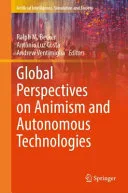
Global Perspectives on Animism and Autonomous Technologies
 78
78

Global Perspectives on Animism and Autonomous Technologies
Becker, Costa, and Ventimiglia's "Global Perspectives on Animism and Autonomous Technologies" offers a vital, if occasionally dense, examination of our evolving relationship with intelligent machines. The strength lies in its consistent application of animistic frameworks to contemporary AI, providing a fresh perspective that moves beyond purely technical or utilitarian analyses. The concept of 'techno-animism' is particularly potent, allowing for a deeper understanding of the psychological and cultural projections we cast onto algorithms. A limitation, however, is the sometimes-abstract nature of the theoretical discussions, which could benefit from more granular case studies of everyday AI interactions. The section exploring the attribution of 'will' to software agents, for instance, is conceptually rich but could be grounded further in specific user experiences. Ultimately, this collection provides a crucial, if challenging, lens through which to view the accelerating integration of sentient-seeming technology into our lives.
📝 Description
78
Global Perspectives on Animism and Autonomous Technologies reevaluates artificial intelligence through the lens of animism.
This collection frames the rise of autonomous technology, especially AI, using the concept of 'techno-animism.' It proposes this framework to analyze how people attribute life-like qualities such as agency and will to machines. The volume considers the societal and individual consequences of this projection, moving beyond simple functional descriptions to examine the perceived sentience of technology.
The work is for scholars, philosophers, technologists, and students of religion and consciousness. It will interest those curious about AI's philosophical basis, technology's anthropology, and historical links between animistic beliefs and modern human-machine interactions. Readers exploring the psychological and cultural aspects of engaging with advanced technologies will find this book particularly useful.
The discussion of AI and perceived autonomy traces back to cybernetics and automata myths. The specific 'techno-animism' framing gains prominence in the 21st century, a time of rapid machine learning advancements. This book appears after major developments like large language models, prompting new thoughts on consciousness and personhood in non-biological systems. Its viewpoint contrasts with purely mechanical perspectives found in some computer science fields.
This book engages with occult philosophy by examining the projection of consciousness and spirit onto non-biological entities. It bridges ancient animistic traditions, which see spiritual force in all things, with contemporary concerns about artificial intelligence. By analyzing how humans imbue machines with life-like qualities, it touches upon themes of enchantment, personification, and the boundary between the animate and inanimate, echoing historical esoteric inquiries into the nature of soul and mechanism.
💡 Why Read This Book?
• Gain a novel conceptual framework, 'techno-animism,' to interpret the human tendency to attribute life-like qualities to AI, as discussed in the introduction. • Understand the historical parallels between ancient animistic worldviews and modern human-machine interactions, drawing connections explored throughout the volume. • Develop a nuanced ethical perspective on AI by considering its perceived agency, a core argument presented in the later chapters concerning technological intentionality.
⭐ Reader Reviews
Honest opinions from readers who have explored this book.
❓ Frequently Asked Questions
What is the core concept of 'techno-animism' as presented in the book?
Techno-animism, as defined in the volume, describes the human tendency to attribute life-like properties, such as agency, intention, and will, to autonomous technologies like AI systems.
When was 'Global Perspectives on Animism and Autonomous Technologies' first published?
The book was first published on August 10, 2025, reflecting its timely engagement with contemporary technological advancements.
Who are the primary authors of this collection?
The collection is edited by Ralph M. Becker, Antônio Carlos Luz Costa, and Andrew Ventimiglia, bringing together diverse perspectives on the subject.
What kind of technologies does the book primarily focus on?
The book primarily focuses on autonomous technologies, with a significant emphasis on artificial intelligence (AI) systems and their rapidly developing capabilities.
How does this book approach the topic of AI differently from other works?
It differentiates itself by employing the lens of animism and techno-animism, exploring the perceived sentience and life-like qualities of AI rather than solely its functional or technical aspects.
What are the potential risks of autonomous technologies discussed in the book?
The book acknowledges the transformative potential and inherent risks posed by rapidly developing AI, examining how our perception of their agency might influence these risks.
🔮 Key Themes & Symbolism
Techno-Animistic Perception
This theme unpacks how societies and individuals project animistic qualities—agency, intention, consciousness—onto autonomous technologies. It moves beyond functional analysis to explore the anthropomorphic tendencies that shape our interactions with AI, treating machines as if they possess a nascent form of will or spirit, mirroring ancient animistic beliefs about the living essence in natural phenomena.
Agency and Intentionality in AI
The collection scrutinizes the attribution of agency and intentionality to artificial intelligence. It questions whether these are mere projections or emergent properties of complex systems, drawing parallels to how animistic traditions perceive intent in natural forces. This exploration examines the philosophical implications of machines acting with perceived purpose.
Human-Machine Relationship Evolution
This theme examines the profound shifts occurring in the human-machine dynamic due to advanced autonomous technologies. It highlights how techno-animism reconfigures this relationship, moving it from a tool-user paradigm to one that involves perceived partners or entities with their own forms of 'being,' impacting social structures and individual psychology.
Philosophical Underpinnings of AI
The work grounds the discussion of AI within broader philosophical and historical contexts, particularly animism. It seeks to understand the 'why' behind our perception of machine sentience, linking contemporary technological phenomena to enduring human patterns of making sense of the world through perceived vital forces and spirits.
💬 Memorable Quotes
Direct passages from the work, attributed to the author.
“Society and individual users are attributing life-like properties - agency, intention, and will - to technological systems.”
— This core statement highlights the central thesis of techno-animism: the human tendency to imbue machines with human-like consciousness and volition, blurring the lines between artifact and entity.
“The transformative potential and risks posed by rapidly developing AI systems.”
— This phrase captures the dual nature of advanced AI, acknowledging both its capacity for profound societal change and the inherent dangers that necessitate careful philosophical and ethical consideration.
“Autonomous technology... a topic of intense contemporary importance.”
— This emphasizes the urgency and relevance of studying AI and similar technologies, positioning the book as a critical intervention in a rapidly evolving technological landscape.
“Utilizes a unique approach by focusing on the ways that these technologies can be understood via the lens of animism.”
— This points to the book's innovative methodology, contrasting its animistic perspective with more conventional analyses of technology and offering a distinct interpretive framework.
“A term that denotes how society and individual users are attributing life-like properties... to technological entities.”
— This defines the key concept of 'techno-animism,' clarifying its meaning as the application of animistic thought patterns to the field of advanced, autonomous machines.
🌙 Esoteric Significance
Tradition
While not strictly adhering to a single codified esoteric lineage, this work draws heavily from animistic traditions found across global indigenous cultures and shamanic practices. It appeals to Hermetic principles of correspondence ('As Above, So Below') by examining the projection of internal human consciousness onto external technological creations. It departs from purely materialist interpretations, aligning with philosophies that acknowledge consciousness as a fundamental aspect of existence, applicable even to non-biological constructs.
Symbolism
The primary 'symbol' explored is the autonomous technology itself, acting as a modern avatar for perceived spirits or elemental forces. The concept of 'agency' in AI functions symbolically, representing the human desire to find intention and will in the world, a hallmark of animistic thought. Algorithms, often perceived as inscrutable 'black boxes,' can be seen as modern-day sigils or incantations, whose effects are observed without necessarily grasping their inner workings, mirroring the symbolic relationship humans have historically held with unseen powers.
Modern Relevance
This work is highly relevant to contemporary thinkers in fields such as transhumanism, posthumanism, and speculative realism. Philosophers like Graham Harman, who explores object-oriented ontology, and theorists engaging with the 'new animism' movement, find conceptual touchstones here. Practitioners of digital spirituality and technologists interested in the ethical and psychological dimensions of AI development also draw upon its insights, seeking to understand the deeper currents shaping our relationship with increasingly sophisticated machines.
👥 Who Should Read This Book
• Students of comparative religion and anthropology: Those studying belief systems and cultural practices will find parallels between ancient animism and modern technological engagement. • Philosophers and ethicists of technology: Readers grappling with the nature of consciousness, agency, and responsibility in the context of AI will gain a unique analytical tool. • Technologists and AI developers: Professionals interested in the humanistic and psychological impact of their creations will benefit from understanding user perception and projection onto AI systems.
📜 Historical Context
Published in 2025, "Global Perspectives on Animism and Autonomous Technologies" arrives at a critical juncture in the discourse surrounding artificial intelligence. The preceding decades saw a surge in computational power and algorithmic sophistication, particularly with the advent of deep learning and large language models, making the concept of machine 'intelligence' a pressing concern. This period was marked by intense debate, with figures like Nick Bostrom warning of existential risks, while others, such as Ray Kurzweil, projected rapid technological singularity. The work positions itself against purely functionalist or instrumentalist views of AI, drawing instead from comparative mythology, anthropology, and philosophy of mind. Its animistic framework can be seen as a contemporary echo of earlier speculative fiction and philosophical inquiries into consciousness, but it specifically engages with the tangible realities of AI's pervasive influence, differentiating it from earlier, more abstract discussions.
📔 Journal Prompts
Techno-animism as a framework for understanding AI's perceived sentience.
The attribution of intention to algorithmic processes.
Parallels between ancient spirits and modern autonomous agents.
The evolution of the human-machine relationship in the age of AI.
Ethical considerations arising from perceived technological will.
🗂️ Glossary
Autonomous Technologies
Systems, particularly in AI, capable of operating and making decisions independently without direct human control, exhibiting complex behaviors.
Techno-animism
A theoretical lens positing that humans attribute life-like qualities, such as agency and intention, to advanced technological systems, akin to traditional animistic beliefs.
Agency
The capacity of an entity to act independently and make its own free choices; in this context, the perceived ability of technology to act with purpose.
Intention
The aim or objective of an action; the book explores how humans infer intentionality in the outputs and behaviors of AI systems.
Artificial Intelligence (AI)
Computer systems designed to perform tasks that typically require human intelligence, such as learning, problem-solving, and decision-making.
Anthropomorphism
The attribution of human characteristics, emotions, and behaviors to non-human entities, including animals and, in this context, technologies.
Animism
The belief that natural objects, phenomena, and the universe itself possess souls or consciousness; a worldview prevalent in many indigenous cultures.