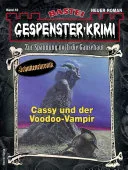
Gespenster-Krimi 62
 75
75

Gespenster-Krimi 62
The opening of Gespenster-Krimi 62 immediately establishes a palpable sense of London's twilight atmosphere, a strength that Curd Cornelius wields effectively. The depiction of a lost child, particularly the detail of street signs becoming illegible, grounds the narrative in a relatable fear. However, the introduction of the 'unheimliche Mann' feels somewhat abrupt, bordering on a common trope within suspense fiction. While the narrative promises an exploration of fear and the unknown, the pacing in these initial sections could benefit from a more gradual unfolding of the psychological tension rather than relying on immediate, archetypal antagonists. The work shows promise in its atmospheric writing, but its reliance on familiar suspense mechanics in its early stages may limit its unique appeal for seasoned readers of the genre. It presents a competent, if not revolutionary, start to what could be a chilling tale.
📝 Description
75
Gespenster-Krimi 62, published in 2021, begins with a child lost in London as night falls.
Curd Cornelius's Gespenster-Krimi 62 unfolds a story set in London, following a child who becomes lost as darkness descends. The narrative introduces an unsettling figure, a mysterious man whose presence amplifies the child's confusion and pulls them deeper into an unfamiliar, potentially threatening part of the city. The initial chapters establish a mood of suspense and disquiet.
This book appeals to readers who enjoy suspenseful tales with a psychological dimension. It is particularly suited for those interested in stories that examine fear and vulnerability within urban settings. The author builds tension gradually, emphasizing atmosphere and a creeping sense of dread over explicit action. Readers who appreciate detailed descriptions of settings, even unsettling ones, will connect with the portrayal of London.
Published in 2021, Gespenster-Krimi 62 arrives in a cultural moment saturated with digital media. Unlike earlier occult literature, which might have been linked to groups like the Hermetic Order of the Golden Dawn in the late 19th century, this work operates in a different context. The 'Krimi' genre itself possesses a long history, but Cornelius appears to merge it with a more atmospheric, possibly supernatural, sensibility. The title suggests a focus on ghostly or phantom elements within this narrative framework.
💡 Why Read This Book?
• Gain an appreciation for atmospheric suspense rooted in urban settings, as demonstrated by the detailed evocation of London in autumn, a specific element of the book's setting. • Experience a narrative that builds tension through disorientation and the psychological impact of the unknown, particularly how the child's fear intensifies as they get deeper into an unfamiliar area. • Explore the subtle interplay between the mundane and the uncanny, as the narrative hints at a spectral presence or psychological threat without immediate exposition, as suggested by the title 'Gespenster-Krimi'.
⭐ Reader Reviews
Honest opinions from readers who have explored this book.
❓ Frequently Asked Questions
When was Gespenster-Krimi 62 first published?
Gespenster-Krimi 62 was first published on February 23, 2021, placing it within contemporary literature.
What is the primary setting for Gespenster-Krimi 62?
The primary setting for Gespenster-Krimi 62 is London during the autumn, with a particular focus on the child's experience as night falls.
Who is the author of Gespenster-Krimi 62?
The author of Gespenster-Krimi 62 is Curd Cornelius.
What genre does Gespenster-Krimi 62 fall into?
Gespenster-Krimi 62 is categorized as Esoteric, blending elements of suspense ('Krimi') with potentially supernatural or psychological themes.
Does the book focus on historical events in London?
While set in London, the book's focus is on a contemporary suspense narrative involving a lost child and an unsettling encounter, rather than specific historical events.
What does 'Gespenster-Krimi' likely refer to?
'Gespenster-Krimi' translates to 'Ghost Crime' or 'Phantom Thriller', suggesting a story that combines elements of mystery and the supernatural or uncanny.
🔮 Key Themes & Symbolism
Urban Disorientation
The narrative masterfully uses the urban range of London as a character, transforming familiar streets into a labyrinth of fear. As night descends, the child's geographical confusion mirrors a growing psychological unease. The book explores how the anonymity of a large city can amplify feelings of vulnerability, especially when an unknown, possibly spectral, figure appears, turning a simple wrong turn into a descent into the unknown.
The Uncanny Stranger
The appearance of the 'unheimliche Mann' (unsettling man) introduces a classic element of folk and psychological horror. This figure represents the unknown threat that lurks just beyond the periphery of perception. The child's attempt to flee only leads them deeper into peril, suggesting that the threat is not merely external but perhaps intrinsically linked to the environment or the child's own state of mind.
Atmosphere of Dread
Curd Cornelius excels at crafting an atmosphere thick with foreboding. The darkening sky and fading light are not just background details but active participants in building suspense. The narrative emphasizes sensory details – the inability to read street signs, the encroaching darkness – to immerse the reader in the child's escalating fear and the pervasive sense that something is profoundly wrong.
Childhood Vulnerability
Fundamentally, the story taps into primal fears surrounding a child's vulnerability when lost and alone. The narrative amplifies this by introducing a menacing presence, raising questions about the nature of evil and the dangers that can manifest when innocence confronts the shadows. The child's perspective heightens the stakes, making the encroaching night and the mysterious man feel all the more terrifying.
💬 Memorable Quotes
Direct passages from the work, attributed to the author.
“The dark clouds of the coming night pushed away the mild autumn evening.”
— This opening sets a somber and ominous tone, using the weather and the transition from day to night as a metaphor for the approaching danger and the shift from safety to unease.
“She knew she was lost.”
— A direct and simple statement that crystallizes the child's predicament, conveying a fundamental fear and the loss of control over her surroundings.
“Maybe the little one would have found the right way again if this uncanny man hadn't appeared behind her.”
— This introduces the antagonist and suggests an important moment where the situation shifts from simple disorientation to active threat, implying a supernatural or sinister intervention.
💡 Key Ideas
Editorial paraphrase of the work's core concepts — not direct quotes.
The letters on the street signs were barely recognizable to the child.
This line immediately establishes a sense of disorientation and fading clarity, mirroring the child's lost state and the encroaching darkness that obscures the familiar world.
She tried to get away from him and noticed much too late that she was getting deeper and deeper into an area...
This passage highlights the escalating peril and the trap-like nature of the child's situation. The attempt to escape leads to a more dangerous predicament, emphasizing the narrative's suspenseful trajectory.
🌙 Esoteric Significance
Tradition
While not explicitly tied to a formal esoteric lineage like Hermeticism or Gnosticism, Gespenster-Krimi 62 taps into the broader tradition of the uncanny and the spectral, often explored in folklore and occult literature. It shares thematic ground with writings that explore the thin veil between the mundane world and hidden, often menacing, realities. Its 'Krimi' classification suggests an engagement with mystery narratives, but the 'Gespenster' element pushes it towards explorations of psychological states and potential paranormal incursions.
Symbolism
The encroaching darkness serves as a potent symbol for the unknown, fear, and the descent into a less rational state of being. The illegible street signs symbolize lost bearings and the breakdown of order and predictability. The 'unheimliche Mann' functions as a symbol of the hidden threat, an archetype of the stranger or the malevolent force that disrupts the perceived safety of the everyday world.
Modern Relevance
In contemporary practice, works like Gespenster-Krimi 62 are relevant to modern occult practitioners and enthusiasts who explore the psychological aspects of fear and the uncanny. It aligns with contemporary horror fiction that emphasizes atmosphere and psychological dread over jump scares. Its themes resonate with modern interest in liminal spaces, urban legends, and the exploration of the subconscious through narrative, finding echoes in psychological thrillers and dark fantasy genres.
👥 Who Should Read This Book
• Readers interested in atmospheric suspense narratives that utilize urban settings to evoke unease, particularly those drawn to tales where the environment itself becomes a source of dread. • Individuals exploring the psychological dimensions of fear and vulnerability, especially as depicted through the experience of a lost child confronting an unknown threat. • Fans of the 'Krimi' genre seeking a blend of mystery with elements of the uncanny or potentially supernatural, offering a departure from purely rational detective stories.
📜 Historical Context
Published in 2021, Gespenster-Krimi 62 arrives in an era saturated with digital media, a stark contrast to the historical development of occult and mystery literature. The late 19th and early 20th centuries, for instance, saw figures like Aleister Crowley and Arthur Machen exploring the occult and the uncanny through prose, often within distinct literary movements. Machen's 'The Great God Pan' (1894), for example, similarly played with hidden horrors within seemingly mundane settings. While 'Krimi' as a genre has deep roots, tracing back to Poe's detective stories and evolving through authors like Agatha Christie, Cornelius's work places itself within a contemporary milieu. It doesn't emerge from the specific intellectual currents of Theosophy or Spiritualism that influenced earlier esoteric fiction, but rather from a broader cultural fascination with the unsettling, amplified by modern storytelling techniques. Reception in 2021 means navigating a landscape where genre boundaries are fluid and public interest in the esoteric is often filtered through online communities and popular culture trends, rather than formal academic engagement or esoteric societies.
📔 Journal Prompts
The child's disorientation in London's twilight: reflect on moments where familiar surroundings felt alien.
The nature of the 'unheimliche Mann': consider archetypes of fear and the unknown in personal experience.
The significance of encroaching darkness: explore how environmental changes can amplify psychological states.
Lost bearings and the search for a way: contemplate personal journeys through uncertainty.
The child's vulnerability versus the encroaching threat: analyze the dynamic between innocence and perceived danger.
🗂️ Glossary
Gespenster
German for 'ghosts' or 'phantoms.' In the context of the title, it suggests the presence of supernatural or spectral entities, or a pervasive sense of the uncanny.
Krimi
German for 'crime' or 'thriller.' It denotes a genre focused on mystery, suspense, and often criminal activity, implying a narrative structure involving investigation or evasion.
Unheimliche Mann
Literally 'uncanny man.' Refers to the mysterious and unsettling male figure who appears and exacerbates the child's fear and disorientation in the narrative.
Disorientation
A state of confusion regarding one's location, time, or identity. In the book, it manifests both geographically (being lost) and psychologically (fear).
Atmosphere
The overall mood or feeling of a place or work of art. In Gespenster-Krimi 62, it is characterized by suspense, dread, and the uncanny, built through descriptions of setting and weather.
Esoteric
Intended for or likely to be understood by only a small number of people with a specialized knowledge or interest. In literature, it often implies themes related to the occult, mysticism, or hidden knowledge.
Archetype
A recurring symbol, character, or pattern of circumstances found universally in literature and human experience, representing fundamental human motifs. The 'unheimliche Mann' can be seen as an archetype of the threatening unknown.