Karmic Relationships

 80
80

Karmic Relationships
Martin Schulman’s Karmic Relationships offers a compelling, if at times dense, astrological framework for understanding the deeper currents that bind individuals. Schulman’s strength lies in his direct, unvarnished approach to astrological interpretation, particularly his focus on the North and South Nodes as indicators of karmic trajectory. He doesn't shy away from the challenging lessons relationships can bring, presenting them as essential components of soul evolution. A particularly impactful section is his analysis of Saturn’s role in relationships, framing it not merely as restriction but as a necessary teacher of responsibility and structure. However, the book’s reliance on intricate astrological calculations and terminology might present a barrier for readers unfamiliar with advanced chart interpretation. While comprehensive, the prose occasionally lacks the fluidity needed to fully absorb the more complex theoretical elements without prior astrological grounding. Nevertheless, for the dedicated student of astrology, Schulman provides an essential lens through which to view the profound, often fated, nature of human connection.
📝 Description
80
Martin Schulman's 1984 book, Karmic Relationships, examines astrological patterns in human connections.
Published in 1984, Karmic Relationships by Martin Schulman offers a detailed look at astrological patterns influencing interpersonal connections. The book goes beyond simple compatibility checks to discuss soul contracts and the lessons relationships are meant to teach. Schulman suggests that specific birth chart configurations point to past life connections and the karmic debts or credits individuals carry into their current lives. This work is for serious astrology students who want to understand relationship dynamics more deeply than Sun sign astrology allows. It will appeal to those interested in the spiritual and psychological roots of human connection, particularly those exploring karma, reincarnation, and life purpose. Readers seeking practical astrological methods for analyzing significant relationships, whether romantic, familial, or professional, will find it valuable.
The book details the 'karmic axis,' comprising the North and South Nodes, as fundamental to understanding relational destiny. It also examines how planetary positions and aspects, especially those involving Saturn and Pluto, define the nature of karmic bonds. Schulman further discusses Chiron, the 'wounded healer,' and its role in identifying areas of deep psychological pain and potential healing within relationships.
Karmic Relationships appeared in the mid-1980s, a time when psychological astrology and New Age thought were gaining traction. Schulman's approach connected esoteric principles with psychological insights, building on earlier astrological works. It provided a more thorough method for analyzing relationships than was typical in mainstream astrology books of the period, predating many later explorations of the subject.
💡 Why Read This Book?
• Gain insight into the karmic underpinnings of your most significant relationships by analyzing the role of your North and South Nodes, as detailed by Schulman’s 1984 work. • Understand the profound lessons and soul contracts guiding your connections through Schulman's interpretation of Saturn's placement and influence in relationship charts. • Discover how Chiron, the 'wounded healer,' acts as a focal point for healing and growth within partnerships, offering a unique perspective not found in generic relationship advice.
⭐ Reader Reviews
Honest opinions from readers who have explored this book.
❓ Frequently Asked Questions
What astrological concepts does Martin Schulman use to explain karmic relationships?
Schulman primarily utilizes the North and South Nodes of the Moon, Saturn, Pluto, and Chiron. He posits that these celestial bodies and points reveal past-life connections, karmic debts, and soul lessons intended for growth within relationships.
Is Karmic Relationships suitable for beginner astrologers?
While the core concepts are accessible, the book assumes a foundational understanding of astrological principles and chart interpretation. Beginners may find it beneficial to consult introductory texts before diving into Schulman's advanced analysis from 1984.
How does this book differ from modern relationship astrology?
Schulman's 1984 publication predates many contemporary psychological and evolutionary astrology approaches. It offers a more direct, karma-focused interpretation rooted in earlier astrological traditions, emphasizing destiny and soul contracts over purely psychological patterns.
What is the significance of Saturn in Schulman's theory of karmic relationships?
In Schulman's framework, Saturn represents karmic lessons, responsibilities, and the structure of relationships. Its placement indicates areas where individuals must learn maturity, discipline, and build lasting foundations, often reflecting challenges carried from past lives.
Can Karmic Relationships help with family dynamics, not just romantic ones?
Absolutely. Schulman's astrological approach to karma applies to all significant relationships, including family ties. The book explores how soul contracts manifest through parents, siblings, and children, offering insights into these complex bonds.
What does the book suggest about soulmates in the context of karma?
Schulman suggests that 'soulmates' in his context are often individuals with whom we have significant karmic ties, indicated by strong nodal connections or challenging Saturn/Pluto aspects. These relationships are designed to facilitate profound soul growth and resolution of past karma.
🔮 Key Themes & Symbolism
Nodes as Karmic Guides
The work posits that the North and South Nodes of the Moon are primary indicators of an individual's karmic path. The South Node represents the baggage and familiar patterns carried from past lives, while the North Node points toward the soul's intended growth and lessons in the present. Schulman analyzes how these points manifest in relationships, suggesting that connections are often drawn to individuals who embody the energies of our North Node or trigger our South Node patterns, compelling us toward resolution and evolution.
Saturn's Role in Relational Structure
Saturn is presented not just as a planet of restriction, but as the great teacher of responsibility, structure, and commitment within relationships. Schulman explores how Saturnian aspects in synastry (relationship astrology) reveal the karmic obligations and lessons that must be learned for a bond to mature and endure. These configurations often highlight areas of fear, obligation, and the need to build solid foundations, reflecting karmic debts that require dedicated effort to overcome and integrate.
Chiron and the Wounded Healer
The placement and aspects of Chiron are examined for their significance in revealing deep-seated wounds that individuals bring into relationships. These wounds, often stemming from past-life experiences or profound early-life hurts, become focal points for both suffering and potential healing. Schulman suggests that relationships often serve as mirrors, bringing these Chironic vulnerabilities to the surface so they can be acknowledged, processed, and ultimately transformed through mutual understanding and support.
Pluto and Transformational Bonds
Pluto's influence is explored in the context of intense, transformative relationships that involve power dynamics, psychological depth, and profound change. Schulman indicates that Pluto aspects in synastry can signify fated connections where individuals are compelled to confront their shadow selves and undergo deep psychological metamorphosis. These relationships, while potentially challenging, are crucial for shedding old patterns and achieving spiritual rebirth, serving as potent vehicles for karmic clearing and soul evolution.
💬 Memorable Quotes
Direct passages from the work, attributed to the author.
“The Nodes of the Moon are the most important indicators of our karmic path.”
— This statement expresses Schulman's core thesis: that understanding one's North and South Node placement is crucial for comprehending the predetermined lessons and soul contracts that shape relational experiences.
“Saturn brings lessons of responsibility and structure into relationships.”
— This highlights Saturn's function not merely as a malefic but as a necessary architect of commitment and maturity, essential for the long-term viability and karmic fulfillment of connections.
“Chiron reveals the deep wounds we carry and seek to heal through others.”
— This emphasizes Chiron's role as a guide to our most vulnerable points, suggesting that relationships often serve as arenas where these ancient hurts are brought into conscious awareness for potential integration.
“Pluto forces us to confront our deepest fears and transform.”
— This points to Pluto's alchemical power within relationships, indicating that intense connections marked by its influence are catalysts for profound psychological upheaval and spiritual rebirth.
“Relationships are mirrors reflecting our unintegrated karma.”
— This concise idea suggests that the challenges and dynamics encountered in our connections are not random but serve as precise feedback mechanisms for our own unresolved karmic issues.
🌙 Esoteric Significance
Tradition
Schulman's work is firmly rooted in Western esoteric astrology, particularly drawing from Theosophical concepts of karma and reincarnation. It integrates these principles with a psychological lens, akin to psychological astrology that gained prominence in the mid-20th century. The book extends the use of astrological symbolism to map out soul-level agreements and lessons, departing from purely predictive or event-based astrology towards a more developmental and soul-oriented framework.
Symbolism
Central to the book's symbolism are the Lunar Nodes (North and South), representing the soul's path from past-life patterns (South Node) towards future growth and integration (North Node). Saturn symbolizes karmic lessons, structure, and the 'tests' encountered in relationships, while Pluto signifies transformative power, shadow aspects, and the potential for profound rebirth through intense connections. Chiron highlights the 'wounded healer' archetype, pointing to areas of deep pain that can become catalysts for healing.
Modern Relevance
Contemporary astrologers and spiritual counselors continue to draw upon Schulman's foundational work on karmic relationships. His emphasis on the Nodes, Saturn, and Chiron as key indicators of soul contracts remains a cornerstone in evolutionary and psychological astrology. Modern practitioners often build upon his framework, integrating it with contemporary psychological theories and other esoteric systems to offer clients deeper insights into their relational destiny and the purpose of their connections.
👥 Who Should Read This Book
• Students of evolutionary astrology: Those seeking to understand the soul's journey across lifetimes and how past-life dynamics manifest in present relationships. • Astrologers analyzing synastry: Practitioners looking for a deeper, karma-focused methodology to interpret compatibility and relational challenges beyond basic aspects. • Individuals exploring spiritual purpose in relationships: Readers interested in the karmic contracts and soul lessons that guide significant connections in their lives.
📜 Historical Context
Martin Schulman's Karmic Relationships, first published in 1984, emerged during a vibrant period for psychological and esoteric astrology. The mid-1980s saw a burgeoning interest in applying astrological principles to understand the deeper, often subconscious, motivations behind human behavior and relationships. This era was influenced by the works of Dane Rudhyar and Liz Greene, who had already begun integrating Jungian psychology with astrological symbolism. Schulman’s book contributed to this trend by offering a specific, karma-focused interpretation of astrological charts for relational analysis, building upon earlier Western esoteric traditions. It provided a more structured, destiny-oriented approach compared to the more humanistic or evolutionary perspectives gaining traction. While not subject to major censorship or controversy, its detailed astrological methodology distinguished it from more general New Age self-help literature of the time.
📔 Journal Prompts
The karmic axis of your birth chart and its relational implications.
Saturn's lessons in your most challenging relationship.
How Chiron's placement illuminates a recurring pattern in your connections.
The South Node's influence on familiar relational dynamics.
Identifying North Node potentials for growth within a current partnership.
🗂️ Glossary
Karmic Axis
The axis formed by the North Node and South Node of the Moon in an astrological chart, representing the soul's path from past-life patterns (South Node) towards present-life lessons and growth (North Node).
Synastry
The astrological technique of comparing two birth charts to analyze the dynamics, compatibility, and potential challenges within a relationship between two individuals.
Lunar Nodes
Two points in space where the Moon's orbit intersects the Earth's orbit around the Sun. In astrology, they are deeply connected to concepts of karma, destiny, and soul evolution.
Chiron
An asteroid or minor planet often called the 'wounded healer.' Its placement in a birth chart indicates areas of deep pain, vulnerability, and potential for profound healing and wisdom.
Soul Contract
In esoteric thought, a pre-birth agreement or understanding made by the soul to experience specific lessons, challenges, and growth opportunities through relationships and life events.
Evolutionary Astrology
A branch of astrology focused on the soul's journey, karma, and psychological evolution across lifetimes, using the birth chart as a map of these processes.
Pluto
The outermost planet in astrology, associated with transformation, power, intensity, death and rebirth, and confronting the shadow self. Its aspects in relationships can indicate profound, often fated, connections.
🔮 Readers Also Liked
Browse all →









More by Martin Schulman
All books →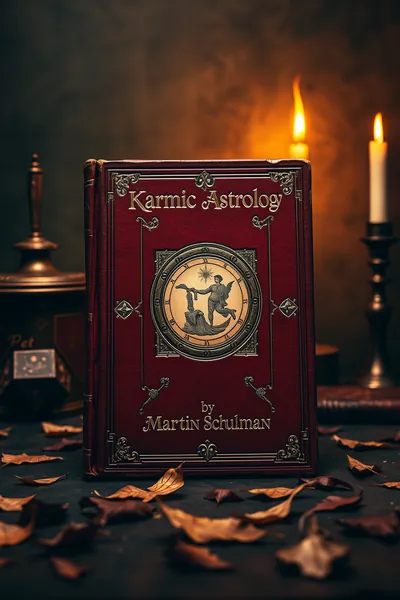




More Free Occult Philosophy Books
View all →
![Secret Societies of the Middle Ages [by T. Keightley]](/img/thumb/secret-societies-of-the-middle-ages-by-t-keightley-thomas-keightley-272139.webp)