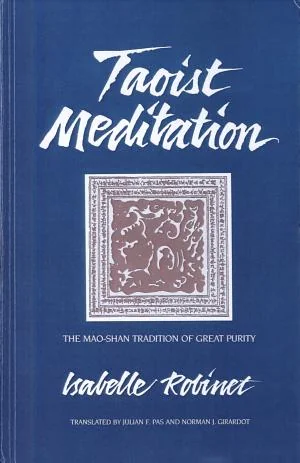
Taoist Meditation
 71
71

Taoist Meditation
Isabelle Robinet's "Taoist Meditation" is a dense, scholarly achievement that fundamentally alters our understanding of the Mao-shan tradition. Its greatest strength lies in its meticulous scholarship, particularly its groundbreaking synthesis of early Taoist classics, Buddhist influences, and later religious practices. Robinet doesn't shy away from the intricate cosmology or the complex internal alchemy, presenting them with a clarity that is both academic and accessible to the dedicated student. However, the book's academic rigor can also be its limitation; it demands significant background knowledge and can be challenging for those new to Taoist studies. The section detailing the "astral journeys" and the bodily symbolism associated with them is particularly revelatory, showcasing the highly sophisticated inner landscape cultivated by Mao-shan practitioners. Ultimately, "Taoist Meditation" is an essential, if demanding, resource for anyone serious about the historical and philosophical underpinnings of Taoist contemplative practice.
📝 Description
71
Isabelle Robinet's 1993 study details the Mao-shan Taoist tradition's visionary practices.
First published in 1993, Isabelle Robinet's "Taoist Meditation" examines the Mao-shan Taoist tradition, a lineage known for its visionary practices. This work clarifies the connections between early Taoist texts, the influence of Buddhism, and the development of Taoist religion. Robinet reconstructs the cosmology, the symbolic language of the body, and techniques of astral projection and internal alchemy specific to this esoteric path.
This book is intended for readers with a serious interest in the historical and practical aspects of Taoist mysticism. Scholars of comparative religion, students of Chinese philosophy, and practitioners interested in academic understanding of meditative states will find it valuable. It offers a framework for understanding the spiritual disciplines that shaped Chinese religious thought and practice.
Robinet's research highlights a period in Taoism's evolution, showing how foundational texts and philosophical ideas became integrated into religious traditions. The book traces the lineage of meditative techniques, documenting their progression from early textual references to the elaborate practices found in the Mao-shan corpus. This historical perspective illuminates continuity and transformation within Taoist thought.
The Mao-shan tradition, detailed in this book, is a significant branch of Taoism focused on achieving spiritual realization through internal cultivation and direct experience. Its practices often involve visualization of celestial realms and divine beings, using the practitioner's own body as a microcosm and symbolic map for spiritual ascent. This tradition integrates philosophical Taoism with religious elements, including techniques for manipulating internal energies and consciousness, sometimes drawing on or interacting with Buddhist concepts. Robinet's work places these practices within their historical and textual context, showing their development over time.
💡 Why Read This Book?
• Understand the Mao-shan tradition's unique visionary cosmology, as described by Robinet, gaining insights into practices that map inner states onto celestial journeys. • Clarify the complex relationship between early Taoist texts, Buddhist thought, and the formation of Taoist religion, a key historical development Robinet meticulously traces. • Explore the sophisticated internal alchemy and bodily symbolism central to Mao-shan meditation, offering a rare look at these esoteric techniques from a scholarly perspective.
⭐ Reader Reviews
Honest opinions from readers who have explored this book.
❓ Frequently Asked Questions
What is the Mao-shan tradition discussed in Isabelle Robinet's "Taoist Meditation"?
The Mao-shan tradition is a significant school of Taoism, particularly known for its emphasis on visionary meditation, scriptural study, and internal alchemy. Robinet's 1993 work is the first scholarly study dedicated to this lineage.
How does "Taoist Meditation" connect early Taoist classics with later religious practices?
The book demonstrates how foundational Taoist philosophical concepts and early texts were integrated and transformed into the elaborate religious practices and cosmology of later traditions, including the Mao-shan school.
What are some key meditative techniques described in the book?
Robinet details visionary meditation, astral journeys, and complex internal alchemy practices. These involve visualizing celestial realms and using the body as a symbolic map for spiritual ascent.
Is "Taoist Meditation" suitable for absolute beginners in Taoism?
While comprehensive, the book is a scholarly study. It is best suited for those with some existing knowledge of Chinese philosophy or comparative religion, offering a deep dive rather than an introductory overview.
When was Isabelle Robinet's "Taoist Meditation" first published?
The original publication date for Isabelle Robinet's "Taoist Meditation" was January 1, 1993, marking it as a seminal scholarly work in its field.
What makes the book's description of bodily symbolism unique?
Robinet explains how the human body was viewed as a microcosm and a map for spiritual journeys in the Mao-shan tradition, with specific organs and energies linked to cosmic principles and divine beings.
🔮 Key Themes & Symbolism
Visionary Cosmology
The work meticulously reconstructs the visionary cosmology of the Mao-shan tradition, detailing the celestial realms, divine hierarchies, and the symbolic landscapes practitioners sought to traverse. Robinet explains how these inner visions were not mere fantasy but structured spiritual maps, often mapped onto the practitioner's own body, providing a framework for understanding the universe and one's place within it. This cosmology guided the meditative journey, offering specific destinations and encounters for the adept.
Internal Alchemy (Neidan)
Central to Mao-shan practice, internal alchemy is explored in depth. Robinet clarifies how practitioners utilized their own bodies as a crucible for transforming vital energies (qi) and essences. This process aimed at spiritual immortality and profound transformation, involving the visualization and manipulation of internal forces. The book details the symbolic language and complex energetic pathways involved in this profound self-cultivation.
Bodily Symbolism and Astral Journeys
A unique aspect of Mao-shan meditation involves the intricate symbolism attributed to the human body. Robinet elucidates how different organs, channels, and energy centers were seen as correspondences to cosmic elements and divine palaces. The practice of "astral journeys" involved projecting consciousness to these spiritual realms, often guided by internal visualizations and the symbolic geography of the body itself.
Historical Synthesis
The book's significance lies in its scholarly synthesis, bridging the gap between early Taoist philosophical texts and the developed religious practices of later centuries. Robinet clarifies the often-obscure relationship between foundational Taoist classics, the influx of Buddhist ideas, and the specific rituals and meditative techniques of the Mao-shan school, situating it within broader Chinese religious history.
💬 Memorable Quotes
Direct passages from the work, attributed to the author.
“The Mao-shan tradition is characterized by a highly developed visionary cosmology.”
— This highlights the core focus of the book: the intricate, structured spiritual universe that Mao-shan practitioners aimed to explore and integrate with. It signifies a complex inner geography.
“Internal alchemy utilized the body as a primary vehicle for spiritual transformation.”
— This emphasizes the embodied nature of Taoist practice within this tradition, where the physical form itself becomes the site and tool for achieving higher states of consciousness and longevity.
“Astral journeys involved the projection of consciousness to celestial realms.”
— This points to the experiential dimension of Mao-shan meditation, where practitioners actively engaged with non-physical dimensions, guided by specific cosmological frameworks and meditative techniques.
“The relationship among early Taoist classics, Buddhism, and later Taoist religion is clarified.”
— This underscores the book's scholarly contribution in mapping the historical and doctrinal influences that shaped Taoism, particularly the Mao-shan school, offering a cohesive understanding of its development.
“Bodily symbolism served as a map for the spiritual adept.”
— This interpretation focuses on how the human anatomy was imbued with cosmic meaning, acting as an internal guide or landscape for reading through the spiritual path and understanding universal principles.
🌙 Esoteric Significance
Tradition
This work is firmly situated within the study of Taoist esotericism, specifically focusing on the Mao-shan (Maoshan) lineage. This tradition, originating in the 4th century CE, represents a significant development in Taoist religious practice, emphasizing scriptural authority, ritual efficacy, and advanced meditative techniques aimed at spiritual transformation and longevity. Robinet's scholarship places Mao-shan within the broader range of Chinese religious history, showing its unique contributions and its interactions with Buddhism.
Symbolism
Key symbols explored include the human body itself, viewed as a microcosm of the cosmos and a map for spiritual journeys. Celestial palaces, divine beings (like the Three Pure Ones), and the manipulation of vital energies (qi) through internal alchemy are central. The visualization of internal landscapes and the symbolic representation of cosmic forces within the practitioner's body are paramount to Mao-shan meditative practices.
Modern Relevance
Contemporary scholars and practitioners interested in embodied spiritual practices, comparative mysticism, and the historical development of meditation techniques find Robinet's work foundational. Thinkers exploring consciousness studies and the phenomenology of religious experience often cite her detailed descriptions of visionary states and internal alchemy. The book remains a touchstone for understanding the sophisticated contemplative systems that emerged from Taoist traditions.
👥 Who Should Read This Book
• Scholars of Chinese religions and philosophy seeking a definitive academic treatment of the Mao-shan tradition and its meditative practices. • Advanced practitioners of Taoism or comparative contemplative disciplines interested in the historical and theoretical underpinnings of visionary meditation and internal alchemy. • Researchers in comparative mysticism and the history of religious experience looking for detailed accounts of esoteric cosmology and embodied spiritual techniques.
📜 Historical Context
Published in 1993, Isabelle Robinet's "Taoist Meditation" emerged during a period of renewed academic interest in Chinese religions, following decades where such studies were less accessible. The book arrived as a crucial corrective and synthesis, particularly regarding the often-overlooked Mao-shan tradition. This lineage, while influential, had previously been fragmented in Western scholarship, often overshadowed by more prominent schools like Quanzhen. Robinet's work directly engaged with primary Taoist texts and commentaries, offering a scholarly counterpoint to earlier, sometimes romanticized, accounts of Taoist practices. Her meticulous research provided a vital bridge, clarifying how the philosophical underpinnings of texts like the *Dao De Jing* and *Zhuangzi* evolved into the complex ritual and meditative systems documented by the 4th century CE onwards, particularly within the Mao-shan corpus. The work implicitly addressed the intellectual currents seeking to understand the historical development of religious traditions beyond simple doctrinal comparisons.
📔 Journal Prompts
Mao-shan visionary cosmology: How might celestial realms be interpreted as internal states?
Internal alchemy's focus on bodily transformation: What parallels exist in other esoteric traditions?
The concept of astral journeys: Reflect on the nature of consciousness projection.
How does the symbolism of the body in Mao-shan meditation compare to other psycho-spiritual systems?
The synthesis of early Taoist classics and later religious practices: Consider the evolution of spiritual ideas.
🗂️ Glossary
Mao-shan
A significant school of Taoism that emerged in the 4th century CE, known for its emphasis on scriptural study, ritual, and visionary meditation practices aimed at spiritual attainment and immortality.
Visionary Meditation
A form of contemplative practice involving the cultivation of inner visions, often of celestial realms, deities, or symbolic landscapes, used as a means of spiritual exploration and transformation.
Internal Alchemy (Neidan)
A Taoist practice that focuses on cultivating spiritual transformation and immortality by refining the body's vital energies (qi), essences (jing), and spirit (shen) internally, rather than through external elixirs.
Bodily Symbolism
The symbolic representation and interpretation of the human body's anatomy, organs, and energies as correspondences to cosmic principles, divine realms, and spiritual pathways within Taoist traditions.
Astral Journeys
Meditative or spiritual experiences involving the projection of consciousness beyond the physical body to explore non-physical realms or celestial dimensions, often guided by cosmological maps.
Cosmology
The study or understanding of the origin, structure, and evolution of the universe, including its celestial hierarchies, divine beings, and the relationships between different planes of existence.
Esoteric
Intended for or likely to be understood by only a small number of people with a specialized knowledge or interest; relating to hidden meanings or mystical interpretations.
This book appears in 1 collection
🔮 Readers Also Liked
Browse all →









From the “Meditation” Collection
View all →






More Free Occult Philosophy Books
View all →