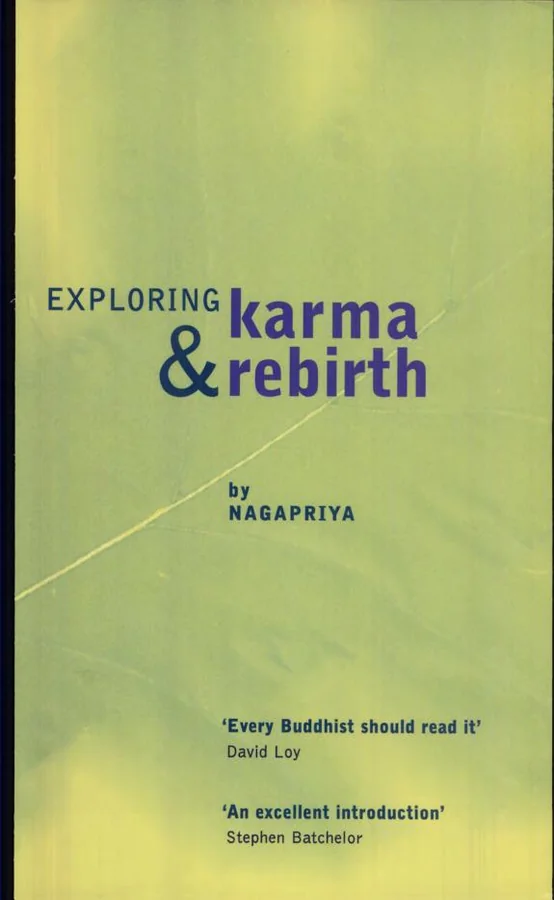
Exploring Karma & Rebirth
 79
79

Exploring Karma & Rebirth
Nagapriya's "Exploring Karma & Rebirth" confronts its subject matter with an admirable intellectual rigor, a welcome departure from more devotional or introductory texts. The book's strength lies in its systematic deconstruction of karma and rebirth, situating them within their historical Indian milieu and questioning their uncritical adoption in the West. Nagapriya particularly excels in dissecting the philosophical arguments, avoiding easy answers and instead fostering a more nuanced understanding. A notable limitation, however, is the book's occasionally dense prose, which may present a barrier for readers less accustomed to academic philosophical discourse. The section examining the potential reinterpretation of these doctrines for the postmodern West, while ambitious, sometimes feels more like an outline of possibilities than a fully realized argument. Overall, "Exploring Karma & Rebirth" is a valuable, if demanding, contribution for those seeking to grapple with the complexities of Buddhist soteriology.
📝 Description
79
Nagapriya's 2004 book examines karma and rebirth as evolving frameworks, not fixed dogmas.
Published in 2004, Nagapriya's "Exploring Karma & Rebirth" offers a rigorous look at two core Buddhist ideas. The book moves past simple definitions to critically engage with how karma and rebirth developed historically and doctrinally. Nagapriya presents these concepts not as unchanging truths, but as frameworks that changed over time due to cultural and intellectual influences.
This work is for students of Buddhist thought and comparative religion who want a scholarly but understandable approach to complex doctrines. It suits readers who question assumptions and seek the philosophical basis for commonly accepted ideas. Those interested in how Eastern philosophy connects with Western thought will find it especially valuable. The book situates karma and rebirth in their Indian origins and considers their use in modern Western settings.
This book engages with the philosophical underpinnings of Buddhist thought, specifically karma and rebirth. It places these concepts within their Indian origins and examines their doctrinal evolution, moving beyond simplistic or devotional interpretations. Nagapriya considers how these ideas function as causal frameworks and processes of continuity, rather than fixed spiritual laws. The work also touches upon the cultural relativity of these doctrines and their potential reinterpretation for contemporary audiences.
💡 Why Read This Book?
• Understand the philosophical underpinnings of karma beyond simple cause-and-effect by examining Nagapriya's critical appraisal of its origins in ancient India. • Grasp the concept of rebirth as a process of continuity, not a transmigration of a fixed self, as explored in the book's doctrinal analysis. • Assess the relevance of these Buddhist teachings for contemporary Western thought, as Nagapriya imaginatively reinterprets them for a postmodern audience.
⭐ Reader Reviews
Honest opinions from readers who have explored this book.
❓ Frequently Asked Questions
When was "Exploring Karma & Rebirth" first published?
The book was first published in 2004, marking its emergence during a period of increased academic and public interest in Buddhist philosophy in the West.
What is the primary focus of Nagapriya's book?
The book's primary focus is a critical examination of the Buddhist doctrines of karma and rebirth, exploring their historical origins, philosophical nuances, and contemporary relevance.
Does the book offer a simplistic view of karma?
No, "Exploring Karma & Rebirth" actively challenges simplistic or fatalistic interpretations, offering a more complex and philosophically grounded understanding of karmic causality.
Is this book suitable for beginners in Buddhist studies?
While accessible, the book's scholarly approach and critical engagement with doctrine make it most suitable for those with some existing familiarity or a strong interest in philosophical inquiry.
What is the author's stance on the relevance of these doctrines today?
Nagapriya critically appraises their relevance, suggesting that traditional understandings may need reinterpretation for the postmodern Western world, moving beyond purely monastic contexts.
Who is Nagapriya?
Nagapriya is the author of "Exploring Karma & Rebirth," a scholar whose work engages deeply with Buddhist philosophy and its cultural context.
🔮 Key Themes & Symbolism
Karma as Causality
The work dissects karma not as divine judgment or predetermined fate, but as a natural principle of ethical causality. It emphasizes volitional actions and their consequential unfolding, challenging Western notions of free will versus determinism by presenting karma as a complex web of intention and action rooted in Indian philosophical traditions.
Rebirth and Continuity
Nagapriya explores rebirth as a process of conditioned arising and continuity, rather than the transmigration of an unchanging soul or 'self'. This Buddhist concept is examined in contrast to Western ideas of personal identity and mortality, highlighting the doctrine's function in understanding ethical responsibility across perceived lifetimes.
Cultural Reinterpretation
A significant theme is the book's engagement with the applicability of these ancient doctrines to the contemporary postmodern West. It questions how concepts developed in specific cultural and religious contexts can be understood and potentially integrated into secular or pluralistic modern societies without losing their core philosophical meaning.
Doctrinal Nuance
The book champions a detailed and critical approach to Buddhist doctrine, moving beyond popularized or superficial understandings. It stresses the importance of historical context and philosophical precision when engaging with concepts like karma and rebirth, urging readers towards deeper study and contemplation.
💬 Memorable Quotes
Direct passages from the work, attributed to the author.
“examines them in relation to their cultural origins”
— This points to the book's commitment to historical and anthropological context, recognizing that doctrines like karma and rebirth are not abstract universals but are shaped by the societies in which they arise.
“discusses whether these teachings are still relevant today”
— This indicates the book's forward-looking perspective, engaging with the enduring philosophical questions posed by Buddhist thought and assessing their applicability in contemporary life.
“offers an imaginative reading of what the teachings could mean for the postmodern Western world”
— This suggests the author's creative approach, seeking to bridge the gap between ancient Eastern wisdom and the specific challenges and frameworks of modern Western consciousness.
“insists that, to be meaningful, these teachings require rigorous inquiry”
— This expresses the book's central thesis: genuine understanding of karma and rebirth necessitates critical engagement, not passive acceptance, urging intellectual honesty.
💡 Key Ideas
Editorial paraphrase of the work's core concepts — not direct quotes.
clarifies and critically appraises these traditional Buddhist doctrines
This passage highlights the book's core academic function: to explain complex concepts and subject them to rigorous philosophical scrutiny, moving beyond received interpretations.
🌙 Esoteric Significance
Tradition
While rooted in Buddhist philosophy, the book's critical and interpretive approach aligns with broader esoteric traditions that seek to uncover underlying universal principles within diverse religious and philosophical systems. It engages with concepts often found in esoteric thought, such as causality, consciousness, and transformation, but grounds them in specific Buddhist doctrinal analysis rather than purely mystical intuition.
Symbolism
The core concepts of karma and rebirth themselves function symbolically. Karma represents the intricate web of cause and effect that governs existence, akin to principles of resonance or sympathetic magic found in Western esotericism. Rebirth symbolizes the potential for continuous transformation and the overcoming of limitations, echoing alchemical processes of dissolution and regeneration.
Modern Relevance
Contemporary thinkers exploring secular Buddhism, comparative psychology of religion, and philosophical approaches to consciousness often draw upon the kind of rigorous doctrinal analysis Nagapriya provides. The book's attempt to reinterpret ancient doctrines for a postmodern audience speaks to current efforts to integrate Eastern philosophical insights into Western ethical and existential frameworks, particularly within fields like mindfulness studies and existential philosophy.
👥 Who Should Read This Book
• Students of Buddhist philosophy seeking a critical and scholarly examination of karma and rebirth beyond introductory texts. • Comparative religion scholars interested in the historical development and cross-cultural transmission of religious doctrines. • Western readers grappling with concepts of destiny, causality, and personal identity who wish to explore alternative philosophical frameworks.
📜 Historical Context
Published in 2004, "Exploring Karma & Rebirth" emerged during a period marked by increasing Western engagement with Buddhist philosophy, often seeking more academic and less devotional interpretations. This era saw scholars like Stephen Batchelor critically examining Buddhist traditions through a secular lens, contributing to a broader discourse on how Eastern thought could be adapted to Western contexts. Nagapriya's work fits within this intellectual current, which was also influenced by the legacy of figures like D.T. Suzuki, who had introduced Zen Buddhism to the West decades earlier, though often in a less critical manner. The book implicitly engages with the reception of Buddhist ideas, which had previously been filtered through various movements like Theosophy and Transcendentalism, aiming for a more philosophically grounded analysis.
📔 Journal Prompts
The principle of karmic causality as examined in the text.
Rebirth as a process of conditioned continuity versus a fixed soul.
The challenges of interpreting Buddhist doctrines for a postmodern Western context.
Assessing the philosophical arguments presented regarding ethical responsibility.
The author's critique of popular or simplistic understandings of karma.
🗂️ Glossary
Karma
In Buddhism, the principle of causality where volitional actions (intentions) lead to future consequences, shaping an individual's experiences and future existences.
Rebirth
The Buddhist doctrine describing the continuity of consciousness and the stream of becoming after death, driven by karmic forces, rather than the transmigration of a permanent self.
Doctrine
A core belief or set of beliefs held and taught by a religious or political group; in this context, referring specifically to Buddhist teachings on karma and rebirth.
Causality
The relationship between cause and effect. The book explores Buddhist causality as distinct from deterministic or mechanistic Western models.
Postmodern
Relating to or characteristic of the cultural, intellectual, or artistic philosophy that has developed since the mid-20th century, often characterized by skepticism towards grand narratives and objective truth.
Appraisal
An act of assessing something or someone. In the book, it refers to the critical evaluation of the doctrines of karma and rebirth.
Volitional Action
An action performed consciously and with intention, considered the primary driver of karmic consequences in Buddhist thought.
This book appears in 2 collections
🔮 Readers Also Liked
Browse all →








From the “Reincarnation” Collection
View all →







More Free Occult Philosophy Books
View all →