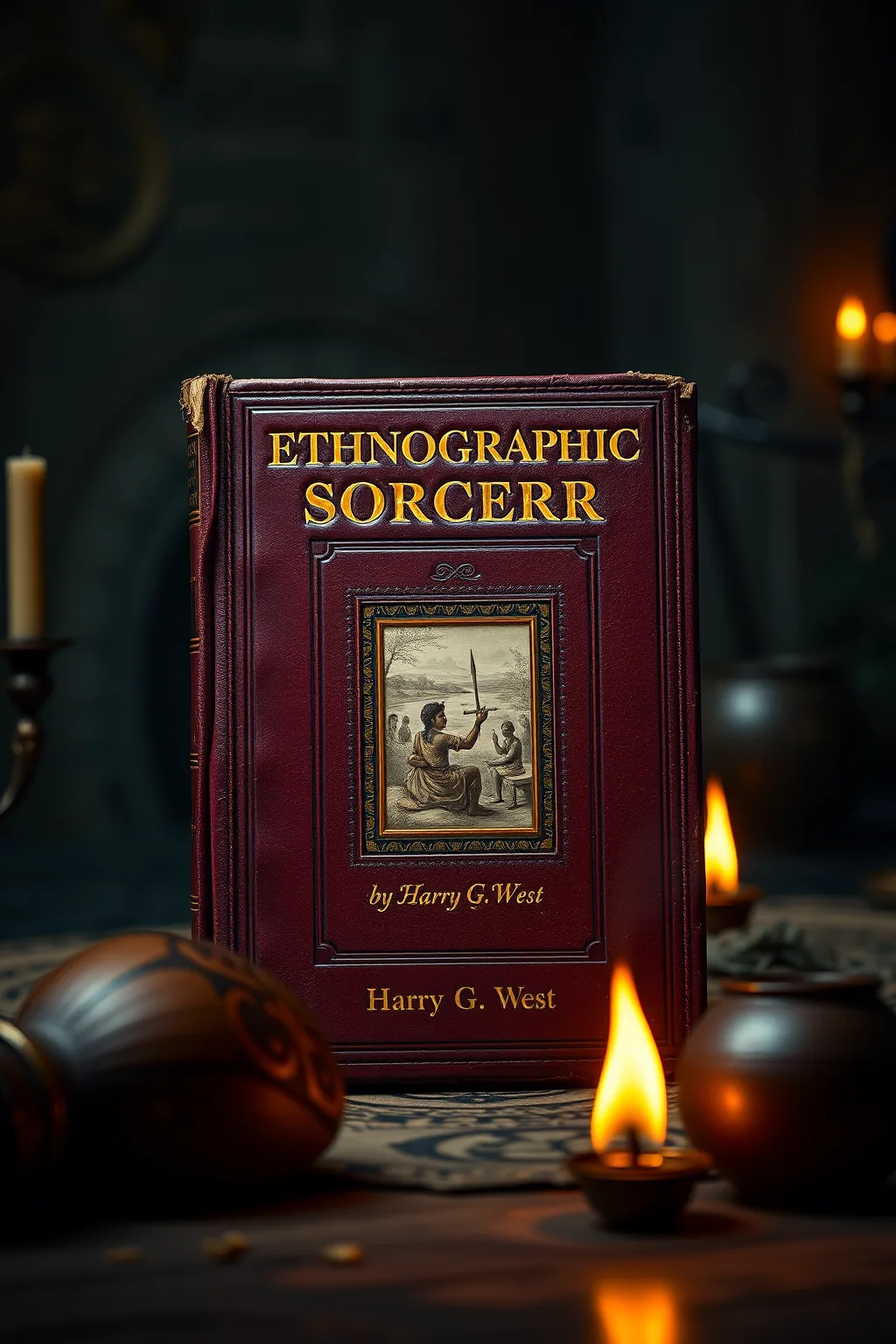
Ethnographic Sorcery
 75
75

Ethnographic Sorcery
Harry G. West’s *Ethnographic Sorcery* offers a vital corrective to the often romanticized or dismissive academic treatment of magical practices. By grounding sorcery firmly within the social and political arenas where it operates, West demonstrates its efficacy not as illusion, but as a potent force in community life. His analysis of how sorcery accusations function as instruments of social ordering, particularly in contexts of inequality, is sharp and illuminating. The strength of the book lies in its unflinching anthropological gaze, refusing to sanitize or exoticize its subject. A limitation, perhaps, is that the theoretical density might present a barrier for readers unfamiliar with contemporary anthropological discourse. West's exploration of the Azande people's belief in witchcraft, referencing E.E. Evans-Pritchard's earlier work, highlights the evolution of ethnographic understanding. Ultimately, *Ethnographic Sorcery* is a crucial, if demanding, study for anyone serious about understanding magic as a lived social reality.
📝 Description
75
Harry G. West's 2008 book examines sorcery not as superstition, but as social action.
Ethnographic Sorcery analyzes the social and political roles of magical practices, moving beyond purely symbolic or psychological views. Cultural anthropologist Harry G. West looks at how sorcery functions within specific community structures, often as a way to control people, negotiate relationships, or assert power. The book questions the common academic habit of separating magic from its real-world social contexts, arguing that this separation prevents a full understanding.
This work is useful for anthropologists, sociologists, and scholars of religion who study belief systems and their societal roles. Students of magic and esotericism who want a careful, realistic perspective that challenges usual ideas will also find it interesting. People curious about how power, knowledge, and ritual interact in non-Western societies will find it especially informative. It is an analytical study of magic's role in human life, not a practical guide.
Published in 2008, Ethnographic Sorcery engages with anthropological studies of religion and magic that consider post-colonial perspectives and critiques of Western thought. West builds on earlier ethnographic work, like E.E. Evans-Pritchard's studies of Azande witchcraft in the 1930s, but provides a more current and varied theoretical viewpoint. The book addresses discussions about belief, rationality, and the continued importance of magical thinking in contemporary societies, referencing thinkers such as Marcel Mauss and Claude Lévi-Strauss.
💡 Why Read This Book?
• You will learn how sorcery functions as a social and political tool, as demonstrated through West's analysis of its role in community structures and power dynamics, a perspective distinct from purely symbolic interpretations. • You will gain an understanding of the ethnographic critique of Western rationality by examining how the book challenges the separation of magic from its material and social contexts, a key insight from its 2008 publication. • You will discover the performative nature of sorcery and its entanglement with kinship and political structures, concepts explored through specific case studies presented in the work.
⭐ Reader Reviews
Honest opinions from readers who have explored this book.
❓ Frequently Asked Questions
What is the primary focus of Harry G. West's Ethnographic Sorcery?
The book primarily focuses on the social and political dimensions of magical practices, examining how sorcery operates within specific community structures as a tool for social control and negotiation, rather than as mere symbolic belief.
Who would benefit most from reading Ethnographic Sorcery?
Anthropologists, sociologists, scholars of religion, and students of esotericism seeking a rigorous, grounded perspective on magic's societal functions would benefit most.
Does Ethnographic Sorcery provide instructions on how to perform magic?
No, the book is an analytical study and does not offer practical instructions for performing magic. Its aim is to understand the social and political roles sorcery plays in human societies.
What historical context is relevant to Ethnographic Sorcery?
Published in 2008, it engages with post-colonial theory and critiques of Western epistemology, building on earlier ethnographic work like E.E. Evans-Pritchard's studies of the Azande.
What are some key concepts discussed in the book?
Key concepts include the performative nature of sorcery, its entanglement with kinship and political structures, and the ethnographic critique of Western notions of rationality.
How does Ethnographic Sorcery challenge Western views on magic?
It challenges Western views by arguing against the academic separation of magic from its material and social contexts, asserting that such separation hinders a full understanding of its function.
🔮 Key Themes & Symbolism
Sorcery as Social Praxis
This theme dissects sorcery not as an isolated belief system but as an active, embodied practice deeply embedded within the social fabric. West emphasizes that understanding sorcery requires analyzing its role in everyday interactions, community disputes, and the establishment of social hierarchies. The book illustrates how knowledge and performance of sorcery are often tied to specific social positions and power relations, demonstrating that its 'reality' is constituted through its social effects and the way it shapes human behavior and relationships within a community.
Critique of Western Rationality
A central pillar of the work is its challenge to the Western intellectual tradition's tendency to categorize magic as irrational or pre-modern. West argues that this categorization is itself a product of specific historical and cultural biases. By presenting sorcery as a coherent system of knowledge and action within its own cultural logic, the book compels readers to reconsider the universal applicability of Western concepts of rationality and science. It suggests that what is deemed 'rational' is often context-dependent and influenced by power structures.
Power, Politics, and Accusation
The book rigorously explores how sorcery and accusations thereof function as instruments of power and political negotiation. West examines how claims of magical harm or efficacy can be used to manage social tensions, assert authority, settle grievances, or even destabilize existing power structures. This perspective moves beyond viewing sorcery solely through the lens of individual belief, highlighting its collective and strategic dimensions within the broader political range of a society.
Ethnographic Method and Theory
Ethnographic Sorcery represents a significant contribution to anthropological theory and methodology. It advocates for an approach that takes indigenous understandings of magic seriously, without resorting to simplistic acceptance or outright dismissal. The work highlights the importance of detailed fieldwork and theoretical engagement to grasp the complex interplay between belief, practice, social structure, and power, offering a model for how to study seemingly 'other' belief systems with intellectual honesty and rigor.
💬 Memorable Quotes
Direct passages from the work, attributed to the author.
“Sorcery is not simply a belief, but a practice that produces social effects.”
— This highlights the book's core argument: magic should be understood not just as a set of ideas, but as an active force that shapes social realities and relationships.
“The separation of magic from its social context is a Western intellectual imposition.”
— West critiques the tendency of Western scholarship to isolate magical beliefs from the communities and power dynamics in which they are embedded, arguing this distorts understanding.
“Accusations of sorcery can serve as mechanisms for social control and political maneuvering.”
— This points to the pragmatic and strategic uses of sorcery within communities, where claims of magic are employed to influence social order and power relations.
“Understanding 'irrational' beliefs requires engaging with their internal logic and social function.”
— The book suggests that judging magical practices by Western rational standards is unproductive; instead, one must grasp their coherence and purpose within their specific cultural milieu.
“The efficacy of sorcery lies in its social and material consequences.”
— This emphasizes that the 'power' of sorcery is demonstrated through its tangible impacts on individuals and communities, not through supernatural intervention alone.
🌙 Esoteric Significance
Tradition
While not strictly adhering to a single esoteric lineage like Hermeticism or Kabbalah, *Ethnographic Sorcery* significantly contributes to the broader field of esoteric studies by providing a critical anthropological lens. It engages with the *phenomenology* of magical experience and belief systems that often form the bedrock of various esoteric traditions. By analyzing sorcery as a lived social practice, it offers a counterpoint to purely textual or speculative approaches, grounding esoteric concepts in observable human behavior and social structures.
Symbolism
The book's focus is less on specific esoteric symbols and more on the *social construction* of meaning around practices and accusations. However, concepts like the 'witch' or 'sorcerer' themselves function as potent symbols within communities, representing forces of chaos, social transgression, or hidden knowledge. The act of accusation, the ritualistic elements sometimes involved, and the perceived efficacy of spells all carry symbolic weight, representing the community's anxieties, desires, and power struggles.
Modern Relevance
Contemporary thinkers and practitioners in fields ranging from critical theory to neo-shamanism and even certain strains of occultism find value in West's work. It informs discussions on the persistence of magical thinking in ostensibly secular societies, the relationship between belief and power in political movements, and the ethical considerations of studying and representing marginalized belief systems. Scholars examining the social impact of conspiracy theories or the performative aspects of modern ritual practices often draw upon its insights.
👥 Who Should Read This Book
• Anthropologists and sociologists studying belief systems, ritual, and social control within communities. • Students of religion and esotericism seeking to understand the social and political dimensions of magic beyond symbolic interpretation. • Critical theorists and researchers interested in the intersection of power, knowledge, and 'irrational' practices in diverse cultural contexts.
📜 Historical Context
Published in 2008, Harry G. West's *Ethnographic Sorcery* arrived at a juncture where anthropology was actively grappling with post-colonial critiques and the legacy of scholars like E.E. Evans-Pritchard, whose work on Azande witchcraft in the 1930s had long shaped the field. West's book engaged with contemporary theoretical currents, pushing back against simplistic dichotomies between 'traditional' and 'modern' or 'rational' and 'magical' thought, a discourse also being explored by scholars like Michael Taussig. While Evans-Pritchard offered a foundational structural-functionalist analysis, West's work is informed by later theoretical developments, including actor-network theory and critical engagement with globalization. The reception of the book highlighted its contribution to a more nuanced understanding of how belief systems, particularly those deemed 'occult' or 'magical,' are inextricably linked to social power, political strategy, and the very construction of reality in diverse societies.
📔 Journal Prompts
The social function of sorcery accusations as discussed by West.
How ethnographic studies like West's challenge Western notions of rationality.
The performative aspects of sorcery within a community context.
Power dynamics revealed through the practice of sorcery.
Reconciling 'magical' beliefs with empirical observation based on the text.
🗂️ Glossary
Sorcery
Practices and beliefs concerned with the use of supernatural powers, often through ritual or incantation, to influence events or people, frequently associated with malevolent intent or social control.
Ethnography
The scientific description of the customs of individual peoples and cultures, typically based on fieldwork and direct observation of a society.
Epistemology
The theory of knowledge, especially with regard to its methods, validity, and scope. Epistemology is the investigation of what distinguishes justified belief from opinion.
Social Praxis
The practical application of a theory or belief in such a way as to change existing conditions. It emphasizes the active role of human agency in shaping social reality.
Rationality
The quality of being based on or in accordance with reason or logic. In the context of the book, it refers to Western-centric standards of logic and evidence.
Performative
In a social context, referring to an action or utterance that constitutes a social reality or effect, rather than merely describing it. For example, a declaration of war or a magical spell.
Kinship
The state of being related to others by blood, marriage, or adoption. Kinship structures are fundamental to social organization and often influence how sorcery is understood and practiced.
🔮 Readers Also Liked
Browse all →







More by Harry G. West
All books →




More Free Magic & Ritual Books
View all →