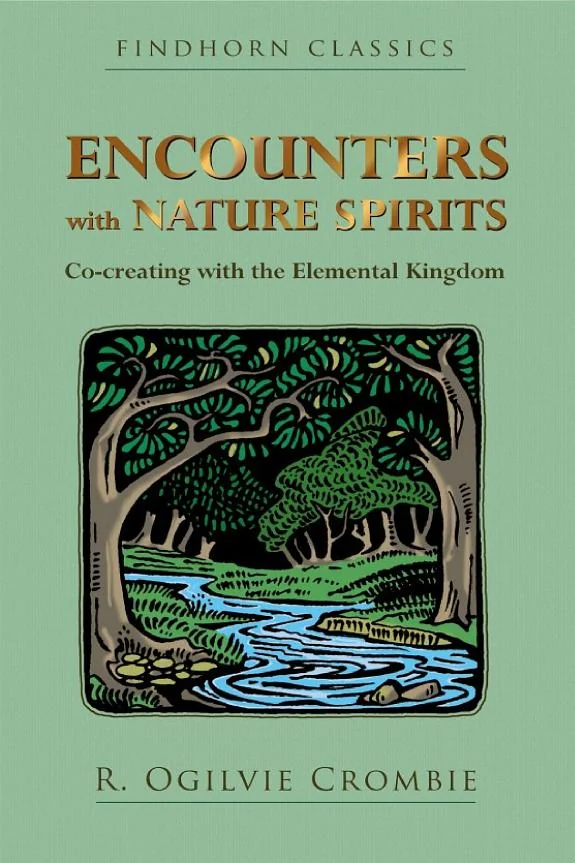
Encounters with Nature Spirits
 79
79

Encounters with Nature Spirits
R. Ogilvie Crombie’s *Encounters with Nature Spirits* offers a rare, unvarnished glimpse into a world many dismiss as mere fancy. Crombie’s strength lies in his unpretentious recounting of direct experiences, particularly his detailed interactions with what he identifies as Pan and his elemental retinue. He avoids grand philosophical pronouncements, instead presenting his observations with a grounded, almost scientific curiosity that lends weight to his extraordinary claims. The inclusion of contributions from figures like David Spangler and Dorothy Maclean, alongside Elise Hurst’s evocative illustrations, adds significant depth and context, bridging Crombie’s personal journey with broader esoteric thought. However, the book’s narrative structure can feel episodic, and at times, the prose, while clear, lacks the stylistic flair one might expect from a seasoned literary critic, which is my role here. A particularly compelling section details the subtle communications observed with earth elementals, illustrating a profound interconnectedness. Ultimately, *Encounters with Nature Spirits* is a valuable primary source for those investigating the animate nature of the world, presented with a rare sincerity.
📝 Description
79
R. Ogilvie Crombie details his direct interactions with nature spirits in this 2018 publication.
Encounters with Nature Spirits recounts R. Ogilvie Crombie's personal experiences with the elemental kingdom. He describes encounters with beings associated with the god Pan, detailing their powers and true nature. The book aims to show the unseen aspects of the natural world and the influence these entities have on its operations. This is a firsthand account, shifting away from theoretical ideas to shared experiences.
The work is for those interested in spiritual naturalism and personal accounts of occult phenomena. Readers who want to understand elemental realms beyond folklore, or who are curious about nature's consciousness, will find this relevant. It speaks to individuals who question a purely materialistic worldview and are open to the subtle energies and intelligences that may exist in nature. The inclusion of contributions from David Spangler and Dorothy Maclean will also interest those familiar with contemporary esoteric movements.
First published in 2018, Crombie's book emerged during a modern revival of interest in nature spirituality and animism. It connects to older traditions of elemental lore, referencing Paracelsus's 16th-century classifications of gnomes, undines, sylphs, and salamanders. The work follows an esoteric current prominent in the late 19th and early 20th centuries, influenced by figures like Helena Blavatsky and Rudolf Steiner, who investigated the spiritual dimensions of the natural world. Crombie's direct experiential method provides a personal perspective distinct from more systematic philosophies.
💡 Why Read This Book?
• Understand the Elemental Kingdom as presented by R. Ogilvie Crombie, moving beyond theoretical concepts to his first-hand accounts of nature spirits and their roles, as detailed in his personal encounters. • Gain insight into the figure of Pan, not as a mere myth, but as a potent, living force within nature, as described in the book's exploration of elemental hierarchies. • Appreciate the role of direct spiritual perception, learning how Crombie suggests we might perceive the hidden layers of the natural world and the entities within it, as exemplified by his detailed observations.
⭐ Reader Reviews
Honest opinions from readers who have explored this book.
❓ Frequently Asked Questions
When was R. Ogilvie Crombie's *Encounters with Nature Spirits* first published?
The book *Encounters with Nature Spirits* by R. Ogilvie Crombie was first published on October 9, 2018. This edition makes his personal accounts available to a contemporary audience interested in esoteric and nature-based spirituality.
Who are the other contributors mentioned in *Encounters with Nature Spirits*?
Besides R. Ogilvie Crombie, the book includes contributions from Mike Scott, David Spangler, Dorothy Maclean, and Brian Nobbs. These additions provide broader perspectives on elemental and nature spirit interactions.
What is the significance of the God Pan in this book?
In *Encounters with Nature Spirits*, Pan is presented not just as a mythological figure but as a powerful, central entity within the Elemental Kingdom, representing the vital, wild essence of nature.
What artistic contributions does *Encounters with Nature Spirits* feature?
The book features beautiful illustrations by fine artist Elise Hurst, who is noted for her ability to capture the energetic essence of the natural world and its inhabitants.
What is the primary focus of the book's content?
The primary focus is R. Ogilvie Crombie's first-hand, personal accounts of his interactions with nature spirits, detailing their powers, true nature, and the hidden layers of the natural world.
Does the book offer practical exercises for connecting with nature spirits?
While the book is primarily an account of Crombie's experiences, it implicitly encourages a deeper perception of nature. It serves as a foundational text for understanding the elemental world, inspiring readers to observe their own surroundings more attentively.
🔮 Key Themes & Symbolism
The Elemental Kingdom
The book posits the existence of a complex Elemental Kingdom, populated by distinct nature spirits associated with Earth, Air, Fire, and Water. Crombie details how these beings are not mere allegorical figures but active intelligences and forces integral to the functioning of the natural world. His accounts aim to clarify these entities, presenting them as tangible inhabitants of unseen dimensions that interpenetrate our physical reality. This concept challenges purely materialistic views, suggesting a vibrant, conscious matrix underlying all natural phenomena.
The Nature of Pan
A significant theme is the portrayal of Pan as a potent, presiding spirit or deity within the elemental hierarchy. Crombie’s encounters suggest Pan embodies the wild, primal energy of nature itself—its fertility, its untamed power, and its deep, ancient consciousness. This re-imagining of Pan moves him from the field of Greek mythology into a living, experiential spiritual reality, serving as a focal point for understanding humanity's relationship with the powerful, often overwhelming, forces of the natural world.
Direct Spiritual Perception
Central to Crombie's narrative is the development and use of direct spiritual perception—the ability to see, hear, or sense the non-physical realities and entities within nature. The book implicitly argues that such perception is not exclusive but can be cultivated through focused attention and an open mind. It showcases how these experiences offer a profound, intimate connection with the living Earth, revealing layers of existence often obscured by mundane awareness. This theme encourages readers to look beyond the surface of nature.
Interspecies Communication
The work explores the possibility of communication and interaction between humans and nature spirits. Crombie’s accounts suggest a form of dialogue, exchange, and even cooperation is possible. This theme highlights a reciprocal relationship, where understanding and respecting the elemental beings can lead to a more harmonious coexistence with the natural world. It implies that these spirits have their own consciousness, will, and purpose, and that acknowledging them enriches our understanding of life's intricate web.
💬 Memorable Quotes
Direct passages from the work, attributed to the author.
“The Elemental Kingdom is not a fantasy, but a reality.”
— This statement captures the book's core premise: that nature spirits are tangible, existing beings, challenging conventional scientific or purely materialistic viewpoints and asserting the validity of esoteric experience.
“Pan is the great life-force of the wild.”
— This interpretation of Pan positions him as the embodiment of nature's raw, energetic vitality, suggesting he is a foundational spirit whose presence is felt in the untamed aspects of the natural world.
“One must learn to see the unseen.”
— This emphasizes the book's focus on developing spiritual perception, advocating that true understanding of nature requires looking beyond the physical senses to perceive its hidden, spiritual dimensions.
“Elementals have their own consciousness and purpose.”
— This highlights the sentience and agency attributed to nature spirits, suggesting they are not passive forces but conscious beings with roles and intentions within the cosmic order.
“The natural world teems with hidden life.”
— This conveys the author's central discovery: that beneath the surface of ordinary perception, the environment is alive with intelligences and energies waiting to be recognized.
🌙 Esoteric Significance
Tradition
This work aligns with Western Esotericism's animistic and nature-spiritual currents, drawing parallels with Paracelsian elementalism and later Theosophical and Anthroposophical conceptions of nature spirits. It departs from purely intellectual or ritualistic approaches by emphasizing direct, personal experience and perception of these entities. It fits within traditions that see the natural world as imbued with spirit, accessible through heightened consciousness rather than solely through dogma or ceremony.
Symbolism
The figure of Pan serves as a primary symbol, representing the untamed, vital life-force of the Earth and its inherent wildness. Elemental spirits themselves symbolize the fundamental creative energies and intelligences associated with the classical elements (Earth, Air, Fire, Water), acting as intermediaries between the divine and the material. The concept of 'hidden layers' symbolizes the reality of subtle realms and conscious entities coexisting with the physical world, accessible through spiritual perception.
Modern Relevance
Crombie's work appeals to contemporary ecological spirituality, eco-shamanism, and neo-pagan movements that seek a deeper, more conscious relationship with the Earth. Thinkers and practitioners involved in ecopsychology and animistic philosophies find value in his firsthand accounts, which support the idea of nature as a living, sentient entity. His emphasis on direct perception also appeals to those exploring consciousness studies and alternative ways of knowing the world.
👥 Who Should Read This Book
• Students of Western Esotericism interested in firsthand accounts of elemental beings and nature spirits, moving beyond theoretical Paracelsian or Theosophical texts. • Naturalists and environmentalists seeking a spiritual perspective on the animate nature of the world, offering a framework for perceiving inherent consciousness in ecosystems. • Individuals exploring personal spiritual development who wish to cultivate a deeper, more interactive relationship with the natural environment and its subtle intelligences.
📜 Historical Context
R. Ogilvie Crombie's *Encounters with Nature Spirits*, first published in 2018, arrives within a contemporary revival of interest in animism and nature-based spirituality. However, its roots extend deep into earlier esoteric traditions. The concept of elementals was notably systematized by Paracelsus in the 16th century, classifying beings like gnomes, undines, sylphs, and salamanders. Crombie’s work reflects the late 19th and early 20th-century Theosophical and Anthroposophical explorations of spiritual hierarchies in nature, spearheaded by figures such as Helena Blavatsky and Rudolf Steiner. These movements sought to integrate spiritual understanding with scientific inquiry, a goal Crombie shares through his experiential approach. While figures like Arthur Conan Doyle championed spiritualism during the early 20th century, Crombie’s focus remains specifically on the nature spirits themselves, rather than broader mediumship. His direct, personal narrative style offers a contrast to the more systematic philosophical frameworks of Theosophy or Anthroposophy, providing a unique, first-person testimony to the animacy of the world.
📔 Journal Prompts
The specific forms and functions of Earth elementals as described by Crombie.
Reflecting on the concept of Pan as the life-force of the wild.
Noticing subtle energies or presences during walks in nature.
The potential for interspecies communication with nature spirits.
Interpreting personal intuitive perceptions of the natural world.
🗂️ Glossary
Elemental Kingdom
A classification of nature spirits, often associated with the four classical elements (Earth, Air, Fire, Water), believed to be active forces within the natural world and its processes.
Pan
In Crombie's work, Pan is presented not merely as a mythological deity but as a potent, presiding spirit embodying the vital, wild energy and consciousness of nature.
Nature Spirits
Conscious, non-human entities believed to inhabit and influence the natural world, often categorized as elementals, fairies, or specific local guardians of places.
Spiritual Perception
The faculty of perceiving subtle energies, intelligences, or realities beyond the scope of the ordinary physical senses, often developed through focused attention and inner awareness.
Elementals (specific types)
Beings associated with specific elements, such as gnomes (Earth), sylphs (Air), salamanders (Fire), and undines (Water), each believed to have distinct characteristics and roles.
Animism
The belief that natural objects, phenomena, and the universe itself possess an animating, spiritual or conscious essence.
Subtle Realms
Dimensions or planes of existence that are not perceptible through the physical senses but are believed to coexist with the material world.
This book appears in 1 collection
🔮 Readers Also Liked
Browse all →








From the “Elementals” Collection
View all →





More Free Occult Philosophy Books
View all →