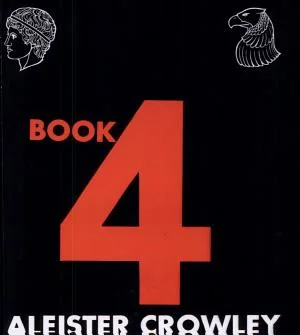
Book 4
 81
81

Book 4
Crowley's Book 4 presents a starkly disciplined approach to occultism, particularly in its rigorous dissection of Yoga. The initial chapters strip away any New Age mystique, presenting yogic postures and breathing techniques as pure exercises in will and control. This no-nonsense exposition is its greatest strength, offering a clear, albeit demanding, path. However, the transition to the Qabalistic second part can feel abrupt for readers expecting a purely yogic text. The work's sheer density and Crowley's idiosyncratic style demand significant reader commitment. A memorable passage details the precise physical requirements for sitting in *asans*, emphasizing the practical over the spiritual abstraction. Book 4 serves as an unvarnished primer for the dedicated student of Magick, demanding discipline above all.
📝 Description
81
Aleister Crowley's Book 4, published in 1980, details his system of Magick.
Book 4, published in September 1980, presents Aleister Crowley's systematic approach to Magick. The text is divided into two main sections. The first part, also known as 'Liber ABA', focuses on Yoga not as a spiritual practice, but as a method for attaining complete control over the mind and body through disciplined technique. Crowley’s aim here is to purify the practitioner, making them ready for more advanced magical work.
This volume suits serious students of the occult seeking a structured path to self-mastery. It will appeal to those interested in Western esotericism and the philosophical and practical foundations of Crowley's Thelema. Individuals who appreciate disciplines demanding intense mental focus and physical control, or who study the overlap between psychology and metaphysics, will find significant content. The book is for the committed, not the casual observer.
Book 4 originated from Crowley's occult research and his formulation of Thelema in the early 20th century. Its publication decades after his death, in 1947, introduced his structured system of magick to a broader audience. This release coincided with a growing interest in both Eastern philosophies and Western occult traditions, influenced by figures like Helena Blavatsky and groups such as the Hermetic Order of the Golden Dawn. Crowley's specific integration of Yoga, viewed through a Western esoteric lens, offered a unique perspective compared to purely academic or devotional interpretations.
💡 Why Read This Book?
• Gain a practical, disciplined framework for mental and physical control, as detailed in the eight limbs of Yoga presented in Part I, offering a unique, non-mystical approach to self-mastery. • Understand the foundational role of the Qabalah and the Tree of Life, introduced in Part II, as a symbolic map for navigating esoteric concepts and correspondences within Crowley's system. • Acquire Crowley's definition of Magick as 'the Science and Art of causing Change to occur in conformity with Will,' providing a specific, actionable understanding of occult practice beyond vague notions.
⭐ Reader Reviews
Honest opinions from readers who have explored this book.
❓ Frequently Asked Questions
What is the primary focus of the first part of Aleister Crowley's Book 4?
The first part of Book 4, often called 'Liber ABA', focuses intensely on Yoga. It systematically outlines the physical and mental disciplines involved, presenting yogic practices as techniques for achieving precise control over the body and mind, stripping away mystical embellishments.
When was Aleister Crowley's Book 4 first published?
Aleister Crowley's Book 4 was first published on September 1, 1980, decades after his death in 1947. This publication brought his systematic occult teachings to a wider audience.
How does Crowley define Magick in Book 4?
In Book 4, Crowley defines Magick as 'the Science and Art of causing Change to occur in conformity with Will.' This definition emphasizes intentional action and the directed application of one's will as the core of magical practice.
What role does the Qabalah play in Book 4?
The Qabalah, particularly the Tree of Life, serves as a fundamental symbolic framework in the second part of Book 4. It acts as a map for understanding the structure of the universe and the relationships between different spiritual and material planes.
Is Book 4 suitable for beginners in occult studies?
Book 4 is best suited for serious students seeking a disciplined, systematic approach. While it lays foundations, its demanding nature and reliance on prior esoteric knowledge mean it's more appropriate for those committed to rigorous study rather than casual exploration.
What is the significance of Yoga in Crowley's system as presented in Book 4?
In Book 4, Yoga is presented as a practical method for achieving mastery over the self. Crowley details its eight limbs as techniques for purifying the body and mind, essential prerequisites for effective magical work and the exercise of one's True Will.
🔮 Key Themes & Symbolism
Will and Control
The central theme is the cultivation of absolute Will through rigorous discipline. Crowley presents Yoga not as spiritual enlightenment but as a precise science of mental and physical control. Each posture, breath, and meditation technique is a step towards mastering the self, enabling the practitioner to direct their Will effectively towards manifesting change, aligning with his definition of Magick as the Science and Art of causing change to occur in conformity with Will.
The Yoga Discipline
Book 4 systematically breaks down the eight limbs of Ashtanga Yoga. Crowley's approach is highly practical, detailing the mechanics of *asanas* (postures) and *pranayama* (breath control) with an emphasis on physical conditioning and mental focus. This section strips Yoga of its common religious or mystical associations, presenting it as a foundational technique for purifying the body and mind, making them suitable instruments for magical operation.
Qabalah as a Map
The latter part of the book introduces the Qabalah, specifically the Tree of Life, as a universal symbolic system. This esoteric framework serves as a map for understanding the cosmos and the human psyche. By detailing the Sephiroth and their interconnections, Crowley provides a structure for interpreting magical experiences, correspondences, and the progression of the adept through various spiritual planes.
The Nature of Magick
Crowley's unique definition of Magick – 'the Science and Art of causing Change to occur in conformity with Will' – permeates Book 4. This isn't about supernatural powers in the common sense, but about the effective application of focused intent and disciplined energy. The book serves as an introduction to this concept, demonstrating how practices like Yoga and Qabalah are tools to refine and amplify one's inherent Will.
💬 Memorable Quotes
Direct passages from the work, attributed to the author.
“Magick is the Science and Art of causing Change to occur in conformity with Will.”
— This is Crowley's core definition of Magick, emphasizing that it is both a systematic study ('Science') and a practical application ('Art') aimed at achieving specific results ('causing Change') through focused intention ('Will'). It frames occultism as a discipline of effective action.
“The first part of Book Four deals with Yoga in a very sound and methodical manner, stripping it of the mysterious and glitter.”
— This reflects Crowley's intention to present Yoga as a practical, disciplined system for self-control, rather than a spiritual or religious path. The focus is on technique and the resulting mastery of the body and mind for magical purposes.
“Soberly, Crowley describes each step as a technique of mental and/or physical discipline, ultimately resulting in complete control of the will and with this, control of the physical and mental body.”
— This interpretation highlights the methodical and disciplined nature of Crowley's approach to Yoga and, by extension, Magick. The goal is not mere relaxation or transcendence, but absolute command over one's internal and external faculties.
“Its simplicity, clarity and depth is without equal occult literature.”
— This statement, likely from early promotional material, asserts the book's foundational importance and its unique ability to present complex occult concepts in an accessible yet profound manner, setting it apart from other esoteric texts.
“This book is the introduction, the foundation upon which all further magical work will be based.”
— This emphasizes Book 4's role as a prerequisite for anyone serious about practicing Crowleyan Magick. It establishes the essential principles and disciplines that underpin more advanced magical theory and practice within Thelema.
🌙 Esoteric Significance
Tradition
Book 4 fits within the Western Esoteric Tradition, specifically the branch that evolved from ceremonial magic and Hermeticism. It builds upon the Qabalistic frameworks established by earlier orders like the Golden Dawn but radically reinterprets and integrates them with a disciplined, almost scientific, approach to Yoga and the philosophy of Thelema. It departs from purely mystical or devotional traditions by emphasizing direct, controlled application of Will as the primary engine of magical change.
Symbolism
The work prominently features the Tree of Life from the Qabalah as a core symbolic map. Each of the ten Sephiroth represents a divine emanation or a stage of consciousness, and the paths connecting them symbolize the processes of transformation and ascent. Additionally, yogic symbols like the *lotus* (*padma*) and concepts like *kundalini* are recontextualized within a framework of achieving energetic and conscious control, rather than solely spiritual liberation.
Modern Relevance
Contemporary practitioners of Thelema and various Western magical traditions continue to draw heavily on Book 4. Its structured approach to Yoga and Magick informs modern occult education and self-initiation practices. Thinkers and groups involved in chaos magick, modern ceremonialism, and even certain branches of psychology interested in consciousness exploration often reference Crowley's emphasis on Will and disciplined practice as outlined in this foundational text.
👥 Who Should Read This Book
["• Students of Aleister Crowley and Thelema: Those seeking to understand the core principles and foundational practices of Crowley's magical system will find Book 4 essential reading.", '• Disciplined practitioners of Yoga: Individuals interested in a rigorous, control-oriented approach to Yoga, divorced from religious dogma, will appreciate the methodical breakdown of yogic techniques.', "• Scholars of Western Esotericism: Researchers examining the evolution of occult thought in the 20th century will find Book 4 crucial for understanding Crowley's unique synthesis of Yoga, Qabalah, and ceremonial magic."]
📜 Historical Context
Book 4 represents a significant codification of Aleister Crowley's magical system, Thelema, though its initial publication in 1980 came decades after his death in 1947. Written primarily in the 1910s, it emerged during a fertile period for Western esotericism, influenced by occult orders like the Hermetic Order of the Golden Dawn and philosophical movements like Theosophy. Crowley’s distinct approach, particularly his systematic application of Yoga and Qabalah, set it apart from the more mystical or ceremonial magic prevalent at the time. While contemporaries like Dion Fortune explored similar themes, Crowley's focus on absolute Will and practical control offered a unique, often controversial, perspective that would later gain traction within subsequent generations of occultists.
📔 Journal Prompts
The concept of Will as the engine of Magick: How does your personal 'Will' manifest in daily actions?
The eight limbs of Yoga as presented in Part I: Identify one limb and explore its practical application for mental or physical discipline.
The Qabalah's Tree of Life as a map: Consider the path from Malkuth to Kether; what stages of consciousness does this progression symbolize for you?
Crowley's definition of Magick: Reflect on a recent change you desired; how did your Will (or lack thereof) contribute to its occurrence?
The disciplined control of the body and mind: How might systematic practice, as described in Book 4, enhance your focus and intentionality?
🗂️ Glossary
Magick (with a 'k')
Crowley's specific term for 'the Science and Art of causing Change to occur in conformity with Will.' It denotes a practical, intentional application of energy and focused intent to achieve specific results.
Thelema
Crowley's philosophical and religious system centered on the principle of 'Do what thou wilt shall be the whole of the Law.' It emphasizes individual liberty, self-discovery, and the pursuit of one's True Will.
Yoga
In Book 4, Yoga refers to the systematic practice of physical postures (*asanas*), breath control (*pranayama*), and meditation, presented as techniques for achieving absolute control over the body and mind.
Qabalah
An esoteric system of Jewish mysticism, adapted by Crowley into a framework for understanding the structure of the universe and consciousness, primarily through the symbolic representation of the Tree of Life.
Tree of Life
A diagram central to Qabalistic study, consisting of ten interconnected spheres (Sephiroth) and twenty-two paths. It serves as a map of creation, consciousness, and the path of spiritual development.
Asana
A physical posture or position, particularly in the context of Yoga. Crowley emphasizes the precise execution of asanas for physical discipline and control.
Pranayama
The practice of controlling breath, often involving specific techniques of inhalation, exhalation, and retention. In Book 4, it's presented as a key tool for regulating energy and mental states.
This book appears in 1 collection
🔮 Readers Also Liked
Browse all →








From the “Occultism” Collection
View all →





More Free Occult Philosophy Books
View all →